<?xml version="1.0" encoding="utf-8"?>
<feed xmlns="http://www.w3.org/2005/Atom">
    <title>Sepp Hasslberger</title>
    <link rel="alternate" type="text/html" href="http://blog.hasslberger.com/" />
    <link rel="self" type="application/atom+xml" href="http://blog.hasslberger.com/atom.xml" />
   <id>tag:blog.hasslberger.com,2013:/1</id>
    <link rel="service.post" type="application/atom+xml" href="http://blog.hasslberger.com/cgi-bin/mt/mt-atom.cgi/weblog/blog_id=1" title="Sepp Hasslberger" />
    <updated>2013-03-20T16:36:37Z</updated>
    <subtitle>Developments in economy, physics and energy technologies</subtitle>
    <generator uri="http://www.sixapart.com/movabletype/">Movable Type 4.37</generator>
 

<entry>
    <title>Beyond Relativity and Quantum Theories - Paramahamsa Tewari&apos;s Vortex Universe</title>
    <link rel="alternate" type="text/html" href="http://blog.hasslberger.com/2013/03/beyond_relativity_and_quantum.html" />
    <link rel="service.edit" type="application/atom+xml" href="http://blog.hasslberger.com/cgi-bin/mt/mt-atom.cgi/weblog/blog_id=1/entry_id=142" title="Beyond Relativity and Quantum Theories - Paramahamsa Tewari's Vortex Universe" />
    <id>tag:blog.hasslberger.com,2013://1.142</id>
    
    <published>2013-03-20T16:32:22Z</published>
    <updated>2013-03-20T16:36:37Z</updated>
    
    <summary>Paramahamsa Tewari, an Indian nuclear engineer and energy researcher, is also the originator of Space Vortex Theory, a theory that posits matter as based on two fundamental particles, the electron and the positron. His website is www.tewari.org According to Tewari, the universe is filled with an incompressible super fluid. Fundamental particles are vortices that create a tiny spherical void, where circulation at the limiting velocity of light leads to a breakdown of the fluid&apos;s integrity. The discontinuity at the void/liquid interface defines the particle boundary. Tension in the external fluid created by the central void gives rise to gravity, while the tangential circulation of the fluid at the interface is the cause of electric field phenomena. Einstein&apos;s Relativity and Quantum...</summary>
    <author>
        <name>Sepp</name>
        
    </author>
    
        <category term="Physics" />
    
    <content type="html" xml:lang="en" xml:base="http://blog.hasslberger.com/">
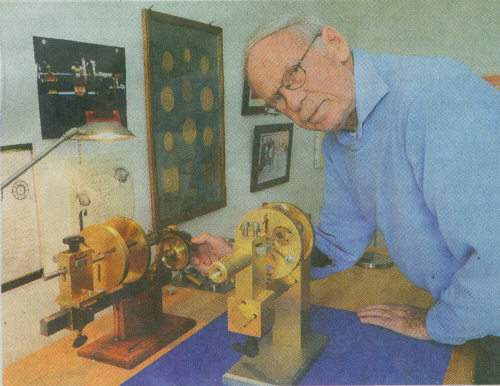
        <![CDATA[<p>Paramahamsa Tewari, an Indian nuclear engineer and energy researcher, is also the originator of Space Vortex Theory, a theory that posits matter as based on two fundamental particles, the electron and the positron. His website is <a href="http://www.tewari.org/" target="_blank">www.tewari.org</a></p>

<p><img alt="tew3_small.jpg" src="http://blog.hasslberger.com/img/tew3_small.jpg" width="215" height="170" class="mt-image-left" style="float: left; margin: 0 20px 20px 0;" /> According to Tewari, the universe is filled with an incompressible super fluid. Fundamental particles are vortices that create a tiny spherical void, where circulation at the limiting velocity of light leads to a breakdown of the fluid's integrity. The discontinuity at the void/liquid interface defines the particle boundary. Tension in the external fluid created by the central void gives rise to gravity, while the tangential circulation of the fluid at the interface is the cause of electric field phenomena.</p>

<p>Einstein's Relativity and Quantum theory have failed to develop a conceptual view of the universe and of the matter we perceive. So in this recent piece, Tewari says that mainstream physics should re-evaluate some of its 'certainties'. The super fluid that fills space - the term was coined by Tewari in 1974, only to be hijacked by others a few years later - is precariously balanced at the edge of rotation, of vortexial motion. The dynamics of this liquid explain the existence of both particles of matter and fields in a way that is intuitive and visual. But let's see what Tewari has to say...</p>

<p><br />
<strong>To the adherents of Relativity and Quantum theories</strong></p>

<p>If the universe cannot be described through your theories with clear-cut  physical pictures that a lay man can understand, the following  may set you thinking as to where your concepts went wrong. This departs radically from your 20th century concepts that need deep revision. You held the field and had your say for more than a century now and have led science to the games of probability and uncertainty, of mere chance and coincidences, based on outer appearances rather than the underlying reality. </p>

<p>You scare humanity that the sun will consume all its matter one day, throwing away its energy into the voids of space – never to be retrieved again, as if you knew for sure the basic processes that created matter, stars and cosmic energy. What you name as “empty space (void)” may itself be the “dynamic vacuum of spatial energy”.  What you think is “dark matter” could be space-vortices that rotate the planets, stars and galaxies, both axially and around in orbits. You are now searching for the Higgs particle to understand the true nature of “mass” ...</p>]]>
        <![CDATA[<p>- - - </p>

<p>You are now searching for the Higgs particle to understand the true nature of “mass” possessed by matter, and may also look for "particles” of momentum, force, kinetic energy, velocity and so on. It does not occur to you or you have so far failed to notice the structural relationship between the vacuum and the electron that was discovered more than a century ago – and that might reveal the first origin of mass and charge in the universe. </p>

<p>And the latest: You talk of “vacuum instability”, “quantum fluctuation” and creation of “a tiny bubble of the vacuum” and expansion of this bubble at the speed of light sweeping everything before it and “the sun and the earth will be really gone by that time”. The above, based on a recent announcement from BBC, if really so said by the scientists interviewed, shows they do not deserve their high status. [Breakdown of vacuum under circulation around a point, at a limiting velocity gradient: (speed of light relative to the vacuum)/ (electron radius), is the basic Principle in this writer’s space vortex theory (SVT), formulated around the mid nineteen seventies. This principle that vacuum breaks down during circulation at the limiting speed of light (relative to the vacuum) into a void was stated in my unpublished short paper to <em>Foundations of Physics</em> (1974), only to be plagiarized by some senior Indian scientists and published in the same journal (1977)].   So, the vacuum that was emptiness for Democritus, Newton, Einstein (1905) becomes now all of a sudden a substance to create bubbles? A turn-about after a century of hot debates between ether and non-ether, between vacuum and void, and with no apology whatsoever from you to the science community! </p>

<p>Looking back into the history of science and noting Natural Philosophers’ contributions since the times of Copernicus, while also accepting the guidelines from the learned scientist/engineers’ research works of the 20th century, we need to lay the foundation of a New Science Philosophy for world science in which your theories will also have a prominent place – declaring that at the start of the 20th century, the path you chose to found your theories to understand the workings of nature was certainly misdirected. It is time for retrospection and to support the new movement to establish a comprehensive new theory of Space and matter.</p>

<p>- - - </p>

<p>This is what Paramahamsa has written by way of introduction to a Soliloquy, a communication outlining the details of his view of Space and matter, which you can download here as a PDF document.</p>

<p><a href="http://blog.hasslberger.com/docs/SOLILOQUY.pdf">Soliloquy - by Paramahamsa Tewari</a></p>

<p>or</p>

<p><a href="http://blog.hasslberger.com/docs/SOLILOQUY.pdf">http://blog.hasslberger.com/docs/SOLILOQUY.pdf</a></p>

<p><br />
<strong>Related earlier articles on this site:</strong></p>

<p><a href="http://blog.hasslberger.com/2006/04/einsteins_contribution_to_phys.html" target="_blank">Einstein's Contribution to Physics in Understanding Nature</a></p>

<p><a href="http://blog.hasslberger.com/2007/02/tewari_hidden_laws_in_the_univ.html" target="_blank">Tewari: Hidden Laws in the Universe</a></p>

<p><a href="http://blog.hasslberger.com/2007/12/star_formation_reverse_whirlpo.html" target="_blank">Star Formation: Vortex Builds Stars, Planets</a></p>

<p><a href="http://blog.hasslberger.com/2008/07/tewari_discovering_universal_r.html" target="_blank">Tewari: Discovering Universal Reality</a></p>

<p><a href="http://blog.hasslberger.com/2011/06/india_tewaris_reactionless_gen.html" target="_blank">India: Tewari's Reactionless Generator Shows Promise</a></p>]]>
    </content>
</entry>

<entry>
    <title>General Science Journal - new electronic journal for scientific communications</title>
    <link rel="alternate" type="text/html" href="http://blog.hasslberger.com/2013/03/general_science_journal_-_new.html" />
    <link rel="service.edit" type="application/atom+xml" href="http://blog.hasslberger.com/cgi-bin/mt/mt-atom.cgi/weblog/blog_id=1/entry_id=141" title="General Science Journal - new electronic journal for scientific communications" />
    <id>tag:blog.hasslberger.com,2013://1.141</id>
    
    <published>2013-03-07T15:09:08Z</published>
    <updated>2013-03-26T08:58:00Z</updated>
    
    <summary> The General Science Journal is a non-peer-reviewed electronic journal that allows all scientific opinions to be aired, particularly in physics. Research papers, essays or communications are accepted in multiple languages for viewing by your colleagues and the general public. They may be submitted at no cost to the respective GSJ Editors (see listing below)....</summary>
    <author>
        <name>Sepp</name>
        
    </author>
    
        <category term="Physics" />
    
    <content type="html" xml:lang="en" xml:base="http://blog.hasslberger.com/">
        <![CDATA[<p><br />
<img alt="General-science-journal.png" src="http://blog.hasslberger.com/img/General-science-journal.png" width="582" height="112" class="mt-image-none" style="" /></p>

<p>The <a href="http://gsjournal.net/">General Science Journal</a> is a non-peer-reviewed electronic journal that allows all scientific opinions to be aired, particularly in physics. Research papers, essays or communications are accepted in multiple languages for viewing by your colleagues and the general public. They may be submitted at no cost to the respective GSJ Editors (see listing below).<br />
</p>]]>
        <![CDATA[<p><br />
Alfred Bennun: South America, Caribbean, Spain, Portugal<br />
stham@gsjournal.net</p>

<p>Hossein Javadi: Middle East (Farsi Language)<br />
meast@gsjournal.net</p>

<p>André Michaud: Administrator, North America, Africa, Australia<br />
ntham@gsjournal.net</p>

<p>Yongfeng Yang: Far East, China, Japan, Korea, Viet Name et. al.<br />
feast@gsjournal.net</p>

<p>Thierry De Mees: Eastern Europe, Western Europe, Great Britain<br />
weuro@gsjournal.net</p>

<p><br />
General Science Journal is not the only alternative publishing venue for physics and science in general. More of those seem to appear just like mushrooms. If you know one, post a comment. I will let them accumulate here in a list. </p>

<p>- - - </p>

<p><a href="http://www.vixra.org/" target="_blank">viXra.org</a> - An alternative archive of 4652 e-prints in Science and Mathematics serving the whole scientific community</p>

<p></p>

<p><br />
</p>]]>
    </content>
</entry>

<entry>
    <title>Bashkir farmers&apos; local demurrage currency recognized by Supreme Court</title>
    <link rel="alternate" type="text/html" href="http://blog.hasslberger.com/2013/02/bashkir_farmers_local_demurrag.html" />
    <link rel="service.edit" type="application/atom+xml" href="http://blog.hasslberger.com/cgi-bin/mt/mt-atom.cgi/weblog/blog_id=1/entry_id=140" title="Bashkir farmers' local demurrage currency recognized by Supreme Court" />
    <id>tag:blog.hasslberger.com,2013://1.140</id>
    
    <published>2013-02-05T18:24:28Z</published>
    <updated>2013-02-05T18:24:48Z</updated>
    
    <summary>The original of this article is in Russian and this translation of it isn&apos;t professional, but I think the news of this is of importance for us and should be shared even if imperfectly. Chances are, you have not heard of the Republic of Bashkortostan. It is one of many individual States that were part of the old Soviet Union, the USSR, and that now are part of the Russian Federation which formed after the Soviet Union dissolved. Wikipedia has an article on history and more here: Bashkortostan The people of Bashkortostan are the Bashkir. Ufa City, capital of Bashkortistan (image from Wikipedia) It seems the farmers of a Bashkir village were successful in creating a workable demurrage-based currency and...</summary>
    <author>
        <name>Sepp</name>
        
    </author>
    
        <category term="Economy" />
    
    <content type="html" xml:lang="en" xml:base="http://blog.hasslberger.com/">
        <![CDATA[<p>The original of this article is in Russian and this translation of it isn't professional, but I think the news of this is of importance for us and should be shared even if imperfectly. </p>

<p>Chances are, you have not heard of the Republic of Bashkortostan. It is one of many individual States that were part of the old Soviet Union, the USSR, and that now are part of the Russian Federation which formed after the Soviet Union dissolved. Wikipedia has an article on history and more here: <a href="http://en.wikipedia.org/wiki/Bashkortostan" target="_blank">Bashkortostan</a> The people of Bashkortostan are the Bashkir. </p>

<p><img alt="UfaCity.jpg" src="http://blog.hasslberger.com/UfaCity.jpg" width="320" height="180" class="mt-image-none" style="" /></p>

<p><em>Ufa City, capital of Bashkortistan</em> (image from <a href="http://en.wikipedia.org/wiki/Bashkortostan" target="_blank">Wikipedia</a>)</p>

<p>It seems the farmers of a Bashkir village were successful in creating a workable demurrage-based currency and to have its legality recognized by their country's Supreme Court. Quite a feat, which incidentally has eluded us in the West ever since the Austrian Supreme Court shut down Silvio Gesell's and Mayor Unterguggenberger's successful <a href="http://www.lietaer.com/2010/03/the-worgl-experiment/" target="_blank">currency experiment in Wörgl</a> 80 years ago...</p>

<p>So now that we have some context, here is the article. The <a href="http://www.vesti.ru/doc.html?id=1023932" target="_blank">original in Russian</a> is also available. </p>

<p><strong>Bashkir farmers who invented their own currency have created an economic miracle</strong></p>

<p><em>The Supreme Court of Bashkortostan allowed the villagers of Shaymuratova to pay in "shaymuratikami." It is a kind of local money - or rather, trade coupons. They can buy products only in one village. A system of mutual settlements is offered by local farmers. But the local prosecutor sought to prohibit this kind of currency .</em></p>]]>
        <![CDATA[<p>- - - </p>

<p>For "shaymuratiki" you can buy any product in local stores, you can even pay them for services. However, this replacement of money was not to the liking of the local prosecutor's office, which ordered to stop circulating the currency. But a businessman appealed. However the Supreme Court of the Republic sided with the farmers and legalized the "shaymuratiki." These commodity tickets were able to raise the whole rural economy.</p>

<p>It would seem nothing unusual had happened: in the rural shop customers pay for goods. But for payment, the cashier not only accepts rubles, he also welcomes the so-called "shaymuratiki" - a local village currency. The unusual bills appeared in rural purses several years ago, when the local agricultural enterprise was in a difficult financial situation: the processors no longer paid the peasants their "living" money, and for a long time no salaries were paid. Then the farmer Arthur Nurgaliyev, together with some partners, came up with the trade tickets: you can make a deal on them right now, and then exchange them for real money. </p>

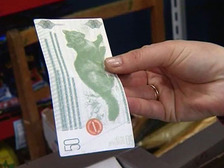
<p><img alt="Tradecoupons.jpg" src="http://blog.hasslberger.com/Tradecoupons.jpg" width="224" height="168" class="mt-image-none" style="" /></p>

<p>"These are trade coupons" - says the businessman. "On the back of the bill there is a table that shows how the tickets become cheaper as time passes. You cannot stash that money - you can only spend it."</p>

<p>Externally, they are really very similar to normal bills: well designed and there are even different features for protection. But the difference is that the tickets are cheaper than their original denomination. The "shaymuratiki" lose two per cent of their value per month. When everyone around was out of money and had to buy goods on credit, sales in the shaymuratovskih village stores began to grow by leaps and bounds.</p>

<p>The effect of the new economic model in Shaymuratova was felt almost immediately. Implementation of its domestic currency has not only resulted in the survival of most agricultural enterprises, but it also pushes the whole rural economy. For the first time in many years, turnover has increased by an incredible 12 times in one go.</p>

<p>However, along with news of success in Shaymuratova came a raid. The prosecutor's office found violations and demanded to cancel and take the "shaymuratiki" out of circulation, but they have not disappeared. The Supreme Court got on the side of the peasants and recognized the legitimacy of the trade tickets. </p>

<p>"It is not money, because the coupons do not have the function of accumulation", says Mikhail Khazin, an economist.  "In the case of agriculture, the problem is that the profit of farmers is received in the fall, and people should always pay. So this is a support tool. As soon as there is good money, "shaymuratiki" fall from use, they do not compete with the money."</p>

<p>This experience in the implementation of a local currency is not only interesting for the neighboring farms, but also for economists. It turned out that "shaymuratiki" could become a universal means of payment among farms in crisis. But there are plans of the shaymuratovskih farmers now to organize the transfer of all payments in electronic form. Employees instead of paper coupons will be issued credit cards.</p>

<p>So far the translation of the article. If there are any Russian speakers among my readers, please tell me of any mistakes I might have made editing.  </p>

<p>Now the question really is: Will we be able to learn from this breakthrough as well? </p>

<p>There is no telling, but I suppose we can be cautiously optimistic. </p>]]>
    </content>
</entry>

<entry>
    <title>Black Whole - Nassim Haramein on the structure of space, matter and the universe [Video 1h 32min]</title>
    <link rel="alternate" type="text/html" href="http://blog.hasslberger.com/2012/10/black_whole_-_nassim_haramein.html" />
    <link rel="service.edit" type="application/atom+xml" href="http://blog.hasslberger.com/cgi-bin/mt/mt-atom.cgi/weblog/blog_id=1/entry_id=139" title="Black Whole - Nassim Haramein on the structure of space, matter and the universe [Video 1h 32min]" />
    <id>tag:blog.hasslberger.com,2012://1.139</id>
    
    <published>2012-10-01T13:31:59Z</published>
    <updated>2012-10-01T13:32:32Z</updated>
    
    <summary>In this video, Nassim Haramein discusses his research into the structure of space, matter and the universe. He challenges some of the &apos;everybody knows&apos; parts of physics and proposes a unification of two theories which have so far been thought to be incompatible. Nassim Haramein - Black Whole (2011) [Video 1h 32min]...</summary>
    <author>
        <name>Sepp</name>
        
    </author>
    
        <category term="Cosmology" />
    
        <category term="Physics" />
    
        <category term="Vortex" />
    
    <content type="html" xml:lang="en" xml:base="http://blog.hasslberger.com/">
        <![CDATA[<p>In this video, Nassim Haramein discusses his research into the structure of space, matter and the universe. He challenges some of the 'everybody knows' parts of physics and proposes a unification of two theories which have so far been thought to be incompatible. </p>

<p><img alt="Haramein01.jpg" src="http://blog.hasslberger.com/img/Haramein01.jpg" width="560" height="350" class="mt-image-none" style="" /></p>

<p><a href="http://www.veoh.com/watch/v211655826NC94xJz?h1=Nassim+Haramein+-++Black+Whole+(2011" target="_blank"><strong>Nassim Haramein - Black Whole (2011) [Video 1h 32min]</strong></a></p>]]>
        <![CDATA[<p>- - - </p>

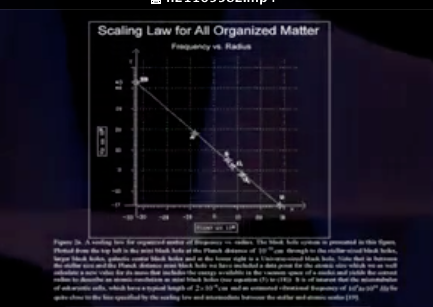
<p>Einstein's field equations and relativity describe the universe and star systems, while quantum physics is used to describe the actions of particles of matter. By looking at a fudge factor - the re-normalization of infinitely large numbers - often used in quantum physics, a door was opened to understanding that matter is similar at all different scales, from the size of galaxies to protons, the minute particles that form the atomic nucleus. </p>

<p><img alt="Scaling-Law.png" src="http://blog.hasslberger.com/img/Scaling-Law.png" width="433" height="307" class="mt-image-none" style="" /></p>

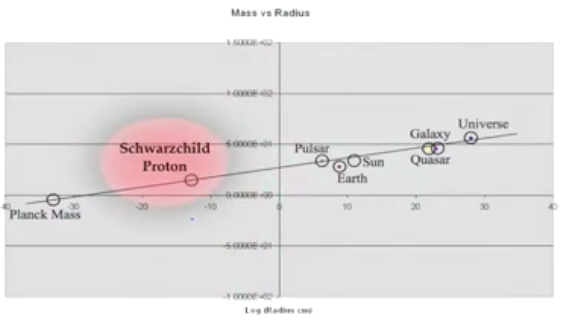
<p>Together with Dr. Elizabeth Rauscher, Haramein found and plotted a progression of parameters, both energy-versus-size and mass-versus-size that hold true for matter at all scales, from the most tiny particle to the universe itself. </p>

<p><img alt="Mass-vs-radius.png" src="http://blog.hasslberger.com/img/Mass-vs-radius.png" width="570" height="320" class="mt-image-none" style="" /></p>

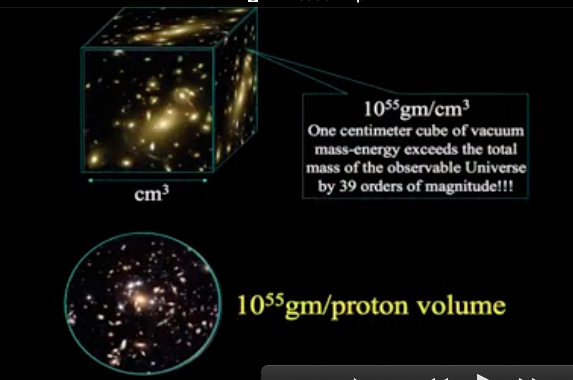
<p>Haramein views space itself as being structured and full of an incredible density of both mass and energy. That concept that was common a century ago but was lost with the advent of Einstein's mathematical discoveries. </p>

<p><img alt="Proton-Mass.png" src="http://blog.hasslberger.com/img/Proton-Mass.png" width="573" height="380" class="mt-image-none" style="" /></p>

<p>Now just let Nassim Haramein take you on a voyage of discovery of both the Universe and his discoveries with regard to matter and space. The video is available here.</p>

<p><a href="http://www.veoh.com/watch/v211655826NC94xJz?h1=Nassim+Haramein+-++Black+Whole+(2011" target="_blank"><strong>Nassim Haramein - Black Whole (2011)</strong></a></p>]]>
    </content>
</entry>

<entry>
    <title>Quantum Aether Dynamics: A New Foundation for Physics</title>
    <link rel="alternate" type="text/html" href="http://blog.hasslberger.com/2012/03/quantum_aether_dynamics_a_new.html" />
    <link rel="service.edit" type="application/atom+xml" href="http://blog.hasslberger.com/cgi-bin/mt/mt-atom.cgi/weblog/blog_id=1/entry_id=138" title="Quantum Aether Dynamics: A New Foundation for Physics" />
    <id>tag:blog.hasslberger.com,2012://1.138</id>
    
    <published>2012-03-25T14:59:41Z</published>
    <updated>2012-03-28T09:30:53Z</updated>
    
    <summary> This is a paper that was first published in PESWiki but it certainly deserves to be widely known. It is based on a deep re-thinking of current physics and models the aether as a substrate for all things physical. While the new model is fully developed in a book: Secrets of the Aether that was published in 2004, authored by David W. Thomson III and Jim D. Bourassa, the paper gives a good description of the basic features and lots of detail about how the new model compares with contemporary physics. Sterling Allan of PESWiki says about it: &quot;The Aether Physics Model quantifies quantum structure within an Aether/angular momentum paradigm (as opposed to the mass/energy paradigm of Einstein). It...</summary>
    <author>
        <name>Sepp</name>
        
    </author>
    
        <category term="Books" />
    
        <category term="Physics" />
    
    <content type="html" xml:lang="en" xml:base="http://blog.hasslberger.com/">
        <![CDATA[<p><img alt="Aether_Unit2_250.jpg" src="http://blog.hasslberger.com/img/Aether_Unit2_250.jpg" width="250" height="399" class="mt-image-right" style="float: right; margin: 0 0 20px 20px;" /></p>

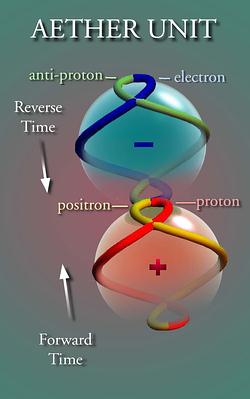
<p>This is a paper that was first published in <a href="http://peswiki.com/index.php/Paper:A_New_Foundation_for_Physics,_by_Quantum_Aether_Dynamics_Institute" target="_blank">PESWiki</a> but it certainly deserves to be widely known. It is based on a deep re-thinking of current physics and models the aether as a substrate for all things physical. </p>

<p>While the new model is fully developed in a book: <a href="http://www.secrets-of-the-aether.com/joomla/" target="_blank">Secrets of the Aether</a> that was published in 2004, authored by David W. Thomson III and Jim D. Bourassa, the paper gives a good description of the basic features and lots of detail about how the new model compares with contemporary physics.  </p>

<p><strong>Sterling Allan of PESWiki says about it:</strong></p>

<p><em>"The Aether Physics Model quantifies quantum structure within an Aether/angular momentum paradigm (as opposed to the mass/energy paradigm of Einstein). It is destined to merge with Quantum Mechanics and provides the means for tapping Zero Point Energy."</em></p>

<p><br />
<strong>Abstract</strong></p>

<p>"Modern physics describes the mechanics of the Universe. We have discovered a new foundation for physics, which explains the components of the Universe with precision and depth. We quantify the existence of Aether, subatomic particles, and the force laws. Some aspects of the theory derive from the Standard Model, but much is unique.<br />
A key discovery from this new foundation is a mathematically correct Unified Force Theory. Other fundamental discoveries follow, including the origin of the fine structure constant and subatomic particle g-factors, a slight correction of neutron magnetic moment, a geometrical structure for charge, the quantification of electromagnetic charge as separate from electrostatic charge, a more precise meaning of spin, the quantification of space-resonance in five dimensions, and a new system of quantum units.</p>

<p>The Aether quantifies as a fabric of quantum rotating magnetic fields with electromagnetic, electrostatic, and gravitational dipole structures. Subatomic particles quantify as angular momentum encapsulated in a quantum, rotating magnetic field. All quantum, atomic, and molecular processes can be precisely modeled, leading to discrete physics with new understandings and insights."</p>]]>
        <![CDATA[<p>- - - </p>

<p><strong>Summary</strong></p>

<p>The Aether Physics Model (APM) is a paradigm of quantum structure, which is based upon</p>

<blockquote>- a clearer definition of dimensions,

<p>- a different structure of units based upon distributed charge dimensions,</p>

<p>- a new system of units based on electron values,</p>

<p>- the structure of non-material existence (Aether),</p>

<p>- a new system of geometrical evaluation,</p>

<p>- new fundamental constants in addition to the established fundamental constants,</p>

<p>- the quantification of a previously unknown type of charge,</p>

<p>- and the quantification of matter as angular momentum.</blockquote></p>

<p>We can postulate that the Universe composes from force, matter, and environment. Space-time is a subset of "environment", which is quantified as Aether. The ontology of the APM assumes quantum matter exists within a quantum environment, and that the quantum environment constructs from primary force acting on quantum dimensional measurements. Let us assume the force as primary, and demonstrate that it factors from Coulomb's constant and Newton's gravitational constant. We name the primary force "Gforce" and assume it is constant, and thus the Universe is a closed system. In this paper, we do not present Gforce as a derived constant from constants that are more fundamental.</p>

<p>The Aether Physics Model (APM) is mathematical and based upon empirical quantum data. Whereas modern physics focuses on what the Universe does, we quantify what the Universe is.</p>

<p><br />
To read the whole paper on PESWiki, follow this link:</p>

<p><a href="http://peswiki.com/index.php/Paper:A_New_Foundation_for_Physics,_by_Quantum_Aether_Dynamics_Institute" target="_blank">A New Foundation for Physics, by Quantum Aether Dynamics Institute</a></p>]]>
    </content>
</entry>

<entry>
    <title>Occupy Economy: The case for soft money</title>
    <link rel="alternate" type="text/html" href="http://blog.hasslberger.com/2012/02/occupy_money_-_the_case_for_so.html" />
    <link rel="service.edit" type="application/atom+xml" href="http://blog.hasslberger.com/cgi-bin/mt/mt-atom.cgi/weblog/blog_id=1/entry_id=137" title="Occupy Economy: The case for soft money" />
    <id>tag:blog.hasslberger.com,2012://1.137</id>
    
    <published>2012-02-22T15:10:13Z</published>
    <updated>2013-05-04T18:11:31Z</updated>
    
    <summary> Money is a tool to facilitate exchange. Money follows, like everything else here on this physical plane, the principles of yin and yang. There is &quot;hard&quot; (yang) money and there is &quot;soft&quot; (yin) money. At this time, the world is dominated by yang money. My purpose with this article is to convince you that we need to find a better balance in matters of exchange and economics. Do we need money at all? There are two systems that have historically been used and that are - to varying degrees - still in use today, that allow us to exchange the fruits of our toil and those we appropriate from nature, without the use of money. There is the gift,...</summary>
    <author>
        <name>Sepp</name>
        
    </author>
    
        <category term="Economy" />
    
    <content type="html" xml:lang="en" xml:base="http://blog.hasslberger.com/">
        <![CDATA[<p></p>

<p><strong>Money is a tool to facilitate exchange.</strong> </p>

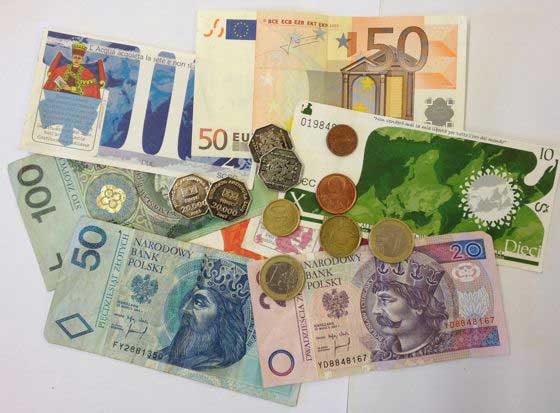
<p>Money follows, like everything else here on this physical plane, the principles of yin and yang. There is "hard" (yang) money and there is "soft" (yin) money. At this time, the world is dominated by yang money. My purpose with this article is to convince you that we need to find a better balance in matters of exchange and economics.</p>

<p><br />
<img alt="Money.jpg" src="http://blog.hasslberger.com/img/Money.jpg" width="470" height="347" class="mt-image-none" style="" /></p>

<p><br />
<strong>Do we need money at all?</strong></p>

<p>There are two systems that have historically been used and that are - to varying degrees - still in use today, that allow us to exchange the fruits of our toil and those we appropriate from nature, without the use of money. </p>

<p>There is <strong>the gift,</strong> which does not require an immediate return. Actually, it's nuanced. Some gifts are freely given without any expectation of return, but if we are talking about a "gift economy", usually the expectation would be that everyone, in some way or another, plays ball. That means, you can't just be a freeloader. Even in a gift economy, there is some expectation for all participants to pull their weight, meaning to participate in the giving. People who only receive and never give will find themselves marginalized, and rightly so. Flows do need to be balanced. If you only inflow (receive) and never get to the outflow part (the giving), things tend to get stuck. The inflow will stop sooner or later. The point is that, even in a gift economy, the principle of exchange cannot be violated with impunity. </p>

<p><iframe src="http://player.vimeo.com/video/36843721?title=0&amp;byline=0&amp;portrait=0" width="400" height="225" frameborder="0" webkitAllowFullScreen mozallowfullscreen allowFullScreen></iframe><p><a href="http://vimeo.com/36843721">Sacred Economics with Charles Eisenstein - A Short Film about the gift economy</a> from <a href="http://vimeo.com/ianmack">Ian MacKenzie</a> on <a href="http://vimeo.com">Vimeo</a>.</p></p>

<p>Then there is barter. In a <strong>barter economy,</strong> we also need no money. The exchange is direct. The needs of one are matched with the offerings of another. It is rather cumbersome at times to find a match, and it isn't always successful, but barter has been with us throughout history. It has served us well where money was not available or its use was not practical. Today, there are various initiatives to revive the barter economy. Computers allow us to provide better tools to match offerings and needs. Some of those tools merely let you choose from a larger number of diverse offerings. Others extend the barter concept from a one-on-one exchange to a circle of linked exchanges. A gives to B, who gives to C, who gives to D, who in turn gives to A. Circle closed. Barter has one big problem though. It generally has no time dimension. It is not easy, in a barter economy, to receive something today and to give maybe next week, or to provide your fruit to someone today when you actually don't need anything of theirs right away.  That is where money comes in... </p>]]>
        <![CDATA[<p>- - - </p>

<p>Money is a placeholder in the business of exchange. It is a little reminder to everyone that you have already given and that, tomorrow, you are within your rights to ask that the exchange be completed. Money allows us to add the missing <strong>time dimension</strong> to barter-type exchanges.</p>

<p><strong>How did money develop?</strong></p>

<p>At first, it was a little object, anything commonly available, not of great value itself, but sufficiently distinct so that it could be given from one person to another to signify there was an open cycle of exchange. Sea shells, pieces of metal, wooden tally sticks ... there are thousands of forms money could and did historically take. </p>

<p>As time passed, money was formalized. The form of money became different. The material used was something more scarce, and the creation of money was restricted to the ruler of the day, the king, the duke, the emperor. Gold and silver as money came into use when scarcity of the physical form of money became important. At the same time as money became scarce and its issuance became the prerogative of the ruler, a caste of assistants or "money handlers" developed who, at first, used to have their banks (tables or market stalls) in the places where people went to buy and sell, the markets. Gradually, money handlers became a respected profession and we had bankers.</p>

<p><strong>"Hard currency"</strong></p>

<p>In the hands of the bankers and over a period of time, money was transformed. What started out as a soft, rather commonly available means of exchange, became - without anyone paying much notice - a more and more scarce "resource". Money itself became a commodity. It hardened. It transformed, in almost imperceptible steps, from yin to yang. Today, money is highly controlled, it is scarce, and it is firmly in the hands of the bankers. Its control passed from the hands of the ruler, into the hands of the banks. We didn't really notice, because the central banks, which control the issue of money today, are a clever fig leaf. Politicians were fooled into a belief that the central banks are actually emanations of the governments. But nothing could be further from the truth. Every country has a central bank, but central banks do no longer respond to politics. They are independent, privately owned institutions that jealously defend their separate nature, their independence from political "meddling".</p>

<p>And with that independence came a price. Money all of a sudden had a price. Those who had money used the banks to defend their "property". Yes, money has become property. So much so, that today, economists tell us that that money has a dual function. It serves as a means of exchange, but it also serves as a "store of value". </p>

<p><strong>The price of money</strong></p>

<p>The price of money, you may have guessed it, is called "interest". If you want my money, you have to pay for using it. Every year, you have to give me a percentage of the money you are using, and unless you can repay me, that price of money is added to increase what I originally gave you. Not only has money turned into a resource, a property, it acquired a quality of life, it could now grow. And grow it did. It became one of the few industries that kept growing and growing. But of course it did not, by itself, produce anything. It only "allowed" us to produce - for a price. </p>

<p>Money's growth, like a cancer, started out slow but then it took off. The tumor got a life of its own. It started growing exponentially. And in the process, it changed our economy, that started out as a happy state of production and exchange between and among ourselves, into a war economy.  It forced us into using ever more of our precious natural resources to chase a mirage ... continuing growth for its own sake. Economists today tell politicians that in order for everyone to survive, in order to avoid certain collapse, the economy must grow. And so here we are, in this present time, doing our darndest to "make the economy grow". But all we are doing is feeding the monster. We are feeding a vicious cycle of wars, of environmental destruction, and ultimately the destruction of ourselves as a species. </p>

<p>The arrangement is so clever and so pervasive that it is actually at the verge of destroying itself. Someone has likened the economy to a pump, a giant machine that is transferring both our resources and our products into the hands of a tiny moneyed elite. Here is how it works:</p>

<p><strong>The wealth pump</strong></p>

<p>95% or more of all money existing today is not in the form of cash. It is bank created "credit" for which interest has to be paid as long as it exists. Banks are credit mediators. Anyone who needs money first needs collateral. You have a house, a car, a regular paycheck, a factory. You go to the bank to take a loan. The bank takes ownership of your collateral and now calls that an asset of the bank. Against that asset, the bank issues a loan in the form of an account entry on your account. The bank has the asset, you have the money. You work. If it takes you 10 years to pay back what the bank gave you, you have just paid twice the amount of the original loan to the bank. The bank made a clean 100% profit on that loan in a relatively short ten years. Not bad for merely providing some digits. Remember, the bank had nothing to lose, it owned your house, until you finished paying. </p>

<p>Now apply that to a whole economy, a whole country's economic activity. As I said, and you can check into that, some 95% of all money in circulation is bank originated loans and it circulates not as cash but as digits in computer systems. Consider that 95% as one big mortgage. It is really made up of millions of loans that constantly get issued and re-paid, but for the purposes of a country's economy, we can say it is a loan from the commercial banks. Let ten years pass, and the economy-as-a-whole must pay to the banks that provided the loan a sum roughly equivalent to the amount of the loan. Do you start to see the wealth pump at work now?</p>

<p>As the economists are telling us, the economy must grow. That means, the economy's mortgage with the banks also must grow. That mortgage is our constant companion. There is no way to pay it back - ever - unless we want to shut down the economy, which clearly we don't want to. So with every per cent of economic growth, we are digging a larger hole. We must now pay more for the privilege of using money, or face disaster. We must cut more trees, extract more oil, grow more food, produce more consumer goods, all in the name of keeping going. It is the end stage of growth, brought about by our continued ignorance of some important facts about economic affairs.  </p>

<p>And what if the banks get in trouble by giving "bad loans"? Don't worry. Our governments are ready to "bail them out" by putting a government-backed mortgage on our future... we have seen that in these last few years. </p>

<p>So what is the solution? </p>

<p>Clearly, "hard currency" has become an unsustainable proposition. </p>

<p>So - drum roll - enter ...</p>

<p><strong>"Soft money"</strong></p>

<p>We cannot change the situation overnight. There is neither the necessary political agreement nor the will to do so. We must continue to toil under the hard money yoke for some time. But do not despair. There IS something we can do. We must find a way to put the yin back into money and the economy - slowly. </p>

<p>With politicians unable and economists and the holders of all that money unwilling to change, it is encumbent on us to do that, any way we can.</p>

<p>Lucky for us, much of the change we are looking for is already well underway. A friend on facebook put it in a nutshell. His comment was in reply to an item, which says that continuing robotization of production will put us all out of work soon. It was introduced with the following quote:</p>

<p></p>

<blockquote>"Too often we treat things as separate subjects, not realizing the interconnected nature of our reality. This mistake has made us weak and vulnerable. Over the last 70 years, we have set the stage of our own demise, we have become increasingly discontent, the quality of our relationships has fallen, and we have lost track of what really matters. Today, everything is amazing, and nobody is happy. It's time to take a step back and think about where we are going."</blockquote>

<p><img alt="Robot.jpg" src="http://blog.hasslberger.com/img/Robot.jpg" width="640" height="360" class="mt-image-none" style="" /></p>

<p>The article: <a href="http://io9.com/5885512/robots-will-steal-your-job-but-thats-okay-how-to-survive-the-coming-economic-collapse">Robots will steal your job, but that's okay: How to Survive the Coming Economic Collapse</a></p>

<p><br />
The comment which nails it, was put in these words:</p>

<p></p>

<blockquote>scenario 1 : the rich get everything, made by robots, protected by robots. everyone else dies.

<p>scenario 2 : p2p production transforms our economy into one where things are made on-demand, locally and sustainably. Everyone is an independent artisan and owner-operator of their specialised fabrication technology.</p>

<p>The crucial point is right now we get to CHOOSE one or the other of these scenarios. But there's no historical / technological determinism which makes one of these scenarios the "right" one. If we want 2, then we have to fight for it. Starting right now.</p>

<p>We need to work - through inventing the technology in a p2p friendly manner; creating the institutions like hackspaces that support p2p learning and making; promoting local currencies and resilient manufacturing; ensuring local food; resisting laws that try to use "intellectual property" to lock up the ownership of all production processes in the hands of the rich; resisting laws that try to take our general purpose computers and 3d printers away from us because they're "too dangerous" for the general public. And resisting companies that do the same by telling us that the public is too stupid to manage their own computer. Etc. etc. </p>

<p>There is NO technological determinism that makes any prediction of the future the right one. As Alan Kay (almost) said : "The ONLY way to predict the future is to MAKE it" Your responsibility starts here.\</blockquote></p>

<p>We already have soft money - to a degree. There are a myriad of local exchange systems springing up, the reformers are busy. Yet, it is easy for all those efforts to be marginalized. For one, they are split into many small initiatives, none of them set to take on the juggernaut. So I think something is missing: a universal standard for soft money that allows us to all work together seemlessly, regardless of distance, regardless of what we are putting our efforts into in our quest to bring about that new world, and that new economy. </p>

<p><strong>"Fuzzy" money?</strong></p>

<p>When the hard (yang) logic of programming languages proved inadequate for complex jobs, someone invented a different kind of logic: <a href="http://en.wikipedia.org/wiki/Fuzzy_logic">Fuzzy logic</a>. And it turns out fuzzy logic is much better suited to run appliances and a number of complicated jobs than the rigid logic of yes/no that came before it. </p>

<p>So the question arose: If fuzzy logic is superior to the yes/no binary type, could this same principle apply to money? Could fuzzy money with no fixed value be better suited to constructing a p2p world than our normal, government-backed "hard" currencies?</p>

<p>How can we put that fuzzy quality into money? So far, most of the efforts to make a local currency have tried to compete with hard money, capturing some of the transactions that fell by the wayside because there was no way to give them value in the context of today's economy. Most of them struggle to, in some way, emulate the "value" part of the hard currencies, even to the extent of fixing their own value in terms of a dollar, a euro or at least something similar like an hour of work's worth. </p>

<p>It seems to me that it would be best to get away from that kind of thinking, that we should let the value of our yin currency float freely. Let it be worth whatever we think it should be worth, in whatever local context we find ourselves. No fixing of value, as that would inexorably draw us back into the world of yang, of banks, of profits, of having to increase economic activity for its own sake. Not that we should not be busy, that we shouldn't produce. But that should be everyone's own decision, not one forced by the kind of money we use.</p>

<p><strong>Whatchamacallit?</strong></p>

<p>We need a name for our new money. I was thinking to call the units "fuzzies", being that the whole idea is for the currency to incorporate the quality of being many-valued. But I am not so sure about that either. Since most local currencies are made by people giving each other credit, there is a good case for just calling them "credits". There is also a precedent in some of the stories of science fiction, where credits were in universal use. So for now, I will use credits as a working name. A better one may come along, and there is no resistance to changing, if that is what emerges. </p>

<p><strong>How to keep track of those credits?</strong></p>

<p>There already is an emerging standard for keeping track of, and for easily exchanging ... credits. It is called Web Credits.</p>

<p><a href="http://www.webcredits.org/">http://www.webcredits.org/</a></p>

<p>The initiators of Web Credits have joined in a W3C Community and Business Group.</p>

<p></p>

<blockquote><em>"The purpose of the Web Payments Community Group is to discuss, research, prototype, and create working systems that enable Universal Payment for the Web. The goal is to create a safe, decentralized system and a set of open, patent and royalty-free specifications that allow people on the Web to send each other money as easily as they exchange instant messages and e-mail today. The group will focus on transforming the way we reward each other on the Web as well as how we organize financial resources to enhance our personal lives and pursue endeavors that improve upon the human condition."</em></blockquote>

<p></p>

<p>Manu Sporny, one of the initiators of the Web Payments Community Group explains in more detail what the purpose and vision behind the initiative is.</p>

<p><a href="http://www.w3.org/community/webpayments/2011/08/16/launch/">http://www.w3.org/community/webpayments/2011/08/16/launch/</a></p>

<p>While Web Credits are not specifically geared to be a currency, they may well be the future infrastructure that is needed to make credits a workable reality.  </p>

<p><strong>Bad money</strong></p>

<p>There is a principle in monetary economics: Bad money will drive out (replace) good money. The thought goes back to Sir Thomas Gresham and the principle is generally referred to as <a href="http://en.wikipedia.org/wiki/Gresham%27s_law">Gresham's Law</a>.</p>

<p>How does this apply in our case? Sir Gresham said that "When a government compulsorily overvalues one type of money and undervalues another, the undervalued money will leave the country or disappear from circulation into hoards, while the overvalued money will flood into circulation." This means that money that is useless as a "store of value" (the compusorily overvalued money) will circulate, while the money that is correctly (exactly) valued will tend to disappear into the coffers of those who wish to use money to store value. Credits, having no fixed value, are the ultimate "bad money". They will circulate like crazy while the "good" money that is guaranteed by the government will be used for speculation and hoarding. Actually that is exactly what we are seeing today. The Euro (good money) is leaving the poor countries and in the absence of "bad" money to take its place, the economies of Greece, Spain, Portugal and to some degree Italy and Ireland, are in shambles, threatening to pull down the whole works with them. So it would actually be in the interest of the countries that are struggling economically to make their own "bad" money and let it circulate, at least the people would have jobs and food. </p>

<p>So the objective, with credits, would be to make real "bad" money.</p>

<p><strong>How could credits work?</strong></p>

<p>Here are my first thoughts, gathered from a recent email discussion, on how to do that. Note that I am not calling them credits yet, in those early exchanges.</p>

<p></p>

<blockquote>February 14, 2012 5:48:03 PM GMT+01:00

<p>There are, as you are well aware of, large numbers of efforts to solve the "money question" with local currencies, bitcoin and others weighing in. All of these, I believe, are making the same mistake: they are too close to the current system, which is tit-for-tat, goods for money, money for my service, etc. </p>

<p>And on the other hand, even a "gift economy", while it seeks to escape from that paradigm, is firmly linked to it by our understanding of gift, which is something that is NOT exchange, i.e. a thing freely given without anything expected in return. So we have the capitalist system of exchange (rigidly regulated either as barter or as money-mediated exchange, and we have its apparent opposite, the gift economy, where ostensibly there is no expectation of any return. </p>

<p>In reality, the natural economic behavior would be a mixture of the two. We do like to give, at times, and we'd give all the time, if we could afford it, but we would like to know that at least in some way we can expect someone (doesn't have to be the same person) to reciprocate and give something to us. That got me thinking of an inbetween-type economy, that is partly gift and partly exchange, but really is neither in a rigid sense. </p>

<p>We do not need money in the traditional sense, but we need something that brings the idea of exchange into a free-flow economy, where people are routinely given things and services like in a gift economy, but where there is still a balancing factor, something that tells me someone is more worthy of receiving my attention than someone else. </p>

<p>How could that be organized?</p>

<p>I propose we need a new kind of "money" that isn't like today's money. Its value is not fixed, yet it eventually becomes ubiquitous. It is a kind of fuzzy money, a point system of sorts. I give something away, and in return I start accumulating units of that fuzzy money. The amount to be determined by the recipient. There is no guarantee that I can ever buy something for it, but that isn't really what I'm after. All I want is for there to be an approximate record that shows that I did my part in sharing, meaning I gave things away (or I gave my time to help, or whatever). </p>

<p>The value of "fuzzies" (I am calling them that for lack of a better term) isn't fixed anywhere, but it will evolve and stabilize with time. Yet it will float freely and it could change. It's the worst kind of currency you could imagine. No guarantee that you can get anything for it at all. No claims can be made for it. Yet people will flock to it and use it all over the place, if someone creates a mechanism for it. According to economists, "bad money will drive out good money", so I am proposing to make the ultimate bad money. Ridiculous and worthless, if looked at from the capitalist point of view, but quite workable in stimulating exchange where there is a willingness to give, and a fuzzy expectation of return. </p>

<p>It will start out like a game, something attached to the "gift" economy, but also something that can act as the "exchange" for any operation. Eventually it will become an accepted exchange mechanism in its own right, and I believe it would give a tough time to official currencies. It would give a minimum of structure to a "gift" economy, but it is soft enough to not be a burden. The only thing is - it can't be attached to any commercial or semi-commercial exchange network. It would have to be open source, free and simple to use. </p>

<p>Perhaps the Web Credits standard could serve as the basic mechanism for keeping track of it. Web Credits is basic and simple enough, it's an open effort, and I believe it would be malleable enough to accomodate the "fuzzies" that could constitute that worst yet in time perhaps most successful of all currencies.</blockquote></p>

<p>and here another message, trying to expand on the argument...</p>

<p></p>

<blockquote>February 16, 2012 5:16:16 PM GMT+01:00

<p>The problem is that, from the standpoint of the individual user, we are no longer used to "go out and do an exchange" like in past times they went to the market with whatever they had to offer, to try and barter it for something they needed. We are used to thinking about inflow (buying, acquiring) and outflow (producing, selling, working) as time-separated activities. We work for hours and even days, and then we go out shopping. We don't do the two things at the same time. Money, as much as we might hate it, is what allows that time separation between inflow and outflow in our personal lives. </p>

<p>Money, even all of the alternative kinds, seems to always be attached to something else that determines its value, and exchanges then tend to be evaluated all in relation to that value. </p>

<p>Yet the time delay factor between inflow and outflow must be taken care of if an exchange system is to work properly. The exchanges to be mediated must be more than just the relatively few that can be perfectly time matched. </p>

<p>"Soft" money</p>

<p>When we hear of money, it is always an accounting unit, and it has a certain value. We hear of "hard currency". It's very exact, and it has VALUE. That seems to be the nature of money. So actually, soft money is not really money at all. It is a convention that is renewed with each transaction, a promise to "pay back" ... if not to the person we acquired something from, then to another member of the circle of exchange. </p>

<p>That is where the idea of fuzzy money (or soft money) comes in. "Fuzzies" aren't really money so much as they are promises. They are the incorporation of a time-storable promise I receive when I give (sell) something but want nothing in return just at the moment. You could look at them as a flexible point system that allows time storage of promises.  </p>

<p>If you look at fuzzies from the viewpoint of money, they are the absolute *worst* incorporation of the money concept you can imagine. But perhaps that is not so bad. After all, we want to get away from a centralized currency with a fixed value. Their value floats freely and is determined newly for each exchange. The value is based on the willingness of the buyer, to accept the request of the seller. The value of the thing being bought/sold is freely determined between the two at the moment of the transaction. </p>

<p>I like to call those things fuzzies, but we could just as well call them promises or - why not - credits.</p>

<p>Fuzzies (or promises) are created by the people transacting. The seller accepts (a fuzzy future promise) in exchange for a valuable thing or service he gives. The buyer puts his reputation on the line, promising to give something of value to anyone who will accept it. The transaction creates a promise, a debt by someone, that is now sitting on the account of the seller, who can in his turn find something (or not) to buy with it.  </p>

<p>Seen from the point of view of the system as a whole, anyone willing to provide goods or a service for a fuzzy promise of future return is actually providing a loan to the system as a whole. He injects 'life' into the circle of commerce by providing something without demanding an immediate return. He gets credit(s), a promise, a "fuzzy" for that. Probably the longer time he lets pass between supplying the value and demanding a return, the more his reputation should grow, because he's subsidizing the life blood of the circle of commerce. </p>

<p>On the other side, someone who receives something without immediately giving in return should feel that in their reputation. They are in the negative on promises (and therefore have a lower reputation) until they do provide something to the community that's worth as much or more than they received. </p>

<p>Now what's the value of a promise? There really is no fixed value. It's all up to people freely agreeing on a transaction. With time, promises will have an approximate (known) value and people will routinely use them. But in essence they will always remain just "a promise" or "a credit".</blockquote></p>

<p>Now that you have seen my ramblings on this, you can get the idea of where this is intended to go. Perhaps I am completely off my rocker. I don't believe I am. Perhaps we need to experiment. People could just send each other credits for what they received, with the idea that someone else, in time will give them something for that worthless thing. We have to take the dive into the unknown. We have been conditioned to think of money as value since the time Kings and Dukes and Archbishops issued funny pieces of metal with their faces stamped on them. We now think that money is a pre-condition for us to work at all. It need not be that way. We can make our own money, fuzzy as those credits might be. Let's try it out!</p>

<p>Oh yes, if you are a programmer and you are into open source, or as Stallmann says, "free" software, consider joining the effort at Web Credits </p>

<p><a href="http://www.w3.org/community/webpayments/wiki/Web_Payments:About">http://www.w3.org/community/webpayments/wiki/Web_Payments:About</a></p>

<p>to polish up that standard and put some meat on the bones of an actual workable payments system on the web. </p>

<p>And if you are into LETS or any other local or alternative currency, please consider whether the principles outlined here could perhaps be applicable to your efforts. </p>

<p>This needs to be a community effort.</p>

<p>And yes, I declare this work to be in the <strong>Public Domain.</strong>  That means it's free. You can copy it, translate it, use it, base your own work on it, whatever. If you are smart and your work makes a big splash (and a lot of money) I explicitly <strong>do not</strong> reserve any right to come after you for part of the proceeds. Of course if you want to give me credit, or even send me some of those credits... I would not say no.</p>

<p><strong>Translators and creators:</strong> Please have a field day with this one. If you like what you read and you make a translation, or use this in another type of work, please send me a link. I will post it here. Should you have no space to put it up, I might be able to help...<br />
 </p>

<p><strong>Related:</strong></p>

<p><a href="http://www.weknowthesecretsofthefederalreserve.com/the-secret-of-oz-understanding-money/" target="_blank">The Secret of Oz - Understanding Money - We Know the Secrets of the Federal Reserve</a></p>

<p><em>The world economy is doomed to spiral downwards until we do 2 things: outlaw government borrowing; 2. outlaw fractional reserve lending. Banks should only be allowed to lend out money they actually have and nations do not have to run up a "National Debt". Remember: It's not what backs the money, it's who controls its quantity.</em></p>

<p>Directly on YouTube:</p>

<p><iframe width="560" height="315" src="http://www.youtube.com/embed/swkq2E8mswI" frameborder="0" allowfullscreen></iframe></p>

<p><br />
<a href="http://blog.p2pfoundation.net/how-barter-followed-and-did-not-precede-the-creation-of-money/2012/02/29">Barter Followed and Did Not Precede the Creation of Money</a><br />
In this article, David Graeber lays bare one of the key myths of economists, i.e. that money followed and simplified barter, while the historical and anthropological evidence shows the opposite... (I found this one after writing my article, so if there is inaccuracy, I beg for your leniency - Sepp)</p>

<p><br />
<a href="http://inthearena.blogs.cnn.com/2011/07/05/david-graeber-studied-5000-years-of-debt-real-dirty-secret-is-that-if-the-deficit-ever-completely-went-away-it-would-cause-a-major-catastrophe/">David Graeber studied 5,000 years of debt: real dirty secret is that if the deficit ever completely went away, it would cause a major catastrophe</a><br />
This article discusses the raising of the debt ceiling in the USA. An interesting point made by Graeber is that, without the mountain of debt money in circulation, the economy could not function. He also makes another interesting observation, which is that there seems to be a 500 to 1000 year cycle of change between "soft" money and "hard" money being used in our society. This makes me ask: Could we be on the cusp of a swing from hard to soft?</p>

<p><br />
<a href="http://www.youtube.com/watch?v=TwmM5Nb6hiE">The Money Fix - a Documentary for Monetary Reform (Full length on YouTube)</a><br />
This video discusses money and argues that we need to change from hard to soft currency...</p>

<p><iframe width="560" height="315" src="http://www.youtube.com/embed/TwmM5Nb6hiE" frameborder="0" allowfullscreen></iframe></p>

<p><br />
<a href="http://www.itk.ntnu.no/ansatte/Andresen_Trond/econ/greece-etc-2.pdf">What if the Greeks, Irish, Baltics, Spaniards, Italians did this: high-tech parallel monetary systems for the underdogs?</a><br />
A proposal from Trond Andresen in Norway that bears some striking similarities with what is proposed in this article...<br />
.</p>]]>
    </content>
</entry>

<entry>
    <title>Particle Annihilation - A Source of Renewable Energy?</title>
    <link rel="alternate" type="text/html" href="http://blog.hasslberger.com/2012/02/particle_annihilation_-_a_sour.html" />
    <link rel="service.edit" type="application/atom+xml" href="http://blog.hasslberger.com/cgi-bin/mt/mt-atom.cgi/weblog/blog_id=1/entry_id=136" title="Particle Annihilation - A Source of Renewable Energy?" />
    <id>tag:blog.hasslberger.com,2012://1.136</id>
    
    <published>2012-02-17T11:29:59Z</published>
    <updated>2012-02-17T11:30:13Z</updated>
    
    <summary>Florian Ion Petrescu, an engineering PhD and senior lecturer at the Bucharest Polytechnic University in Rumania, has written about a variety of subjects including physics, mechanical engineering, and the development of flight. His books are available through LuLu publishers at http://www.lulu.com/spotlight/petrescuflorian One of those books, TURN ON THE LIGHTS! describes how the process of particle annihilation, the destructive interference between a particle and its anti-particle, could be used to obtain comparatively cheap and perfectly renewable energy. Although using the energy of sub-atomic particles, the process would neither necessitate nor create radioactive particles. It would also be much cheaper and simpler to realize than atomic fusion and present-day atomic fission reactors. Here is a summary, slightly edited, from a communication printed...</summary>
    <author>
        <name>Sepp</name>
        
    </author>
    
        <category term="Physics" />
    
        <category term="Technology" />
    
    <content type="html" xml:lang="en" xml:base="http://blog.hasslberger.com/">
        <![CDATA[<p>Florian Ion Petrescu, an engineering PhD and senior lecturer at the Bucharest Polytechnic University in Rumania, has written about a variety of subjects including physics, mechanical engineering, and the development of flight. His books are available through LuLu publishers at <a href="http://www.lulu.com/spotlight/petrescuflorian" target="_blank">http://www.lulu.com/spotlight/petrescuflorian</a></p>

<p><img alt="Petrescu_lights.jpeg" src="http://blog.hasslberger.com/img/Petrescu_lights.jpeg" width="226" height="320" class="mt-image-none" style="" /></p>

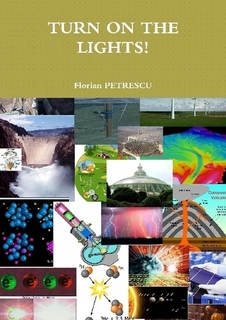
<p>One of those books, <a href="http://www.lulu.com/product/ebook/turn-on-the-lights/17355477?productTrackingContext=author_spotlight_101008078_" target="_blank">TURN ON THE LIGHTS!</a> describes how the process of particle annihilation, the destructive interference between a particle and its anti-particle, could be used to obtain comparatively cheap and perfectly renewable energy. </p>

<p>Although using the energy of sub-atomic particles, the process would neither necessitate nor create radioactive particles. It would also be much cheaper and simpler to realize than atomic fusion and present-day atomic fission reactors. </p>

<p>Here is a summary, slightly edited, from a communication printed in the January/February 2012 issue of <a href="http://www.infinite-energy.com/" target="_blank">Infinite Energy</a> Magazine.</p>]]>
        <![CDATA[<p><font size="4px" face="verdana"><strong>Obtaining Energy by Annihilation of an Electron with a Positron</strong></font></p>

<p>by <em>Florian Ion Petrescu</em> Bucharest, Romania </p>

<p>We can obtain renewable, clean, safe, cheap energy by annihilation, for example, of an electron with an anti-electron (positron). An electron and positron are obtained by extracting them from atoms; the extraction consumes a negligible amount of energy. Then, the two particles are brought near one another (collision).</p>

<p>The phenomenon of annihilation occurs when particle rest mass is converted totally into energy (gamma photons). Gamma photons occur as much as needed to retrieve the total energy of the electron and positron (rest energy and kinetic energy); usually one can get two or three gamma particles when we have a low energy annihilation, i.e. two anti-particles with lower energy, each with a little beyond rest mass (the particles are accelerated at a low-speed motion), but we can get more particles when we have a high energy annihilation (i.e. when the particle energy is high and the particles were strongly accelerated before the collision). </p>

<p>The rest energy of an electron-positron pair slightly exceeds 1 MeV which is an extremely large amount of energy from a small particle, comparable with that achieved by the merger of two much larger particles, having a rest mass about 2,000 times higher. Hence the first great advantage of the new method proposed: namely, that the most complex physical process that has so far been tried to obtain particle energy (hot or cold fusion) draws only about a thousandth part of the rest mass of the particle, resulting in the fusion of two particles. Practically, only the energy gap between two particles is freed when their energy is united. The proposed method would be able to extract virtually all the internal energy of the particles that are annihilated. </p>

<p>We started with the electron positron pair because these small particles are more easily extracted from the atoms. The atoms are then immediately regenerated naturally, which makes energy from the annihilation of particles perfectly renewable. A future step will be to test the annihilation between a proton and an anti-proton, because their mass is about 1,800 times higher than that of the electron and positron, resulting in their annihilation energy being about 1,000 times higher. Instead of 1 MeV, 1 GeV is considered as the really obtainable energy, the energy donated by the proton of the hydrogen ion. The energy of an antiproton is considered to be donated by us almost entirely, for now, because to obtain an anti-proton we must accelerate some particles at very high-energy and then collide them. So the real comparison must be made between the deuteron fusion and annihilation processes of a hydrogen ion (proton) with an anti-proton. It will be a difference of energy of about 1,000 times higher per pair of particles used, in favor of the annihilation process. </p>

<p>Practically this realizes the dream of extracting all of the energy from matter. </p>

<p>Another great advantage of this method is that there are no radioactive substances nor radioactive wastes from the process. The process produces only gamma photons (i.e. energy) and possibly other energetic mini particles. The process does not pose any threat to humans and the environment. The energy produced is clean. </p>

<p><br />
<img alt="Synchrotron02.jpg" src="http://blog.hasslberger.com/img/Synchrotron02.jpg" width="720" height="540" class="mt-image-none" style="" /></p>

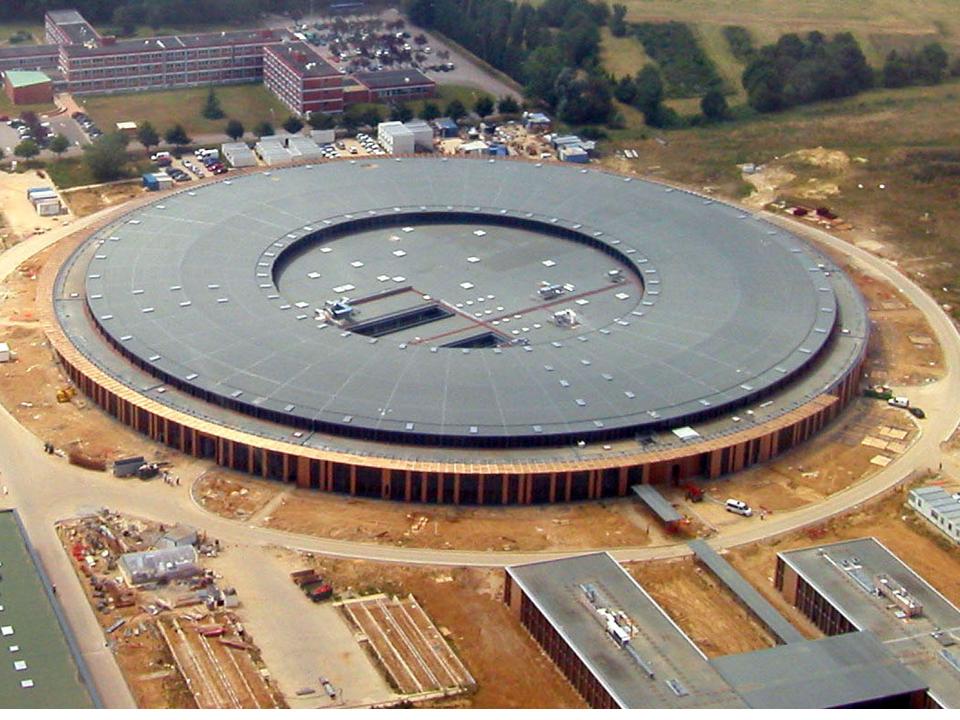
<p><em>Modern industrial-scale synchrotrons can be quite large</em> (here <a href="http://www.synchrotron-soleil.fr/" target="_blank">Soleil</a>, near Paris, soon after construction)</p>

<p><br />
The technology required, however, is much simpler than that for nuclear fission or fusion, it is also cheaper and easier to maintain. A great amount of energy is released by the annihilation process (virtually unlimited), and it will be cheap, clean, safe, as well as immediately renewable (sustainable), while using technology that is currently available. </p>

<p>We can extract the energy of the rest mass of an electron. For a pair of an electron and a positron, this energy is about 1 MeV. "Synchrotron radiation" as produced in a synchrotron light source is a deliberately produced source of radiation. Electrons are accelerated to high speeds in several stages to achieve a final energy (typically in the GeV range). </p>

<p>We need two synchrotrons, a synchrotron for electrons and another that accelerates positrons. The particles must be collided, after they are accelerated to an optimal energy level. All the energy is collected at the exit of the synchrotrons, after the collision of the opposite particles. We will recover the accelerating energy, and in addition we also collect the rest energy of the electrons and positrons. </p>

<p>At a rate of 10<sup>19</sup> electrons/s we obtain an energy of about 7 GWh/year, even if only half of the possible collisions are produced. This high rate can be obtained with 60 pulses per minute and 10<sup>19</sup> electrons per pulse, or with 600 pulses per minute and 10<sup>18</sup> electrons per pulse. If we increase the flow rate 1,000 times, we can have a power of about 7 TWh/year. This type of energy can be a complement to fusion energy, and together they must replace the energy obtained by burning hydrocarbons. </p>

<p>Advantages of the annihilation of an electron with a positron, compared with nuclear fission reactors, are the absence of radioactive waste, and a much lessened risk (no explosion or chain reaction). Energy from the rest mass of the electron is more easily controlled compared with the fusion reaction, cold or hot. </p>

<p>There will be no need for enriched radioactive fuel (as in nuclear fission), for deuterium, lithium and accelerated neutrons (like in cold fusion), or of extremely high temperatures and pressures (as in hot fusion). </p>]]>
    </content>
</entry>

<entry>
    <title>Magnetic vortex - experimental proof</title>
    <link rel="alternate" type="text/html" href="http://blog.hasslberger.com/2011/12/magnetic_vortex_-_experimental.html" />
    <link rel="service.edit" type="application/atom+xml" href="http://blog.hasslberger.com/cgi-bin/mt/mt-atom.cgi/weblog/blog_id=1/entry_id=135" title="Magnetic vortex - experimental proof" />
    <id>tag:blog.hasslberger.com,2011://1.135</id>
    
    <published>2011-12-23T17:38:42Z</published>
    <updated>2012-03-29T09:51:52Z</updated>
    
    <summary>The video linked here shows experimental proof of the existence of a magnetic vortex. The direction of rotation changes when magnetic polarity is reversed. Usually, we see magnetic field lines shown as bending straight back from one end of the magnet to the other. Correctly, what should be shown is magnetic lines of force in a vortex configuration, with flow spiraling into the magnet (or out of it) in a right-hand or left-hand turning motion, depending on the magnetic polarity. It appears to me that the separation of magnetic poles, and the tension that is created by this stable distancing of two opposing poles, creates rotation which, incidentally, is the seed of all matter. The work was done by Pedro...</summary>
    <author>
        <name>Sepp</name>
        
    </author>
    
        <category term="Physics" />
    
        <category term="Vortex" />
    
    <content type="html" xml:lang="en" xml:base="http://blog.hasslberger.com/">
        <![CDATA[<p>The video linked here shows experimental proof of the existence of a magnetic vortex. The direction of rotation changes when magnetic polarity is reversed.</p>

<p>Usually, we see magnetic field lines shown as bending straight back from one end of the magnet to the other. Correctly, what should be shown is magnetic lines of force in a vortex configuration, with flow spiraling into the magnet (or out of it) in a right-hand or left-hand turning motion, depending on the magnetic polarity. </p>

<p>It appears to me that the separation of magnetic poles, and the tension that is created by this stable distancing of two opposing poles, creates rotation which, incidentally, is the seed of all matter.</p>

<p>The work was done by Pedro Alexandre Lino Silva, a Portuguese free energy researcher. His site is <a href="http://linoavac.no.sapo.pt/" target="_blank">http://linoavac.no.sapo.pt/</a></p>

<p><a href="http://www.youtube.com/watch?v=EVhaFnPxiZ8&feature=related" target="_blank">vortex with magnets - magnetic vortex</a></p>

<p><iframe width="480" height="360" src="http://www.youtube.com/embed/EVhaFnPxiZ8" frameborder="0" allowfullscreen></iframe></p>

<p><br />
</p>]]>
        <![CDATA[<p>- - - </p>

<p>Other videos by Pedro Silva at <a href="http://www.youtube.com/user/espiritosantosilva" target="_blank">http://www.youtube.com/user/espiritosantosilva</a></p>]]>
    </content>
</entry>

<entry>
    <title>India: Tewari&apos;s Reactionless Generator Shows Promise</title>
    <link rel="alternate" type="text/html" href="http://blog.hasslberger.com/2011/06/india_tewaris_reactionless_gen.html" />
    <link rel="service.edit" type="application/atom+xml" href="http://blog.hasslberger.com/cgi-bin/mt/mt-atom.cgi/weblog/blog_id=1/entry_id=134" title="India: Tewari's Reactionless Generator Shows Promise" />
    <id>tag:blog.hasslberger.com,2011://1.134</id>
    
    <published>2011-06-15T08:25:24Z</published>
    <updated>2013-03-18T11:20:39Z</updated>
    
    <summary>Indian engineer Paramahamsa Tewari, who is not unknown to readers of this site, is experimenting with what he calls a Reaction Less Generator. Measurements taken by Tewari show that the generator is edging towards useful over unity production of electricity. Ever since the discovery of electromagnetic induction by Faraday and the invention of electrical generators based on these principles, any efficiency higher than unity obtained from these machines has been ruled out due to the Law of Energy Conservation (LCE) and the Lenz&apos;s Law. But, through a new Reaction Less Generator (RLG), under development for some time, efficiency much higher than 100% has been achieved. Tests are now being performed on a small Motor-RLG set which has a DC Motor...</summary>
    <author>
        <name>Sepp</name>
        
    </author>
    
        <category term="Technology" />
    
    <content type="html" xml:lang="en" xml:base="http://blog.hasslberger.com/">
        <![CDATA[<p>Indian engineer Paramahamsa Tewari, who is not unknown to readers of this site, is experimenting with what he calls a Reaction Less Generator. Measurements taken by Tewari show that the generator is edging towards useful over unity production of electricity. </p>

<p><strong><em>Ever since the discovery of electromagnetic induction by Faraday and the invention of electrical generators based on these principles, any efficiency higher than unity obtained from these machines has been ruled out due to the Law of Energy Conservation (LCE) and the Lenz's Law. But, through  a new Reaction Less Generator (RLG), under development for some time, efficiency much higher than 100% has been achieved.</em></strong></p>

<p><em>Tests are now being performed on a small Motor-RLG set which has a DC Motor coupled to an AC RLG. The test results show the graphs of input power to the drive motor  and the output from the RLG.</em> </p>

<p><img alt="RLG_Graph.jpg" src="http://blog.hasslberger.com/img/RLG_Graph.jpg" width="564" height="268" class="mt-image-none" style="" /></p>

<p><em>The lowest line on this graph from <a href="http://www.tewari.org/">www.tewari.org</a> (violet) shows the actual input to the RLG from the coupled motor with 0.8 efficiency. The next higher graph (green )  shows the input to RLG without taking motor efficiency into account. The highest graph (blue) shows the output from the RLG. Even at the moderate speed of 1750 r/m, at which the set is run, the ratio: Output from RLG / Input to RLG is 160%  (from the lowest and the highest graphs). With extrapolation it can be shown that at 3000 r/m, the efficiency of the M-RLG set will reach 275 %.</em></p>

<p><strong>Notes on the graph: </strong></p>

<p>1. Power to electromagnets is not taken into account, as these can be replaced by permanent magnets.</p>

<p>2. Entire power produced in the armature circuits has been taken into account. When higher voltages are induced in each circuit, suitable load resistors can be placed in series with the shunt</p>

<p>3. Drive-Motor efficiency is 80%.</p>

<p><br />
While the test results are encouraging, we aren't quite there yet. The research is still preliminary and useful over unity production of electricity, although seemingly within grasp, may still be off some time into the future. I hope to be able to report more news soon. </p>

<p>For now, development is in progress. Speed is being raised, says Tewari, and detailed tests are continuing. </p>

<p><img alt="RLG_Experimental.jpg" src="http://blog.hasslberger.com/img/RLG_Experimental.jpg" width="416" height="306" class="mt-image-none" style="" /></p>

<p><em>RLG experimental set-up</em></p>

<p><br />
<strong>The explanation to this new RLG phenomenon,</strong> says Tewari, <strong>comes from the principles of Space Vortex Theory.</strong>  That theory goes deeper into creation and stability of the electron, the flow of electrons from atom to atom, as they form a current in a conductor, and the creation of the field structure of electrons. All these arise from the absolute vacuum or space (mass less, nonmaterial fluid). </p>

<p>The positive terminal of a DC generator has a shortage of electrons, while the negative terminal has more electrons. This is because the electrons in the atoms of the armature conductors in rotation are interacting with the magnetic fields that strip them of their orbital electrons and pushes [displaces] them to form the negative terminal. When the positive terminal of the generator is connected to the external stationary output circuit, the electrons of the neutral atoms of the circuit, now in contact with the positive terminal, are pulled by the positive generator terminal and this is a continuing process. The negative terminal supplies the electrons that are pulled from atom to atom -- the process starting from the positive generator terminal. Though the atoms of the circuit conductor do work in pulling the electrons from the negative terminal and up to the positive terminal, their structural energy remains intact without any loss. This is because the electrons as well as the atoms are vortices of a mass less, continuous, non viscous, vacuum. The vortices continue to retain their structure despite their continuing interactions. <br />
 <br />
In a RLG, by a specific configuration of the armature conductor and the magnetic field, a torque that supports the motor torque is created. This way the armature reaction is nullified and Lenz's law is bypassed. There is no creation of energy from any source. There is no applicability of the Law of Conservation of Energy.<br />
 <br />
<strong>We have erred, though unknowingly, in our design of electrical generators and have remained in error for more than two centuries.</strong></p>]]>
        <![CDATA[<p>- - - </p>

<p>Here is how it started:</p>

<p>In June of 2010, Paramahamsa Tewari announced the discovery of a way to make electric power generation super efficient, in short, to recover more electric energy from a generator than is invested into turning it. His message at the time was:</p>

<p>"Please know this for sure that a Free Power Generator has been discovered! A model of Reaction Less Generator (RLG) has fully nullified the Armature Reaction due to which electrical generators produce a counter torque in opposition to their prime mover's torque. Generators designed with the principles of RLG will require excitation to their electromagnets (if permanent magnets are not used) and windage and frictional power input to the coupled Drive Motor. The armature reaction being zero, a very high overall efficiency --400 to 500 % can be expected. Present discovery pertains to a single phase AC generator and has full possibility to develop into 3 phase generators and also to self running engines through back feeding.</p>

<p>Where does the extra power come from is the question: A generator develops positive (P) and negative (N) polarities across its terminals. Positive polarity has less electrons compared to the negative terminal. When the generator output switch is closed, P pulls electrons from the neutral atoms (A) of the outside circuit thus making it positive, and in turn A , now positive, pulls electrons from its neighboring atoms. This process continues throughout the circuit and the current flows. Both, the atoms and the electrons are vortices of Vacuum--a zero-viscosity, massless, continuous medium. Though the atom's vortices do work in pulling the electrons one after the other , their vortex structure remains the same--there being no loss of their structural energy . So is the case with the electrons----their structure remains the same despite the interactions with the atoms. It is important to note that "co-linear elements of a current flowing in a conductor are Attractive", not repulsive as , perhaps, currently believed. Late Dr. Stefan Marinov was of the same opinion and came to this conclusion through his own Physical Theory, whereas I reached to the above conclusion through the principles of Space Vortex Theory.</p>

<p>Further development of RLG is continuing."</p>

<p><br />
<strong>Update from Paramahamsa Tewari - December 31, 2011</strong></p>

<p>"RLG experimental models being tried out now are in 250 V to 415 V conventional voltage and 6 kW range. Overall efficiency now is 160% and higher range. Indian patent has been applied.  Future RLG generators, say a 500 kW motor generator unit, can feed 1000 kW to the electrical grid supply. The experiments are proving time and again the correctness of the explananation for RLG effects through SVT principles."</p>

<p><br />
<strong>Further information: </strong></p>

<p>Paramahamsa Tewari's site is <a href="http://www.tewari.org/">www.tewari.org/</a></p>

<p><a href="http://www.cedc.ro/media/MSD/Papers/Volume%202%20no%202%202010/1.pdf" target="_blank">TAPPING NATURE'S LAWS FOR FREE POWER GENERATION - TOWARDS A MORE SUSTAINABLE FUTURE FOR MANKIND</a></p>

<p><a href="http://blog.hasslberger.com/2008/07/tewari_discovering_universal_r.html" target="_blank">Tewari: Discovering Universal Reality</a></p>

<p><a href="http://blog.hasslberger.com/2007/02/tewari_hidden_laws_in_the_univ.html" target="_blank">Tewari: Hidden Laws in the Universe</a></p>]]>
    </content>
</entry>

<entry>
    <title>Can Chemtrails be proved?</title>
    <link rel="alternate" type="text/html" href="http://blog.hasslberger.com/2011/05/can_chemtrails_be_proved.html" />
    <link rel="service.edit" type="application/atom+xml" href="http://blog.hasslberger.com/cgi-bin/mt/mt-atom.cgi/weblog/blog_id=1/entry_id=133" title="Can Chemtrails be proved?" />
    <id>tag:blog.hasslberger.com,2011://1.133</id>
    
    <published>2011-05-26T10:46:52Z</published>
    <updated>2013-03-18T19:31:26Z</updated>
    
    <summary>May 26 2011 - This is an appeal for cooperation from G. Edward Griffin (see his Reality Zone Site) which I would like to make available here ... perhaps one or the other of my readers is interested in the chemtrail phenomenon and would like to contribute to ending any uncertainty that still surrounds this &quot;painted skies&quot; mess. Image: Chemtrails over Rome - December 29, 2010 INVESTIGATORS WANTED Can Chemtrails be proved? It seems that the die-hard skeptics refuse to believe what they see with their own eyes. No matter how many laboratory tests we collect, they always seem to come up with a theory that, no matter how far fetched it is, would explain the high levels of aluminum,...</summary>
    <author>
        <name>Sepp</name>
        
    </author>
    
        <category term="Environment" />
    
        <category term="Science" />
    
        <category term="Technology" />
    
    <content type="html" xml:lang="en" xml:base="http://blog.hasslberger.com/">
        <![CDATA[<p>May 26 2011 - This is an appeal for cooperation from G. Edward Griffin (see his <a href="http://www.realityzone.com/">Reality Zone Site</a>) which I would like to make available here ... perhaps one or the other of my readers is interested in the chemtrail phenomenon and would like to contribute to ending any uncertainty that still surrounds this "painted skies" mess.</p>

<p><br />
<img alt="Chemtrails_Rome722.jpg" src="http://blog.hasslberger.com/img/Chemtrails_Rome722.jpg" width="580" height="326" class="mt-image-none" style="" /></p>

<p><em>Image: Chemtrails over Rome - December 29, 2010</em></p>

<p><br />
<strong>INVESTIGATORS WANTED</p>

<p>Can Chemtrails be proved?</strong></p>

<p>It seems that the die-hard skeptics refuse to believe what they see with their own eyes. No matter how many laboratory tests we collect, they always seem to come up with a theory that, no matter how far fetched it is, would explain the high levels of aluminum, barium, and strontium as merely due to some climate condition or error in preparing the chemical sample or some unintended human interaction. </p>

<p><br />
<strong>SKI SLOPE THEORY</strong></p>

<p>When we released our documentary, <em>What in the World Are They Spraying,</em> we included snow samples taken from Mt. Shasta in Northern California, which contained toxic levels of these metals. Since snow is merely frozen rain water, it was clear that this came from the sky and not from the soil or water run-off from some toxic waste dump. Nevertheless, an Internet debunker challenged our conclusion by claiming that people ski on Mt. Shasta, and skis are made of aluminum. Therefore, the tested aluminum probably came from the skis! Nothing to worry about after all.</p>

<p>Of course, this was all made-up nonsense. People do ski on Mt. Shasta, but it is a big mountain, and there has never been any skiing in the area where the samples were taken. Even if there had been, that would not explain the high levels of barium and strontium. These metals are not used in the construction of skis. Our debunker never bothered to check on any of that. He was merely looking for some plausible explanation in order to plant doubts into the minds of casual readers. If people are confused by seemingly plausible explanations that even remotely could explain away the high levels of aluminum, barium, and strontium in snow and rain water, they will back away from coming to a conclusion and align themselves with the prevailing view.</p>

<p><br />
<strong>DUST-BOWL THEORY</strong></p>

<p>Another debunker contacted me a few days ago and claimed that a plausible explanation for the chemicals in snow on Mt. Shasta is that the samples were taken in a year with early snow melt which, according to him, means there was a lot of bare earth exposed at the time, and the wind must have blown dust from the earth onto the snow. Furthermore, he claims that the soil on Mt. Shasta contains the same metals as found in the samples; so, you see? Here is another perfectly plausible explanation. Once again, nothing to worry about.</p>

<p>We are planning to respond to this gentleman as soon as we can find the time to carefully examine his claims about the early snow melt, the amount of bare earth exposed, the composition of the surface soil, and especially the rainfall and moisture levels of the soil during this period. I expect to find that, even if there had been an early snow melt, the soil on Mt. Shasta would have been far too moist and covered with moss, ferns, or other ground cover to make the "dust-bowl" theory even remotely plausible. But it will take a little time to pull the facts together.</p>

<p>Meanwhile, we must not just play defensive and spend our lives answering the debunkers. We must take the initiative and obtain new data and information that will be impossible to dispute. The on-going collection of new snow and rain samples is part of that strategy. After we have literally hundreds of such chemical tests, I think our critics will run out of plausible-denial theories. </p>

<p><br />
<strong>PLANE FINDER</strong></p>

<p>One of the most promising technologies to generate hard evidence of chemtrails is the Internet tracking of planes in flight. There are several computer programs and devices that track commercial flights in real time and show, not only their location, but also their flight number, type of aircraft, origin, destination, speed, and altitude. The cost for this App on an iPhone is about $4, and on a computer, it is free. This is amazing technology, and the programs actually are fun to use. They work by receiving what is called ADS-B plane feeds, which are radio signals transmitted by commercial and private aircraft. Military aircraft and those on classified missions do not transmit this signal.</p>

<p>I'm sure you already see where this is going. It is theoretically possible to identify every commercial plane you see overhead either by pointing your iPhone camera at it or locating it on the screen of your computer. If the debunkers are correct, we will find that planes spewing a trail from horizon-to-horizon will all be identified as merely commercial craft and what we see are merely normal contrails after all. On the other hand, if we find that commercial craft do not leave streaks from horizon to horizon but the ones that do are missing from the system ... well, even the most die-hard skeptic would have to take a serious look at that.</p>]]>
        <![CDATA[<p>- - - </p>

<p>To be sure, the debunkers will always be able to find some semi-plausible explanation for everything, even this. For example, not all parts of the world or even of the United States are serviced by this technology at the present time, although the most populated areas are. So the debunkers will likely claim that the coverage is not complete and, therefore, not reliable. Also, there is some question about whether all commercial planes are equipped with these transmitters or merely most of them, so the debunkers will claim that a plane that does not show up in the system is probably just one of those commercial planes without transmitters. One blogger who is not happy with the technology claims that his iPhone does not work if the plane is closer than 50 miles, supposedly because of some interference by Homeland Security to protect planes from terrorists. (I do not have an iPhone so I cannot verify his claim, but I had no trouble tracking aircraft directly overhead when using the full computer version of Plane Tracker.) In any event, debunkers will claim that the system is filled with quirks and errors and is not reliable ... you get the picture.</p>

<p>In spite of the debunkers, there is an opportunity here to collect data that will be very compelling, even if there are areas not serviced by the technology and even if a small percentage of commercial planes are, in fact, without transmitters. If we can demonstrate that most flights with long trails are missing from the system, I think we will have put the final nail into the coffin of chemtrail denial.</p>

<p><br />
<strong>TWO-EDGED SWORD</strong></p>

<p>This project is a two-edged sword. What if we find that all those trails really are coming from the same scheduled planes that carry passengers? That would mean we have been on the wrong track, and we would have to re-examine our evidence and re-consider our position. There are some who are convinced that spraying is done by planes performing routine commercial services, but I have not considered that to be likely in view of the huge amount of chemicals needed for such missions and the difficulty in concealing the mixing of chemicals with jet fuel, to say nothing of the effect it would have on fuel performance and damage to the engines. Furthermore, Planes that fly in the crazy patterns we have seen would hardly go unnoticed and unreported by passengers. In any event, the results of a field test such as I am proposing will clear up many of these questions.</p>

<p><strong>Here is what I am asking you to do.</strong> If this project interests you, please go on the Internet and become familiar with a program called Plane Finder.</p>

<p><a href="http://planefinder.net/" target="_blank">http://planefinder.net/</a></p>

<p>Play with it a while to see how you can track aircraft anywhere in the world, provided there are receiving stations in that area. When you see on your screen that a plane is moving over your location, you should be able to go outdoors and watch it in the sky. Every time you see a plane, get its identity from Plane Finder and note if it has very long trails (lingering over more than half the sky and feathering out into a lingering milky haze), short trails (moving along with the aircraft and dissipating as they go), or no trails (usually low altitude flights). Record all the data about the flight including the time.</p>

<p>For those with iPhones or other smart phones that can handle the Plane Finder App, purchase it and install it. Then, every time you see a plane, aim the camera lens of the phone at the plane and record its identification, including the time.</p>

<p>That's it. If 50 or 100 people will do this, and if they are able to collect data on flights over a one-month period, we will have a data base of immense value. When complete, please prepare a summary, including the locations where observations were made and a brief summary of your experience, and send it to me at </p>

<p><a href="mailto:gedward.griffin@verizon.net">gedward.griffin@verizon.net</a></p>

<p>Are we going to have fun or what?</p>

<p>Ed Griffin</p>

<p>P.S. If you have not yet obtained a copy of What in the World Are They Spraying, there is no better time than now. It can be ordered here:</p>

<p><a href="http://www.realityzone.com/whatspray.html" target="_blank">What in the World Are They Spraying?</a></p>

<p>There is also a version on YouTube. Much lower quality, but if you can't buy right now...</p>

<p><a href="http://www.youtube.com/watch?v=jf0khstYDLA&feature=share" target="_blank">What in the World Are They Spraying?</a> (Full Length)</p>

<p><iframe width="480" height="390" src="http://www.youtube.com/embed/jf0khstYDLA" frameborder="0" allowfullscreen></iframe></p>

<p>... and there is another, more recent documentary titled WHY in the world are they spraying. I recommend seeing it.</p>

<p><iframe width="560" height="315" src="http://www.youtube.com/embed/j0fBcH0iuX0" frameborder="0" allowfullscreen></iframe></p>

<p><br />
<strong>CHEMTRAIL UPDATE #2</strong><br />
<em>(update number 1 was directly incorporated into the article)</em></p>

<p><strong>Choice of Tracking Programs</strong></p>

<p>The first few days of experience with tracking live flights has been highly instructional, and we have had some surprises. One of them is that Plane Finder is not the best program for tacking commercial aircraft in the United States or Canada. There are numerous areas with high levels of air traffic, such as Las Vegas, that show no aircraft at all on their maps. In Canada, only a few routes along the southern border are included. Other parts of the world, except Europe, seem to be similarly blank. </p>

<p>I think the reason for this is that the company is still in the process of adding data receivers to its network, and these areas are not yet included. While scanning the Internet for more information, I came across a posting from Pinkfroot, the company that owns this software, offering to provide free receivers to private parties in North America who were willing to share the data with the company. That was posted on July 4, 2010, and there were numerous responses from private parties offering to help build the network. I don't know if the company still is offering receivers on this basis, but I mention it because it suggests that their coverage may still be in expansion mode. </p>

<p>When I checked out Plane Finder where I live in the greater Los Angeles area, the program picked up a large number of flights, and I was able to go outside and verify visually that what was on my computer screen actually was flying overhead. It was on that basis that I thought we were in good hands with this program.</p>

<p>There are two other tracking programs that have better coverage than Plane Finder. They are <a href="http://www.flightexplorer.com/" target="_blank">Flight Explorer</a> and <a href="http://flightaware.com/" target="_blank">Flight Aware</a>. Flight Explorer (Personal Edition) costs $10 a month for ten hours usage plus a small  fee for each additional hour. Flight Aware is free. They are relatively easy to use if you are willing to spend about fifteen minutes exploring their features and controls. If you live in an area where Plane Finder does not work, you probably will find that one of these programs will.</p>

<p>There is, however, a drawback to both. According to the information provided on their web sites, flight data is delayed by five minutes because of FAA requirements. Only government and commercial users are able to access this data in real time. That means that what you see in the sky will not show up in the tracking program until five minutes after you see it. That is not too difficult to work around insofar as keeping records. It just means you have to be a bit patient.</p>

<p>Plane Finder says its images are displayed in "near real time." As far as I can tell with flights passing over my house (I am under a major air-lane into Los Angeles), the images either are in real time or within a minute of it. I don't know why Plane Finder displays flights so close to real time when others services are not allowed to do so, but I think it may be because it takes its flight data from a different source. </p>

<p>Plane Finder says it derives its flight data from radio signals constantly generated from each aircraft. These are called ADS-B plane feeds. This is not the same as signals from aircraft transponders. That is another type of identification altogether. Wikipedia says that a transponder "is an electronic device that produces a response when it receives a radio-frequency interrogation. In aviation, aircraft have transponders to assist in identifying them on radar and on other aircraft's collision avoidance systems. Air traffic control units use the term "squawk" when they are assigning an aircraft a transponder code." The reason we have created a place on our data sheets for "Squawk" is to make a record of each plane's transponder code.</p>

<p>So, what is the difference between a transponder signal and an ADS-B plane feed, and why are there two systems? As far as I can tell (I trust I will be soundly corrected if I am wrong, in which case I will pass along the correction), there are three differences." (1) Transponders send out signals only when they are contacted by a radio request, while ADS-B is constantly broadcasting; (2) Transponders have a wide range of responses available depending on the nature of the request, while ADS-B transmits only one set of information; and (3) transponders are used in larger planes and commercial flights, not available to everyone, while ADS-B is a kind of poor-man's system, available to anyone who wants to have the safety benefits of being electronically visible to other aircraft. </p>

<p>According to Commercial Aviation Safety, 4th Edition, "ADS-B uses satellite navigation and datalink to enable an aircraft to broadcast its identification, position, altitude, velocity, and intent to every other aircraft in the vicinity as well as to the ground tracking system. This broadcast information may be received and processed by other aircraft or ground systems for use in improved situational awareness...." </p>

<p>That is the source of flight data used by Plane Finder. Data used by Flight Explorer and Flight Aware apparently are derived from a composite of other sources. Flight Aware says: "FlightAware compiles, aggregates, and processes data from a variety of government sources, airlines, commercial data providers, as well as FlightAware proprietary tracking network." It is possible that this aggregate includes ADS-B feeds, but I have not been able to find any mention of it. </p>

<p>The primary reason to be aware of this is that it takes some of the mystery out of the technology and makes the process less intimidating. The important thing to remember is that all three systems are locked into data that comes from conventional sources that exclude military or classified flight missions. Therefore, if there are such things as chemical tankers whose sole mission is to implement geo-engineering, they will not be tracked by any of these programs. Plane Finder has the advantage of being able to point an iPhone or Android camera at a specific aircraft and quickly identify it if it is in the system, whereas Flight Explorer and Flight Aware have the current advantage of being able to identify more planes. All of this leads to several challenges: </p>

<p>(1) If you look at the tracking screen of any of these programs and then try to locate them in the sky, you will never spot anything but a flight that is acknowledged by the system. In that event, do not be surprised if all of them show up as normal commercial flights.</p>

<p>(2) If you first spot planes in the sky and then try to locate them on the tracking screen (the preferred method for our purposes), they may not show up on the screen for up to five minutes or, possibly, not at all. </p>

<p>(3a) If not at all, and you are using Plane Finder, you have to determine if they are missing because they are private planes without ADS-B transmitters, your tracking program is not receiving ADS-B flight data in your area, or because the flight is blocked from the system. OR</p>

<p>(3b) If not at all, and you are using Flight Explorer or Flight Aware, you have to determine if they are missing because they are small, private planes without flight plans filed with the FAA, or because the flight is blocked from the system.</p>

<p>This may not be as difficult as it may seem at first. Knowing in advance that Plane Finder has areas with no coverage, the first step is to determine if your location is one of those. That can be done simply by looking at the tracking map and watching for a while. It soon will be evident that planes either are being tracked in your area or not. If <strong>any</strong> planes are being tracked in and out of your nearest major airport, probably <strong>all</strong> of them are, in which case you are set to go. If <strong>no</strong> planes are being tracked, simply choose another tracking program until you find one that shows the flights.</p>

<p>We have other issues that also need to be clarified in this project, but I want to get out this notice right away for the benefit of those who have been having trouble with Plane Finder. Another update will be sent in the near future.</p>

<p>To all of you helping in this investigation, I send my deepest gratitude.</p>

<p>G. Edward Griffin    </p>

<p><br />
<strong>June 6, 2011 - CHEMTRAIL UPDATE #3</strong></p>

<p><strong>Narrowing the Observations</strong></p>

<p>Project Plane Tracker is well underway, and we have learned a great deal in the first few weeks. One of those lessons is that some of the data we have been collecting still will not close the case for many skeptics. It is tempting to just dismiss them as incurably brainwashed and not even try to answer their questions, but I feel that the better path is to dig deeper and try harder. I was once a skeptic, myself, and the fact that they are not yet in agreement with us is, I think, more of a reflection on us than them. In all honesty, we can do better - and we shall.</p>

<p>One of the issues omitted from the documentary, <em>What in the World Are They Spraying,</em> was an explanation of the difference between contrails and chemtrails. Because of that, many people think we don't know that contrails are real or that, under certain atmospheric conditions, they actually can look like chemtrails; so we are constantly bombarded with emails referring us to books and web sites that say what we think are chemtrails really are just old-fashioned contrails, and we are ignorant fools for thinking otherwise. </p>

<p>We cannot ignore those charges, especially since we have learned a great deal about contrails and now are assembling data through Project Plane Tracker that we hope will demonstrate once and for all that <em><strong>most</strong></em> of the trails we are watching in the sky are not persistent contrails because they occur where the temperature and relative humidity are inadequate to cause their formation. This is not opinion or speculation. It is science.</p>

<p><strong>A CLOSER LOOK AT CONTRAILS</strong><br />
Contrails can form at any temperature below freezing. That's because the water-vapor component of jet-engine exhaust comes in contact with cold air and turns into ice crystals. The important question is not <em><strong>if</strong></em> they form but how long they persist. </p>

<p>Below freezing at low relative humidity (RH), they are readily absorbed into the dry atmosphere around them and disappear in a few seconds. As RH rises, it takes longer for them to be absorbed, and their length increases. At the far end of the scale, humidity is 100%, which means the atmosphere at any given temperature cannot absorb more moisture. At that point, the ice crystals remain visible until they eventually come in contact with atmosphere with less than 100% RH, at which point they will be absorbed and disappear. In the meantime, as long as contrails remain at the extreme end of the scale where the atmosphere is totally saturated with moisture (a condition called saturation over ice), they can persist from horizon to horizon, spread out, and be mixed by high altitude winds to form a haze over large portions of the sky. In some cases, they may take on the appearance of  natural cirrus (feathery, high altitude) clouds. These high altitude contrails are mostly just ice, have no toxic chemicals added, and are pretty harmless. So, what's the big fuss?</p>

<p><strong>THE COOKIE-JAR THEORY</strong><br />
Before jumping to conclusions, we need to ask an important question: Just because contrails theoretically <em><strong>can</strong></em> produce these effects at specific conditions of temperature and humidity, does it necessarily follow that <em><strong>most</strong></em> of the trails we have been observing (or any of them) are contrails? Just because a thief <em><strong>could</strong></em> have come through the kitchen back door and taken the cookies out of the cookie jar, does it necessarily follow that this is what actually happened to the cookies?</p>

<p>The purpose of this research is to demonstrate that 85% to 95% of the trails seen completely covering the sky are forming in air space that does not even come close to the atmospheric conditions needed for a contrail. In other words, if the kitchen door is locked (and the window, too), the cookie thief will have to be found elsewhere, probably in the household.</p>

<p>If not contrails, then what?</p>

<p><strong>BACK TO THE DRAWING BOARDS</strong><br />
The core of the present problem is that we started by asking field investigators to track aircraft in their areas regardless of the length of their trails, and we used terminology such as "short trail" and "long trail." This has turned out to be useless information for the following reasons.<br />
 <br />
As we have seen, contrails can be short, medium, long, or very long depending on atmospheric conditions. In other words, we are dealing, not with an absolute, but a continuum. However, at the end of that continuum, there is an absolute (ice over saturation). Therefore, we should forget the continuum and work solely with the absolute.</p>

<p>For this reason, using the saturation-over-ice test is of value only for horizon-to-horizon trails, because anything less could be explained as a contrail in the continuum. It would be impossible to quantify the atmospheric conditions that could produce a short, medium, or long trail - or even a so-called persistent trail - because those are subjective evaluations. A horizon-to-horizon test, accompanied by ample photo or video documentation, is far more difficult to challenge because it is independent of variables and subjective interpretation. </p>

<p>Saturation-over-ice is required for horizon-to-horizon contrails. I am not aware of any conventional alternate explanation for such formations. Therefore, we need to concentrate solely on that category of observations. </p>

<p><strong>NEW TRACKING WORKSHEET AND NEW DATA SOURCE</strong><br />
We have updated our data worksheet to reflect this change, so that simplifies things a bit. But, wouldn't you know we thought of a way to complicate it again. We need two additional bits of information before we can generate the proof we seek. They are temperature and RH at the time and location the aircraft is observed. Without that, we cannot demonstrate that saturation-over-ice did not exist. Fortunately, this information is readily available from a web site maintained by the University of Wyoming, Department of Atmospheric Science. Twice each day they send up weather balloons that measure different parameters of the weather, including temperature and RH, at different altitudes up to about 50,000 feet. With a click of the mouse, we are able to select almost any major city in North America and find weather data for that general area for either the first or last half of each day. You won't need to worry about determining conditions for saturation-over-ice. We will do that. (If you want to do it yourself, we'll be happy to send you the chart, but it is not necessary.) The University shows altitude in meters; so, if you are using a plane-tracking program that measures in feet, you will need to convert to meters before you can locate the right elevation on their site.</p>

<p>Download new Observation Worksheet <a href="http://m1e.net/c?21703740-Mj7bx6vwhezwc%406519684-/Ve7BBO.WEBJA" target="_blank">here</a>. <br />
Link to University of Wyoming atmospheric web site <a href="http://m1e.net/c?21703740-j/wIS7/wgFYZU%406519685-9vBatiaKe1rlc" target="_blank">here</a>. <br />
Link to chart converting feet to meters <a href="http://m1e.net/c?21703740-ZjfLBYxLij/VQ%406519686-TVRfbnCzRmGKk" target="_blank">here</a>. <br />
Learn more about saturation over ice <a href="http://m1e.net/c?21703740-4XPeHkYNhJS5.%406519687-eoYke2GTcyCgA" target="_blank">here</a>. </p>

<p>*******</p>

<p><strong>FURTHER CLARIFICATION ON AIRCRAFT SIGNALS</strong><br />
2011 June 2 from L. Graves<br />
ADS-B is relatively new in aviation, lagging the in-cockpit use of GPS by several years, while transponders have been around for 40+ years. I would characterize the use of transponders and "squawk codes," especially in busy airspace, as nearly universal, even among the "low-and-slow" trainer fleet of little two-seaters. Ground radar sends out an interrogation, and the transponder replies, amplifying the radar signature of the individual aircraft. ADS-B is in the adoption stage, and will someday take the place of the ubiquitous transponder interrogation/response IFF system. ADS-B is satellite-based and is not radar-dependent.</p>

<p><strong>PILOT CLARIFIES AIRCRAFT TRANSPONDERS</strong><br />
2011 June 1 from David Lamb<br />
As a licensed private pilot, I offer some clarification on the issue of aircraft transponders. Operating transponders are required to be installed on all civil aircraft, by FAR 91.215 (US Code of Federal Aviation Regulations). (Exceptions are aircraft manufactured without an electrical system (ultralights, antiques, and gliders) .) The requirements for when the transponder must be operating are complex, but basically any civil aircraft operating in any controlled airspace, in any Class A, B, or C airspace, within 30 miles of a major airport, within 10 miles of a minor airport, in or above a cloud ceiling, or above 10,000 ft., must have the transponder operating during flight. Essentially, any civil aircraft flying near a populated area below 10,000 ft., and any civil aircraft flying above 10,000 ft., will have the transponder turned on. The transponder is the primary means for ATC radar to identify specific aircraft and verify location.</p>

<p>The ADS-B system is the new GPS-based system. Civil aircraft are not required to have a ADS-B transmitter, but the newer aircraft that do are still required to have an operating transponder. My guess is that most commercial airlines are installing ADS-B transmitters in all of their older planes too, but there may be some that aren't.</p>

<p>I'm not sure why there's the assumption that the chemtrail sprayers won't be operating a transponder. My guess is that they probably are, because it is likely that they are civil aircraft per FAR definition, and I'd wait for some data to come back that indicates otherwise.</p>

<center>*******</center>

<p>Thanks again to everyone who has volunteered to participate in this important project</p>

<p><strong><em>G. Edward Griffin</em></strong> </p>

<p>- - - </p>

<p>A related article that documents many of the effects of chemtrails</p>

<p><a href="http://www.geoengineeringwatch.org/global-weather-modification-assault-causing-climate-chaos-and-environmental-catastrophe/">Global Weather Modification Assault Causing Climate Chaos And Environmental Catastrophe</a></p>]]>
    </content>
</entry>

<entry>
    <title>Concentrated solar thermal power could replace nuclear reactors</title>
    <link rel="alternate" type="text/html" href="http://blog.hasslberger.com/2011/03/concentrated_solar_thermal_pow.html" />
    <link rel="service.edit" type="application/atom+xml" href="http://blog.hasslberger.com/cgi-bin/mt/mt-atom.cgi/weblog/blog_id=1/entry_id=131" title="Concentrated solar thermal power could replace nuclear reactors" />
    <id>tag:blog.hasslberger.com,2011://1.131</id>
    
    <published>2011-03-23T19:19:35Z</published>
    <updated>2013-03-21T08:23:10Z</updated>
    
    <summary> Catastrophic nuclear accidents are just about impossible, we need not worry about them. That is what the nuclear experts and the lobby for nuclear power production are telling us. Yet, an earthquake and a tsunami in Japan, and the subsequent loss of control over nuclear reactors at the Fukushima power plant teach us a different lesson. What is happening there reminds us that &quot;impossible&quot; is not something we can really put any stock in. An explosion destroys reactor number 1 at Fukushima nuclear power plant The nuclear catastrophe following a destructive earthquake and tsunami at Japan&apos;s eastern coast is still unfolding. No one knows yet what the ultimate consequences will be for the people of Japan and the world....</summary>
    <author>
        <name>Sepp</name>
        
    </author>
    
        <category term="Technology" />
    
    <content type="html" xml:lang="en" xml:base="http://blog.hasslberger.com/">
        <![CDATA[<p><br />
Catastrophic nuclear accidents are just about impossible, we need not worry about them. That is what the nuclear experts and the lobby for nuclear power production are telling us. Yet, an earthquake and a tsunami in Japan, and the subsequent loss of control over nuclear reactors at the Fukushima power plant teach us a different lesson. What is happening there reminds us that "impossible" is not something we can really put any stock in. </p>

<p><img alt="Fukushima_nuclear.gif" src="http://blog.hasslberger.com/img/Fukushima_nuclear.gif" width="560" height="254" class="mt-image-none" style="" /></p>

<p><em>An explosion destroys reactor number 1 at Fukushima nuclear power plant</em></p>

<p><br />
The nuclear catastrophe following a destructive earthquake and tsunami at Japan's eastern coast is still unfolding. No one knows yet what the ultimate consequences will be for the people of Japan and the world. What we do know is that nuclear power production is based on a highly unstable reaction that must be actively controlled if the fuel is not to overheat and blow up in our face. </p>

<p>People are getting uneasy about the 'nuclear option', promoted as the needed replacement for carbon, oil and gas based energy, as global warming takes its toll. Leaving aside for the moment the discussion on climate change and anthropogenic global warming, which is far from resolved, I do agree that we need to change our energy policy. Not because of CO2 but because we pollute the environment, making it inhospitable to humans and other life, by continuing on our current course. Coal, oil and nuclear are not options for the future.</p>

<p>Yet in discussions about the necessity of changing over to a different mode of energy production, we are told that renewables could never replace conventional energy, and that the only choice is between coal/oil and nuclear power plants. </p>

<p>That is a rather bald-faced lie. The fact is that by concentrating the sun's rays, great quantities of high grade thermal energy can be obtained, sufficient to run the industrial machines needed to uphold present levels of civilization. We can produce steel and aluminium with the electricity a concentrated solar thermal plant supplies. The steam turbines and generators that are today being run by coal and gas or by nuclear can just as well be driven by ... the sun's rays. </p>

<p><br />
<img alt="concentrated-solar-power.jpg" src="http://blog.hasslberger.com/img/concentrated-solar-power.jpg" width="560" height="373" class="mt-image-none" style="" /></p>

<p><em>Mirrors concentrate the sun's rays and direct them on a heat exchanger located on a central tower</em></p>

<p><br />
<img alt="parabolic_solar_troughs.jpg" src="http://blog.hasslberger.com/img/parabolic_solar_troughs.jpg" width="560" height="371" class="mt-image-none" style="" /></p>

<p><em>Long troughs of parabolic mirrors with a heat exchanger at their focal point are another way of harvesting the sun's heat</em></p>

<p><br />
<img alt="Dishmirrors.gif" src="http://blog.hasslberger.com/img/Dishmirrors.gif" width="560" height="314" class="mt-image-none" style="" /></p>

<p><em>Mirrors can also take the form of a "satellite dish" and concentrate the sun's rays on a generator driven by a stirling motor</em></p>]]>
        <![CDATA[<p>- - - </p>

<p>The most important thing about the sun's energy is its abundance. In just six hours, more energy from the sun reaches the Earth's deserts than is consumed by all of humanity in an entire year. Consequently, it would take a relatively small area of desert land to produce all the electric power the world consumes.</p>

<p><br />
<img alt="CSP_map.jpg" src="http://blog.hasslberger.com/img/CSP_map.jpg" width="560" height="347" class="mt-image-none" style="" /></p>

<p><em>This map shows how much land would need to be covered by concentrating solar power plants to produce all of the electricity currently used in Europe (the small red square) and in the whole world (the larger red square)</em></p>

<p>The illustration was part of a report on a German-inspired proposal to produce Europe's electricity in the North African Sahara desert using concentrating solar power plants. Going to the desert for solar power would require additional investment in new electric transmission lines to bring the electricity where it is needed, but there is nothing impossible about it. We can subsidize nuclear power plants with tax payers' funds, so we could certainly subsidize a clean energy alternative. </p>

<p>The proposed concept lives under the name of <a href="http://www.desertec.org/en/concept/" target="_blank">Desertec</a>:</p>

<blockquote><strong>The key technologies are available, proven and field-tested</strong>

<p><em>Deserts span the Earth north and south of the equator. With the help of High Voltage Direct Current transmission lines, clean solar and wind energy can be transmitted over thousands of kilometers to the consumption centers of the world. Transmission losses amount to only three percent per 1,000 km and slight additional costs of about 1-2 cent per kilowatt-hour, compared to the significantly higher efficiency of the solar-thermal power plants coming from the higher and longer insolation.<br />
 <br />
Concentrating solar thermal power (CSP) plants offer a noticeable advantage when compared to photovoltaics: Different to electricity, large amounts of thermal energy can be stored easily with minimal losses, thus they can provide energy on demand - day and night. In this manner, CSP plants are capable of both reliably producing large quantities of power and, if they are part of a network with other renewable energies, compensating fluctuations of wind and photovoltaic energy.</em></blockquote></p>

<p>The Desertec proposal is specific for Europe. The U.S. could easily adapt this concept and produce all the energy it needs in their own deserts of the American southwest. And while deserts are a natural choice for this kind of solar energy, it is by no means limited to the hot, dry and sandy areas. Nor are we limited to megawatt-sized power plants. Farms could have their own solar power plants, and where space is a consideration, solar panels for direct photovoltaic conversion of the sun's light into electricity could cover every roof.</p>

<p><br />
Other reports and collections of information:</p>

<p><a href="http://www.circleofblue.org/waternews/wp-content/uploads/2010/09/Concentrated-Solar-Power.pdf" target="_blank">Concentrating Solar Power Now - Clean energy for sustainable development</a><br />
(published by the German Center for Aviation and Space - DLR)</p>

<p><a href="https://almanac2010.wordpress.com/2011/03/17/q-what-is-solar-power/" target="_blank">Poor Richard's Almanack - What is solar power?</a></p>

<p><a href="http://peswiki.com/index.php/Directory:Concentrated_Solar_Power" target="_blank">Concentrated solar power on PESWiki</a></p>

<p><a href="http://en.wikipedia.org/wiki/Concentrated_solar_power" target="_blank">Concentrated solar power on Wikipedia</a></p>

<p><a href="http://www.csposi.org/" target="_blank">The Concentrated Solar Power Open Source Initiative </a></p>

<p><a href="http://www.gizmag.com/solar-collector-runs-air-conditioner/20029/" target="_blank">Solar thermal collection system uses Sun's heat to keeps things cool</a></p>

<p><br />
and about solar photovoltaic:</p>

<p><a href="http://www.grist.org/article/2011-03-22-germanys-solar-panels-produce-more-power-than-japans-entire-fuku" target="_blank">Germany's solar panels produce more power than Japan's entire Fukushima complex</a></p>

<p><a href="http://www.fourwinds10.com/siterun_data/environment/humans/nuclear_du_radiation/news.php?q=1301161018">GERMANY SET TO ABANDON NUCLEAR POWER FOR GOOD</a></p>

<p><a href="http://cleantechnica.com/2011/04/07/cost-of-solar-power-competitive-with-coal-some-places-dropping-fast/" target="_blank">Energy: Cost of Solar Power Competitive with Coal Some Places, & Dropping Fast</a></p>

<p>"Large photovoltaic projects will cost $1.45 a watt to build by 2020, half the current price," Bloomberg New Energy Finance reported. However, already, in sunny regions like the Middle East and California, "solar is viable against fossil fuels on the electric grid."</p>

<p>"We are already in this phase change and are very close to grid parity," Shawn Qu, chief executive officer of Canadian Solar Inc. (CSIQ), said. "In many markets, solar is already competitive with peak electricity prices, such as in California and Japan."</p>

<p><br />
<strong>Open source concentrating solar thermal in India:</strong></p>

<p><a href="http://www.solarfire.org/General-comments" target="_blank">Solar Fire</a></p>

<p>Solar Fire is the use of direct solar thermal energy to replace conventional fires of wood and coal at the domestic, agricultural and industrial level. The project is open source.</p>

<p><a href="http://www.youtube.com/watch?feature=player_embedded&v=CXJgAmft2jI" target="_blank">Video: Solar Fire P32 - Part 1 - Basics</a></p>

<p><iframe width="640" height="390" src="http://www.youtube.com/embed/CXJgAmft2jI" frameborder="0" allowfullscreen></iframe></p>

<p><br />
And a rather large solar project now under construction, showing this can really replace older technologies:</p>

<p><a href="http://buildaroo.com/news/article/largest-solar-plant-blythe-california/">World's Largest Solar Plant in Blythe, California Approved for Construction</a></p>

<p>Construction of a 1000 MW solar plant in Blythe, California finally received approval yesterday by the U.S. government. The plant, to be built in the Mojave Desert, is currently the largest solar plant to begin construction and will generate electricity to power 300,000 homes, more than doubling the amount of solar power currently produced in the United States.</p>

<p>The 7000 acre solar plant will be developed by Solar Millenium and will create 1066 jobs during construction and 295 permanent jobs when operational.  Construction is expected to begin at the end of 2010 and to produce electricity by 2013. The project is estimated to cost $6 billion.</p>

<p>The solar plant will use a parabolic trough system, a form of concentrating solar power (CSP), "whereby parabolic mirrors focus the sun's energy onto collector tubes. Fluid in the tubes is then heated and sent to a boiler, which sends live steam to a turbine to produce electricity."</p>

<p><br />
<a href="http://www.physorg.com/news/2011-08-solar-power.html" target="_blank">How to make solar power 24/7</a></p>

<p>The biggest hurdle to widespread implementation of solar power is the fact that the sun doesn't shine constantly in any given place, so backup power systems are needed for nights and cloudy days. But a novel system designed by researchers at MIT could finally overcome that problem, delivering steady power 24/7.</p>

<p>The plan, detailed in a paper published in the journal Solar Energy, would use an array of mirrors spread across a hillside, aimed to focus sunlight on the top of the tank of salt below. The system could be "cheap, with a minimum number of parts," says Slocum, the Pappalardo Professor of Mechanical Engineering at MIT and lead author of the paper. Reflecting the system's 24/7 power capability, it is called CSPonD (for Concentrated Solar Power on Demand).</p>

<p>The new system could also be more durable than existing CSP systems whose heat-absorbing receivers cool down at night or on cloudy days. "It's the swings in temperature that cause [metal] fatigue and failure," Slocum says. The traditional way to address temperature swings, he says: "You have to way oversize" the system's components. "That adds cost and reduces efficiency."</p>

<p><br />
<a href="http://www.dailymail.co.uk/sciencetech/article-2295717/Who-needs-oil-Worlds-largest-concentrated-solar-power-plant-258-000-mirrors-opens-Abu-Dhabi.html">Who needs oil? World's largest solar power plant with 258,000 mirrors opens in Abu Dhabi</a></p>

<p>You might think that as one of the world's top oil producing nations, the United Arab Emirates would have little use for solar energy.</p>

<p>But that hasn't stopped the Middle East state from unveiling the largest concentrated solar power plant in operation anywhere in the world.</p>

<p>The 100-megawatt solar-thermal project in Abu Dhabi will power thousands of homes in the country and, it is hoped, displace approximately 175,000 tons of CO2 per year.</p>]]>
    </content>
</entry>

<entry>
    <title>The Economics of Spaceship Earth</title>
    <link rel="alternate" type="text/html" href="http://blog.hasslberger.com/2011/02/the_economics_of_spaceship_ear.html" />
    <link rel="service.edit" type="application/atom+xml" href="http://blog.hasslberger.com/cgi-bin/mt/mt-atom.cgi/weblog/blog_id=1/entry_id=130" title="The Economics of Spaceship Earth" />
    <id>tag:blog.hasslberger.com,2011://1.130</id>
    
    <published>2011-02-22T13:50:17Z</published>
    <updated>2012-03-29T09:55:32Z</updated>
    
    <summary> &quot;Fifty Island&quot; or &quot;Isla Cincuenta&quot; is a tale of economics by Francisco Ortega Martinez - a small island economy, based on human values and a continuous re-distribution of money. The story, in two parts, tells us about the economic life of the island community and their hypothetical experiment in finding a new way of living together. It is made in the form of a powerpoint presentation, (Chapter I and Chapter II) which can be downloaded either in English or in Spanish from this page: &quot;Fifty Island&quot;, a tale to understand axiological economics. Axiology, of course, is the philosophical study of value - a study of human values based on aesthetics and ethics. ( Axiology ) The story is an...</summary>
    <author>
        <name>Sepp</name>
        
    </author>
    
        <category term="Economy" />
    
    <content type="html" xml:lang="en" xml:base="http://blog.hasslberger.com/">
        <![CDATA[<p><br />
<img alt="Fifty_Island.gif" src="http://blog.hasslberger.com/img/Fifty_Island.gif" width="562" height="211" class="mt-image-none" style="" /></p>

<p><br />
<em>"Fifty Island"</em> or <em>"Isla Cincuenta"</em> is a tale of economics by Francisco Ortega Martinez - a small island economy, based on human values and a continuous re-distribution of money. The story, in two parts, tells us about the economic life of the island community and their hypothetical experiment in finding a new way of living together. It is made in the form of a powerpoint presentation, (Chapter I and Chapter II) which can be downloaded either in English or in Spanish from this page: </p>

<p><a href="http://personales.ya.com/kapitalverdad/" target="_blank">"Fifty Island", a tale to understand axiological economics.</a></p>

<p>Axiology, of course, is the philosophical study of value - a study of human values based on aesthetics and ethics. ( <a href="http://en.wikipedia.org/wiki/Axiology" target="_blank">Axiology</a> )</p>

<p>The story is an explanation, in simple terms, of a real experiment Francisco Ortega has developed, and for which he wrote a program (in php) that can be installed on a server and made accessible to any group of participants wishing to do the experiment. The program, and some information about it, can also be found on the "Fifty Island" page as linked above. </p>

<p>Both the story and the program are based on a paper by Kenneth E. Boulding titled <strong>"The Economics of the Coming Spaceship Earth".</strong> </p>

<p>Boulding states that our human economy is part of, and must exist in the context of, the ecology of its surroundings. The ability of those surroundings, the ecosystem in which we live, to provide inputs of material and energy, and to absorb outputs of pollution, is limited by the fact that planet earth is a sphere with finite capacities of regeneration. It is as if - borrowing Buckminster Fuller's concept - we lived on a spaceship and while traveling on our common journey had to make do with the resources that are available on the ship.</p>

<p>According to Boulding, humanity is due to take an evolutionary step away from the "cowboy economy", the free-for-all of production and consumption, towards what he calls the "spaceman" economy, where production and consumption give way to continuous reproduction. </p>

<p>The paper by Boulding, discussing an <a href="http://en.wikipedia.org/wiki/Ecological_economics" target="_blank">ecological approach to economics</a>, is an very interesting read, and I found it here on the site of dieoff.org:</p>

<p><a href="http://dieoff.org/page160.htm" target="_blank">THE ECONOMICS OF THE COMING SPACESHIP EARTH</a></p>

<p>I have brought a copy of that paper here to this blog, to have it available for easy reference and also to correct some of the typos that crept in when the paper was scanned...</p>]]>
        <![CDATA[<p>- - - </p>

<p><br />
<img alt="Spaceship_Earth_Geodesic.gif" src="http://blog.hasslberger.com/img/Spaceship_Earth_Geodesic.gif" width="326" height="443" class="mt-image-none" style="" /></p>

<p><br />
<strong>THE ECONOMICS OF THE COMING SPACESHIP EARTH </strong><br />
By Kenneth E. Boulding, 1966</p>

<p>We are now in the middle of a long process of transition in the nature of the image which man has of himself and his environment. Primitive men, and to a large extent also men of the early civilizations, imagined themselves to be living on a virtually illimitable plane. There was almost always somewhere beyond the known limits of human habitation, and over a very large part of the time that man has been on earth, there has been something like a frontier. That is, there was always some place else to go when things got too difficult, either by reason of the deterioration of the natural environment or a deterioration of the social structure in places where people happened to live. The image of the frontier is probably one of the oldest images of mankind, and it is not surprising that we find it hard to get rid of.</p>

<p>Gradually, however, man has been accustoming himself to the notion of the spherical earth and a closed sphere of human activity. A few unusual spirits among the ancient Greeks perceived that the earth was a sphere. It was only with the circumnavigations and the geographical explorations of the fifteenth and sixteenth centuries, however, that the fact that the earth was a sphere became at all widely known and accepted. Even in the thirteenth century, the commonest map was Mercator's projection, which visualizes the earth as an illimitable cylinder, essentially a plane wrapped around the globe, and it was not until the Second World War and the development of the air age that the global nature of the planet really entered the popular imagination. Even now we are very far from having made the moral, political, and psychological adjustments which are implied in this transition from the illimitable plane to the closed sphere.</p>

<p>Economists in particular, for the most part, have failed to come to grips with the ultimate consequences of the transition from the open to the closed earth. One hesitates to use the terms "open" and "closed" in this connection, as they have been used with so many different shades of meaning. Nevertheless, it is hard to find equivalents. The open system, indeed, has some similarities to the open system of von Bertalanffy, 1 in that it implies that some kind of a structure is maintained in the midst of a throughput from inputs to outputs. In a closed system, the outputs of all parts of the system are linked to the inputs of other parts. There are no inputs from outside and no outputs to the outside; indeed, there is no outside at all. Closed systems, in fact, are very rare in human experience, in fact almost by definition unknowable, for if there are genuinely closed systems around us, we have no way of getting information into them or out of them; and hence if they are really closed, we would be quite unaware of their existence. We can only find out about a closed system if we participate in it. Some isolated primitive societies may have approximated to this, but even these had to take inputs from the environment and give outputs to it. All living organisms, including man himself, are open systems. They have to receive inputs in the shape of air, food, water, and give off outputs in the form of effluvia and excrement. Deprivation of input of air, even for a few minutes, is fatal. Deprivation of the ability to obtain any input or to dispose of any output is fatal in a relatively short time. All human societies have likewise been open systems. They receive inputs from the earth, the atmosphere, and the waters, and they give outputs into these reservoirs; they also produce inputs internally in the shape of babies and outputs in the shape of corpses. Given a capacity to draw upon inputs and to get rid of outputs, an open system of this kind can persist indefinitely.</p>

<p>There are some systems -- such as the biological phenotype, for instance the human body - which cannot maintain themselves indefinitely by inputs and outputs because of the phenomenon of aging. This process is very little understood. It occurs, evidently, because there are some outputs which cannot be replaced by any known input. There is not the same necessity for aging in organizations and in societies, although an analogous phenomenon may take place. The structure and composition of all organization or society, however, can be maintained by inputs of fresh personnel from birth and education as the existing personnel ages and eventually dies. Here we have an interesting example of a system which seems to maintain itself by the self-generation of inputs, and in this sense is moving towards closure. The input of people (that is, babies) is also all output of people (that is, parents).</p>

<p>Systems may be open or closed in respect to a number of classes of inputs and outputs. Three important classes are matter, energy, and information. The present world economy is open in regard to all three. We can think of the world economy or "econosphere" as a subset of the "world set," which is the set of all objects of possible discourse in the world. We then think of the state of the econosphere at any one moment as being the total capital stock, that is, the set of all objects, people, organizations, and so on, which are interesting from the point of view of the system of exchange. This total stock of capital is clearly an open system in the sense that it has inputs and outputs, inputs being production which adds to the capital stock, outputs being consumption which subtracts from it. From a material point of view, we see objects passing from the noneconomic into the economic set in the process of production, and we similarly see products passing out of the economic set as their value becomes zero. Thus we see the econosphere as a material process involving the discovery and mining of fossil fuels, ores, etc., and at the other end a process by which the effluents of the system are passed out into noneconomic reservoirs -- for instance, the atmosphere and the oceans -- which are not appropriated and do not enter into the exchange system.</p>

<p>From the point of view of the energy system, the econosphere involves inputs of available energy in the form, say, of water power, fossil fuels, or sunlight, which are necessary in order to create the material throughput and to move matter from the noneconomic set into the economic set or even out of it again; and energy itself is given off by the system in a less available form, mostly in the form of heat. These inputs of available energy must come either from the sun (the energy supplied by other stars being assumed to be negligible) or it may come from the earth itself, either through its internal heat or through its energy of rotation or other motions, which generate, for instance, the energy of the tides. Agriculture, a few solar machines, and water power use the current available energy income. In advanced societies this is supplemented very extensively by the use of fossil fuels, which represent as it were a capital stock of stored-up sunshine. Because of this capital stock of energy, we have been able to maintain an energy input into the system, particularly over the last two centuries, much larger than we would have been able to do with existing techniques if we had had to rely on the current input of available energy from the sun or the earth itself. This supplementary input, however, is by its very nature exhaustible.</p>

<p>The inputs and outputs of information are more subtle and harder to trace, but also represent an open system, related to, but not wholly dependent on, the transformations of matter and energy. By far the larger amount of information and knowledge is self-generated by the human society, though a certain amount of information comes into the sociosphere in the form of light from the universe outside. The information that comes from the universe has certainly affected man's image of himself and of his environment, as we can easily visualize if we suppose that we lived on a planet with a total cloud-cover that kept out all information from the exterior universe. It is only in very recent times, of course, that the information coming in from the universe has been captured and coded into the form of a complex image of what the universe is like outside the earth; but even in primitive times, man's perception of the heavenly bodies has always profoundly affected his image of earth and of himself. It is the information generated within the planet, however, and particularly that generated by man himself, which forms by far the larger part of the information system. We can think of the stock of knowledge, or as Teilhard de Chardin called it, the "noosphere," and consider this as an open system, losing knowledge through aging and death and gaining it through birth and education and the ordinary experience of life.</p>

<p>From the human point of view, knowledge or information is by far the most important of the three systems. Matter only acquires significance and only enters the sociosphere or the econosphere insofar as it becomes an object of human knowledge. We can think of capital, indeed, as frozen knowledge or knowledge imposed on the material world in the form of improbable arrangements. A machine, for instance, originated in the mind of man, and both its construction and its use involve information processes imposed on the material world by man himself. The cumulation of knowledge, that is, the excess of its production over its consumption, is the key to human development of all kinds, especially to economic development. We can see this pre-eminence of knowledge very clearly in the experiences of countries where the material capital has been destroyed by a war, as in Japan and Germany. The knowledge of the people was not destroyed, and it did not take long, therefore, certainly not more than ten years, for most of the material capital to be reestablished again. In a country such as Indonesia, however, where the knowledge did not exist, the material capital did not come into being either. By "knowledge" here I mean, of course, the whole cognitive structure, which includes valuations and motivations as well as images of the factual world.</p>

<p>The concept of entropy, used in a somewhat loose sense, can be applied to all three of these open systems. In the case of material systems, we can distinguish between entropic processes, which take concentrated materials and diffuse them through the oceans or over the earth's surface or into the atmosphere, and anti-entropic processes, which take diffuse materials and concentrate them. Material entropy can be taken as a measure of the uniformity of the distribution of elements and, more uncertainly, compounds and other structures on the earth's surface. There is, fortunately, no law of increasing material entropy, as there is in the corresponding case of energy, as it is quite possible to concentrate diffused materials if energy inputs are allowed. Thus the processes for fixation of nitrogen from the air, processes for the extraction of magnesium or other elements from the sea, and processes for the desalinization of sea water are anti-entropic in the material sense, though the reduction of material entropy has to be paid for by inputs of energy and also inputs of information, or at least a stock of information in the system. In regard to matter, therefore, a closed system is conceivable, that is, a system in which there is neither increase nor decrease in material entropy. In such a system all outputs from consumption would constantly be recycled to become inputs for production, as for instance, nitrogen in the nitrogen cycle of the natural ecosystem.</p>

<p>In regard to the energy system there is, unfortunately, no escape from the grim Second Law of Thermodynamics; and if there were no energy inputs into the earth, any evolutionary or developmental process would be impossible. The large energy inputs which we have obtained from fossil fuels are strictly temporary. Even the most optimistic predictions would expect the easily available supply of fossil fuels to be exhausted in a mere matter of centuries at present rates of use. If the rest of the world were to rise to American standards of power consumption, and still more if world population continues to increase, the exhaustion of fossil fuels would be even more rapid. The development of nuclear energy has improved this picture, but has not fundamentally altered it, at least in present technologies, for fissionable material is still relatively scarce. If we should achieve the economic use of energy through fusion, of course, a much larger source of energy materials would be available, which would expand the time horizons of supplementary energy input into an open social system by perhaps tens to hundreds of thousands of years. Failing this, however, the time is not very far distant, historically speaking, when man will once more have to retreat to his current energy input from the sun, even though this could be used much more effectively than in the past with increased knowledge. Up to now, certainly, we have not got very far with the technology of using current solar energy, but the possibility of substantial improvements in the future is certainly high. It may be, indeed, that the biological revolution which is just beginning will produce a solution to this problem, as we develop artificial organisms which are capable of much more efficient transformation of solar energy into easily available forms than any that we now have. As Richard Meier has suggested, we may run our machines in the future with methane-producing algae. 2</p>

<p>The question of whether there is anything corresponding to entropy in the information system is a puzzling one, though of great interest. There are certainly many examples of social systems and cultures which have lost knowledge, especially in transition from one generation to the next, and in which the culture has therefore degenerated. One only has to look at the folk culture of Appalachian migrants to American cities to see a culture which started out as a fairly rich European folk culture in Elizabethan times and which seems to have lost both skills, adaptability, folk tales, songs, and almost everything that goes up to make richness and complexity in a culture, in the course of about ten generations. The American Indians on reservations provide another example of such degradation of the information and knowledge system. On the other hand, over a great part of human history, the growth of knowledge in the earth as a whole seems to have been almost continuous, even though there have been times of relatively slow growth and times of rapid growth. As it is knowledge of certain kinds that produces the growth of knowledge in general, we have here a very subtle and complicated system, and it is hard to put one's finger on the particular elements in a culture which make knowledge grow more or less rapidly, or even which make it decline. One of the great puzzles in this connection, for instance, is why the take-off into science, which represents an "acceleration," or an increase in the rate of growth of knowledge in European society in the sixteenth century, did not take place in China, which at that time (about 1600) was unquestionably ahead of Europe, and one would think even more ready for the breakthrough. This is perhaps the most crucial question in the theory of social development, yet we must confess that it is very little understood. Perhaps the most significant factor in this connection is the existence of "slack" in the culture, which permits a divergence from established patterns and activity which is not merely devoted to reproducing the existing society but is devoted to changing it. China was perhaps too well-organized and had too little slack in its society to produce the kind of acceleration which we find in the somewhat poorer and less well-organized but more diverse societies of Europe.</p>

<p>The closed earth of the future requires economic principles which are somewhat different from those of the open earth of the past. For the sake of picturesqueness, I am tempted to call the open economy the "cowboy economy," the cowboy being symbolic of the illimitable plains and also associated with reckless, exploitative, romantic, and violent behavior, which is characteristic of open societies. The closed economy of the future might similarly be called the "spaceman" economy, in which the earth has become a single spaceship, without unlimited reservoirs of anything, either for extraction or for pollution, and in which, therefore, man must find his place in a cyclical ecological system which is capable of continuous reproduction of material form even though it cannot escape having inputs of energy. The difference between the two types of economy becomes most apparent in the attitude towards consumption. In the cowboy economy, consumption is regarded as a good thing and production likewise; and the success of the economy is measured by the amount of the throughput from the "factors of production," a part of which, at any rate, is extracted from the reservoirs of raw materials and noneconomic objects, and another part of which is output into the reservoirs of pollution. If there are infinite reservoirs from which material can be obtained and into which effluvia can be deposited, then the throughput is at least a plausible measure of the success of the economy. The gross national product is a rough measure of this total throughput. It should be possible, however, to distinguish that part of the GNP which is derived from exhaustible and that which is derived from reproducible resources, as well as that part of consumption which represents effluvia and that which represents input into the productive system again. Nobody, as far as I know, has ever attempted to break down the GNP in this way, although it Would be an interesting and extremely important exercise, which is unfortunately beyond the scope of this paper.</p>

<p>By contrast, in the spaceman economy, throughput is by no means a desideratum, and is indeed to be regarded as something to be minimized rather than maximized. The essential measure of the success of the economy is not production and consumption at all, but the nature, extent, quality, and complexity of the total capital stock, including in this the state of the human bodies and minds included in the system. In the spaceman economy, what we are primarily concerned with is stock maintenance, and any technological change which results in the maintenance of a given total stock with a lessened throughput (that is, less production and consumption) is clearly a gain. This idea that both production and consumption are bad things rather than good things is very strange to economists, who have been obsessed with the income-flow concepts to the exclusion, almost, of capital-stock concepts.</p>

<p>There are actually some very tricky and unsolved problems involved in the questions as to whether human welfare or well-being is to be regarded as a stock or a flow. Something of both these elements seems actually to be involved in it, and as far as I know there have been practically no studies directed towards identifying these two dimensions of human satisfaction. Is it, for instance, eating that is a good thing, or is it being well fed? Does economic welfare involve having nice clothes, fine houses, good equipment, and so on, or is it to be measured by the depreciation and the wearing out of these things? I am inclined myself to regard the stock concept as most fundamental, that is, to think of being well fed as more important than eating, and to think even of so-called services as essentially involving the restoration of a depleting psychic capital. Thus I have argued that we go to a concert in order to restore a psychic condition which might be called "just having gone to a concert," which, once established, tends to depreciate. When it depreciates beyond a certain point, we go to another concert in order to restore it. If it depreciates rapidly, we go to a lot of concerts; if it depreciates slowly, we go to few. On this view, similarly, we eat primarily to restore bodily homeostasis, that is, to maintain a condition of being well fed, and so on. On this view, there is nothing desirable in consumption at all. The less consumption we can maintain a given state with, the better off we are. If we had clothes that did not wear out, houses that did not depreciate, and even if we could maintain our bodily condition without eating, we would clearly be much better off.</p>

<p>It is this last consideration, perhaps, which makes one pause. Would we, for instance, really want an operation that at would enable us to restore all our bodily tissues by intravenous feeding while we slept? Is there not, that is to say, a certain virtue in throughput itself, in activity itself, in production and consumption itself, in raising food and in eating it? It would certainly be rash to exclude this possibility. Further interesting problems are raised by the demand for variety. We certainly do not want a constant state to be maintained; we want fluctuations in the state. Otherwise there would be no demand for variety in food, for variety in scene, as in travel, for variety in social contact, and so on. The demand for variety can, of course, be costly, and sometimes it seems to be too costly to be tolerated or at least legitimated, as in the case of marital partners, where the maintenance of a homeostatic state in the family is usually regarded as much more desirable than the variety and excessive throughput of the libertine. There are problems here which the economics profession has neglected with astonishing singlemindedness. My own attempts to call attention to some of them, for instance, in two articles, 3 as far as I call judge, produced no response whatever; and economists continue to think and act as if production, consumption, throughput, and the GNP were the sufficient and adequate measure of economic success.</p>

<p>It may be said, of course, why worry about all this when the spaceman economy is still a good way off (at least beyond the lifetimes of any now living), so let us eat, drink, spend, extract and pollute, and be as merry as we can, and let posterity worry about the spaceship earth. It is always a little hard to find a convincing answer to the man who says, "What has posterity ever done for me?" and the conservationist has always had to fall back on rather vague ethical principles postulating identity of the individual with some human community or society which extends not only back into the past but forward into the future. Unless the individual identifies with some community of this kind, conservation is obviously "irrational." Why should we not maximize the welfare of this generation at the cost of posterity? "Apres nous, le deluge" has been the motto of not insignificant numbers of human societies. The only answer to this, as far as I can see, is to point out that the welfare of the individual depends on the extent to which he can identify himself with others, and that the most satisfactory individual identity is that which identifies not only with a community in space but also with a community extending over time from the past into the future. If this kind of identity is recognized as desirable, then posterity has a voice, even if it does not have a vote; and in a sense, if its voice can influence votes, it has votes too. This whole problem is linked tip with the much larger one of the determinants of the morale, legitimacy, and "nerve" of a society, and there is a great deal of historical evidence to suggest that a society which loses its identity with posterity and which loses its positive image of the future loses also its capacity to deal with present problems, and soon falls apart. 4</p>

<p>Even if we concede that posterity is relevant to our present problems, we still face the question of time-discounting and the closely related question of uncertainty-discounting. It is a well-known phenomenon that individuals discount the future, even in their own lives. The very existence of a positive rate of interest may be taken as at least strong supporting evidence of this hypothesis. If we discount our own future, it is certainly not unreasonable to discount posterity's future even more, even if we do give posterity a vote. If we discount this at 5 per cent per annum, posterity's vote or dollar halves every fourteen years as we look into the future, and after even a mere hundred years it is pretty small -- only about 1 1/2 cents on the dollar. If we add another 5 per cent for uncertainty, even the vote of our grandchildren reduces almost to insignificance. We can argue, of course, that the ethical thing to do is not to discount the future at all, that time-discounting is mainly the result of myopia and perspective, and hence is an illusion which the moral man should not tolerate. It is a very popular illusion, however, and one that must certainly be taken into consideration in the formulation of policies. It explains, perhaps, why conservationist policies almost have to be sold under some other excuse which seems more urgent, and why, indeed, necessities which are visualized as urgent, such as defense, always seem to hold priority over those which involve the future.</p>

<p>All these considerations add some credence to the point of view which says that we should not worry about the spaceman economy at all, and that we should just go on increasing the GNP and indeed the gross world product, or GWP, in the expectation that the problems of the future can be left to the future, that when scarcities arise, whether this is of raw materials or of pollutable reservoirs, the needs of the then present will determine the solutions of the then present, and there is no use giving ourselves ulcers by worrying about problems that we really do not have to solve. There is even high ethical authority for this point of view in the New Testament, which advocates that we should take no thought for tomorrow and let the dead bury their dead. There has always been something rather refreshing in the view that we should live like the birds, and perhaps posterity is for the birds in more senses than one; so perhaps we should all call it a day and go out and pollute something cheerfully. As an old taker of thought for the morrow, however, I cannot quite accept this solution; and I would argue, furthermore, that tomorrow is not only very close, but in many respects it is already here. The shadow of the future spaceship, indeed, is already falling over our spendthrift merriment. Oddly enough, it seems to be in pollution rather than in exhaustion that the problem is first becoming salient. Los Angeles has run out of air, Lake Erie has become a cesspool, the oceans are getting full of lead and DDT, and the atmosphere may become man's major problem in another generation, at the rate at which we are filling</p>

<p>it up with gunk. It is, of course, true that at least on it microscale, things have been worse at times in the past. The cities of today, with all their foul air and polluted waterways, are probably not as bad as the filthy cities of the petrochemical age. Nevertheless, that fouling of the nest which has been typical of man's activity in the past on a local scale now seems to be extending to the whole world society; and one certainly cannot view with equanimity the present rate of pollution of any of the natural reservoirs, whether the atmosphere, the lakes, or even the oceans.</p>

<p>I would argue strongly also that our obsession with production and consumption to the exclusion of the "state" aspects of human welfare distorts the process of technological change in a most undesirable way. We are all familiar, of course, with the wastes involved in planned obsolescence, in competitive advertising, and in poor quality of consumer goods. These problems may not be so important as the "view with alarm," school indicates, and indeed the evidence at many points is conflicting. New materials especially seem to edge towards the side of improved durability, such as, for instance, neolite soles for footwear, nylon socks, wash and wear shirts, and so on. The case of household equipment and automobiles is a little less clear. Housing and building construction generally almost certainly has declined in durability since the Middle Ages, but this decline also reflects a change in tastes towards flexibility and fashion and a need for novelty, so that it is not easy to assess. What is clear is that no serious attempt has been made to assess the impact over the whole of economic life of changes in durability, that is, in the ratio of capital in the widest possible sense to income. I suspect that we have underestimated, even in our spendthrift society, the gains from increased durability, and that this might very well be one of the places where the price system needs correction through government-sponsored research and development. The problems which the spaceship earth is going to present, therefore, are not all in the future by any means, and a strong case can be made for paying much more attention to them in the present than we now do.</p>

<p>It may be complained that the considerations I have been putting forth relate only to the very long run, and they do not much concern our immediate problems. There may be some justice in this criticism, and my main excuse is that other writers have dealt adequately with the more immediate problems of deterioration in the quality of the environment. It is true, for instance, that many of the immediate problems of pollution of the atmosphere or of bodies of water arise because of the failure of the price system, and many of them could be solved by corrective taxation. If people had to pay the losses due to the nuisances which they create, a good deal more resources would go into the prevention of nuisances. These arguments involving external economies and diseconomics are familiar to economists, and there is no need to recapitulate them. The law of torts is quite inadequate to provide for the correction of the price system which is required, simply because where damages are widespread and their incidence on any particular person is small, the ordinary remedies of the civil law are quite inadequate and inappropriate. There needs, therefore, to be special legislation to cover those cases, and though such legislation seems hard to get in practice, mainly because of the widespread and small personal incidence of the injuries, the technical problems involved are not insuperable. If we were to adopt in principle a law for tax penalties for social damages, with an apparatus for making assessments under it, a very large proportion of current pollution and deterioration of the environment would be prevented. There are tricky problems of equity involved, particularly where old established nuisances create a kind of "right by purchase" to perpetuate themselves, but these are problems again which a few rather arbitrary decisions can bring to some kind of solution.</p>

<p>The problems which I have been raising in this paper are of larger scale and perhaps much harder to solve than the more practical and immediate problems of the above paragraph. Our success in dealing with the larger problems, however, is not unrelated to the development of skill in the solution of the more immediate and perhaps less difficult problems. One can hope, therefore, that as a succession of mounting crises, especially in pollution, arouse public opinion and mobilize support for the solution of the immediate problems, a learning process will be set in motion which will eventually lead to an appreciation of and perhaps solutions for the larger ones. My neglect of the immediate problems, therefore, is in no way intended to deny their importance, for unless we at least make a beginning on a process for solving the immediate problems we will not have much chance of solving the larger ones. On the other hand, it may also be true that a long-run vision, as it were, of the deep crisis which faces mankind may predispose people to taking more interest in the immediate problems and to devote more effort for their solution. This may sound like a rather modest optimism, but perhaps a modest optimism is better than no optimism at all.</p>

<p>1 Ludwig von Berlalanffy, Problems of Life (New York: John Wiley and Sons, 1952).</p>

<p>2 Richard L. Meier, Science and Economic Development (New York: John Wiley and Sons, 1956).</p>

<p>3 K. E. Boulding, "The Consumption Concept in Economic Theory," American Economic Review, 35:2 (May 1945), pp. 1-14; and "Income or Welfare?," Review o/Economic Studies, 17 (1949-50), pp. 77-86.</p>

<p>4 Fred L. Polak, The Image o/ the Future. Vols. I and II, translated by Elise Boulding (New York: Sythoff, Leyden and Oceana, 1961 ).</p>]]>
    </content>
</entry>

<entry>
    <title>Italian Engineer announces commercial &apos;Cold Fusion&apos; reactor</title>
    <link rel="alternate" type="text/html" href="http://blog.hasslberger.com/2011/02/italian_engineer_announces_com.html" />
    <link rel="service.edit" type="application/atom+xml" href="http://blog.hasslberger.com/cgi-bin/mt/mt-atom.cgi/weblog/blog_id=1/entry_id=129" title="Italian Engineer announces commercial 'Cold Fusion' reactor" />
    <id>tag:blog.hasslberger.com,2011://1.129</id>
    
    <published>2011-02-15T11:18:48Z</published>
    <updated>2012-03-29T09:56:03Z</updated>
    
    <summary> Italian engineer Andrea Rossi and Professor Sergio Focardi of the University of Bologna announced in January 2011 that they have mastered an energy catalyzing technology that produces heat from a reaction between hydrogen, nickel and some other - so far secret - ingredients. Their press conference on 14 January 2011 was preceded by an invitation-only demonstration of the reactor attended by press and scientists. They are careful not to describe their reactor as a &quot;Cold Fusion&quot; generator - probably because the term has become so controversial it is almost impossible to have a serious discussion about its practical application. Sterling Allan has been reporting on this development in PESWiki: Directory:Andrea A. Rossi Cold Fusion Generator Rossi has been into...</summary>
    <author>
        <name>Sepp</name>
        
    </author>
    
        <category term="Technology" />
    
    <content type="html" xml:lang="en" xml:base="http://blog.hasslberger.com/">
        <![CDATA[<p></p>

<p>Italian engineer Andrea Rossi and Professor Sergio Focardi of the University of Bologna announced in January 2011 that they have mastered an energy catalyzing technology that produces heat from a reaction between hydrogen, nickel and some other - so far secret - ingredients. Their press conference on 14 January 2011 was preceded by an invitation-only demonstration of the reactor attended by press and scientists.</p>

<p><br />
<img alt="rossifocardi1814.gif" src="http://blog.hasslberger.com/img/rossifocardi1814.gif" width="460" height="308" class="mt-image-none" style="" /></p>

<p><br />
They are careful not to describe their reactor as a "Cold Fusion" generator - probably because the term has become so controversial it is almost impossible to have a serious discussion about its practical application. Sterling Allan has been reporting on this development in PESWiki: </p>

<p><a href="http://peswiki.com/index.php/Directory:Andrea_A._Rossi_Cold_Fusion_Generator" target="_blank">Directory:Andrea A. Rossi Cold Fusion Generator</a></p>

<p><br />
Rossi has been into alternative energy for many years.  It was in the 1970s and 1980s that Rossi was busy building garbage disposal facilities that burned household garbage and utilized the recovered heat. During that period, he found out how to not only recover heat from burning garbage but also to turn garbage into fuel. His company, Petroldragon, had a valid garbage-to-fuel technology that could turn household waste into combustible oil, coal and gas. Production had started and reached some 20 tons of fuel oil a day in 1989, when corrupt bureaucrats started to attack. </p>

<p>The first step was to tax his process just as if he was producing alcohol, making the resulting fuel ridiculously expensive. When he opposed the unjust tax, the next step was a challenge that proved more difficult: the bureaucrats asserted that the garbage stocked and ready to be transformed in his production facilities wasn't raw material for his process but was an illegal and fraudulent attempt to hide and "treat toxic garbage" for which he had no license. </p>

<p><br />
<img alt="petroldragon-rossi.jpeg" src="http://blog.hasslberger.com/img/petroldragon-rossi.jpeg" width="533" height="720" class="mt-image-none" style="" /></p>

<p><em>Andrea Rossi in front of an early (1970s) prototype of his garbage-to-fuel reactor</em></p>

<p><br />
Rossi was imprisoned on trumped up eco-charges for trying to produce an ecologically sustainable fuel that did not come from petroleum deposits, and after one of his companies was forced into bankruptcy, he was again imprisoned for not paying his creditors ... great government support for alternative energy technologies, one might say. That whole sad story is well documented on Rossi's website:</p>

<p><a href="http://ingandrearossi.net/" target="_blank">The beginning, the media boom around Petroldragon, plans for the future</a></p>

<p><br />
But let's get back to "cold fusion" and its first real commercial implementation.</p>

<p>As we have seen, Rossi is a serious industrialist and not one to give up easily. His announcement of a new energy technology, based on a catalytic process involving hydrogen, nickel and a few other elements has made waves in the blogosphere, but strangely, the mainstream media have stayed away from the story. It is almost as if they were afraid to repeat the disaster of the Fleischmann and Pons revelations about their "cold fusion" discovery, where glowing press reports had brought every skeptic on the face of the earth out of lethargy, "proving" that such low energy nuclear processes were just not possible - as if forbidden by the laws of physics we know. </p>

<p>No matter that the Pons and Fleischmann process has since been replicated hundreds of times with several variations, and been described in what must be thousands of published articles (see collection of papers on <a href="http://www.lenr-canr.org/" target="_blank">lenr-canr.org</a>), that numerous experimenters and theoreticians have been working on lifting low temperature fusion's secrets and explaining the transformation of certain elements observed during the experiments, no matter that we now have an actually workable and controllable implementation of the principle ... there is a great silence of the media that are supposed to inform us.  </p>]]>
        <![CDATA[<p>- - - </p>

<p><strong>One (reactor) size fits all</strong></p>

<p>The fusion ... pardon ... catalytic reactor of Rossi and Focardi is a relatively simple implementation of the cold fusion concept. Hydrogen gas is introduced in a chamber that contains a powder of nickel and a few other, yet unspecified, elements. The gas is pressurized and heated by means of an electrical resistance. After a short warm-up time, the chamber starts self-heating and giving off better than ten times more the thermal energy over what is put in by the electric heating element. The steam output is the equivalent of 10 - 12 KWh of thermal energy, in contrast to an electrical input of 600 - 700 W/h. There is very little consumption of the hydrogen gas, indicating that it is not a hydrogen combustion process but a low energy nuclear reaction that is catalyzed in the apparatus.</p>

<p><br />
<img alt="rossi-focardi_energy-catalyzer.jpg" src="http://blog.hasslberger.com/img/rossi-focardi_energy-catalyzer.jpg" width="320" height="240" class="mt-image-none" style="" /></p>

<p><br />
So we are talking about a fuelless technology, or at least a very low fuel consumption, and a closed-loop electric generation process that can sustain itself for years in an autonomous fashion. Costs are rather low. According to an interview with Rossi, published on an Italian blog (<a href="http://22passi.blogspot.com/2011/02/energy-catalyzer-facciamo-un-po-di.html" target="_blank">Energy Catalyzer: facciamo un po' di chiarezza</a>) the reactor construction cost is around 2000 $ per kW, and the cost of electricity production is estimated to be around 1 cent per KWh.</p>

<p>The reactor is a standard size and configuration. In order to scale up production, Rossi is avoiding any change in size for now. The available size reactor is secure. Its function is understood and well controlled, so the first step will be to manufacture more of those reactors and link them into larger generation facilities. Reactors can be linked in series, to achieve higher absolute steam temperatures, and in parallel, to achieve greater volume of steam production. Converting the steam into electricity has the usual limitations, and Rossi says that 10 KWh thermal energy can be converted into 3 to 3.5 KWh of electric output.</p>

<p>The first larger facility is planned to have a thermal capacity of one MWh, combining a hundred units, and will have an electrical output of some 300 to 350 KWh. Estimated time of completion is October 2011.</p>

<p>In an industrial environment, the reactor can be run without problems, and it is expected that such industrial-sized reactor units will be mounted in shipping containers for easy transportability. It will be more difficult to obtain permits for individual household-type units, because of the requirement for complete automatic and safe operation under all circumstances. For now, trained personnel that cares for maintenance is still necessary, so household units seem to be about a decade in the future yet. </p>

<p>The most complete coverage of the announcement and various commentary is available at the PESWiki site, which also has links to other reports ...</p>

<p><a href="http://peswiki.com/index.php/Directory:Andrea_A._Rossi_Cold_Fusion_Generator" target="_blank">Directory:Andrea A. Rossi Cold Fusion Generator</a></p>

<p>An example of a more mainstream (but rather skeptic) coverage is this phys.org article</p>

<p><a href="http://www.physorg.com/news/2011-01-italian-scientists-cold-fusion-video.html" target="_blank">Italian scientists claim to have demonstrated cold fusion</a></p>

<p>In German, published in <a href="http://www.borderlands.de/inet.jrnl.php3" target="_blank">NET Journal</a>:</p>

<p><a href="http://www.borderlands.de/net_pdf/NET0111S9-17" target="_blank">Unerschöpfliche Energie aus einer Nickel-Wasserstoff-Reaktion</a></p>

<p>Here is a recent interview by Italian blogger-journalist Daniele Passerini</p>

<p><a href="http://22passi.blogspot.com/2011/02/energy-catalyzer-facciamo-un-po-di.html" target="_blank">Energy Catalyzer: facciamo un po' di chiarezza</a></p>

<p>and an English rendition of the post on the Pure Energy Systems site of Sterling Allan</p>

<p><a href="http://pesn.com/2011/02/14/9501766_Rossi_catalyzer_clarity_interview/" target="_blank">Interview with Rossi (cold fusion) to get clarity on his catalyzer technology</a></p>

<p>- - - </p>

<p><br />
<strong>See also:</strong></p>

<p><br />
<a href="http://coldfusionnow.wordpress.com/2011/03/04/edmund-storms-on-the-rossi-device-there-will-be-a-stampede/" target="_blank">Cold Fusion: Edmund Storms on the Rossi device... "There will be a stampede."</a></p>

<p>"The Swedish newspapers, the Italian newspapers, the Greek newspapers, they showed an interest. The American newspapers showed none at all. It's been on a number of blogs and talked about in a number of chat rooms, but no, it hasn't reached a level of any serious importance to the American press."</p>

<p>"Of course, he's taking orders, and I'm sure there'll be people from all over the world, where regulations are not quite so severe and minds are more open than they are here, and <em>they'll</em> buy units, and put them in their factories, and suddenly the cost of energy to those companies will go down significantly, and all of a sudden people will panic, and then there'll be a stampede to buy these things." </p>

<p><br />
<a href="http://pesn.com/2011/03/07/9501782_Cold_Fusion_Steams_Ahead_at_Worlds_Oldest_University/" target="_blank">Cold Fusion Steams Ahead at World's Oldest University</a></p>

<p><em>Progress accelerates as a year long study of Andrea Rossi's Nickel-Hydrogen Cold Fusion technology (energy catalyzer) at the University of Bologna is announced. The birthplace of higher education has become the developmental womb for a game changing technology! </em></p>

<p><br />
<a href="http://ecatnow.com/" target="_blank">eCatNow!</a></p>

<p><em>Check this site for latest news on Rossi's Energy Catalyzer or e-Cat</em></p>

<p></p>

<p><strong>Related: </strong></p>

<p><a href="http://pesn.com/2011/03/30/9501800_Zirconium_Flavored_Cold_Fusion_from_Poland/" target="_blank">Zirconium Flavored Cold Fusion from Poland</a> </p>

<p><em>Ukranian inventor, Profesor Bolotov, has developed a cold fusion reactor based on the transmutation of Zirconium to other elements. He claims a system could have an input of 5 kW and an output of 200 kW. This is from a system that only costs 10,000 euro to build. It was demonstrated for academic review on March 25.</em></p>

<p><br />
<a href="http://freeenergytruth.blogspot.com/2011/06/nasa-chief-scientist-rossi-ecatalyzer.html" target="_blank">NASA Chief Scientist: Rossi eCatalyzer "Could Change Geo-Politics / Economics"</a></p>

<p>The most interesting, and promising, at this point, in the farther term, but maybe not so far, is low-energy nuclear reactions. This has come out of years of people producing energy but not knowing what it is -- and we think we have a theory on it. It's producing beta decay and heat without radiation. The research on this is very promising and it alone, if it comes to pass, would literally solve both [the] climate and energy [problems.]</p>]]>
    </content>
</entry>

<entry>
    <title>Karpen&apos;s Pile: Producing Energy Continuously Since 1950</title>
    <link rel="alternate" type="text/html" href="http://blog.hasslberger.com/2011/01/karpens_pile_producing_energy.html" />
    <link rel="service.edit" type="application/atom+xml" href="http://blog.hasslberger.com/cgi-bin/mt/mt-atom.cgi/weblog/blog_id=1/entry_id=128" title="Karpen's Pile: Producing Energy Continuously Since 1950" />
    <id>tag:blog.hasslberger.com,2011://1.128</id>
    
    <published>2011-01-11T13:51:36Z</published>
    <updated>2012-03-29T09:56:33Z</updated>
    
    <summary>A scientist can demonstrate that it is possible to tap the energy of space but we will not believe him because what must not be can not be, in other words, what can not be explained by our scientific world view must not be examined ... it cannot even be acknowledged to exist. The following story is about just such a machine. It has been producing a constant if small energy output since 1950 and still going. It has been kept in a museum in Romania for all these years, waiting to be finally understood. Karpen&apos;s Pile: A Battery That Produces Energy Continuously Since 1950 Exists in Romanian Museum The &quot;Dimitrie Leonida&quot; National Technical Museum from Romania hosts a weird...</summary>
    <author>
        <name>Sepp</name>
        
    </author>
    
        <category term="Technology" />
    
    <content type="html" xml:lang="en" xml:base="http://blog.hasslberger.com/">
        <![CDATA[<p>A scientist can demonstrate that it is possible to tap the energy of space but we will not believe him because what must not be can not be, in other words, what can not be explained by our scientific world view must not be examined ... it cannot even be acknowledged to exist. </p>

<p>The following story is about just such a machine. It has been producing a constant if small energy output since 1950 and still going. It has been kept in a museum in Romania for all these years, waiting to be finally understood.  </p>

<p><br />
<strong>Karpen's Pile: A Battery That Produces Energy Continuously Since 1950 Exists in Romanian Museum</strong></p>

<p><br />
<span class="mt-enclosure mt-enclosure-image" style="display: inline;"><img alt="karpen-pile-old.png" src="http://blog.hasslberger.com/img/karpen-pile-old.png" width="290" height="202" class="mt-image-none" style="" /></span></p>

<p><br />
<strong>The "Dimitrie Leonida" National Technical Museum from Romania hosts a weird kind of battery. Built by Vasile Karpen, the pile has been working uninterrupted for 60 years. "I admit it's also hard for me to advance the idea of an overunity generator without sounding ridiculous, even if the object exists," says Nicolae Diaconescu, engineer and director of the museum.</strong></p>

<p>The invention cannot be exposed because the museum doesn't have enough money to buy the security system necessary for such an exhibit.</p>

<p>Half a century ago, the pile's inventor had said it will work forever, and so far it looks like he was right. Karpen's perpetual motion machine now sits secured right in the director's office. It has been called "the uniform-temperature thermoelectric pile," and the first prototype has been built in the 1950s. Although it should have stopped working decades ago, it didn't.</p>

<p>The scientists can't explain how the contraption, patented in 1922, works. The fact that still puzzles them is how a man of such a scientific stature such as Karpen's could have started building something "that crazy."</p>

<p>The prototype has been assembled in 1950 and consists of two series-connected electric piles moving a small galvanometric motor. The motor moves a blade that is connected to a switch. With every half rotation, the blade opens the circuit and closes it at the the start of the second half. The blade's rotation time had been calculated so that the piles have time to recharge and that they can rebuild their polarity during the time that the circuit is open.</p>]]>
        <![CDATA[<p>- - - </p>

<p><em>Karpens Pile: A Battery That Produces Energy Continuously Since 1950 Exists in Romanian Museum</em></p>

<p><span class="mt-enclosure mt-enclosure-image" style="display: inline;"><img alt="karpen-pile1.jpg" src="http://blog.hasslberger.com/img/karpen-pile1.jpg" width="240" height="320" class="mt-image-left" style="float: left; margin: 0 20px 20px 0;" /></span>The purpose of the motor and the blades was to show that the piles actually generate electricity, but they're not needed anymore, since current technology allows us to measure all the parameters and outline all of them in a more proper way.</p>

<p>A Romanian newspaper, ZIUA (The Day), went to the museum for an interview with director Diaconescu. He took the system our of its secured shelf and allowed the specialists to measure its output with a digital multimeter. This happened on Feb. 27, 2006, and the batteries had indicated the same 1 Volt as back in 1950.</p>

<p>They had mentioned that "unlike the lessons they teach you in the 7th grade physics class, the 'Karpen's Pile' has one of its electrodes made of gold, the other of platinum, and the electrolyte (the liquid that the two electrodes are immersed in), is high-purity sulfuric acid." Karpen's device could be scaled up to harvest more power, adds Diaconescu.</p>

<p>Karpen's battery had been exhibited in several scientific conferences in Paris, Bucharest and Bologna, Italy, where its construction had been explained widely. Researchers from the University of Brasov and the Polytechnic University of Bucharest in Romania have even performed special studies on the battery, but didn't pull a clear conclusion.<br />
 <br />
<strong>"The French showed themselves very interested by this patrimonial object in the 70s, and wanted to take it. Our museum has been able to keep it, though. As time passed, the fact that the battery doesn't stop producing energy is more and more clear, giving birth to the legend of a perpetual motion machine."</strong></p>

<p>Some scientists say the device works by transforming thermal energy into mechanical work, but Diaconescu doesn't subscribe to this theory.</p>

<p>According to some who studied Karpen's theoretical work, the pile he invented defies the second principle of thermodynamics (referring to the transformation of thermal energy into mechanical work), and this makes it a second-degree perpetual motion machine. Others say it doesn't, being merely a generalization to the law, and an application of zero point energy.</p>

<p>If Karpen was right, and the principle is 100% correct, it would revolutionize all of the physics theories from the bottom up, with hard to imagine consequences. Though I guess this isn't going to happen very soon, the museum still needs proper private funding to acquire the necessary security equipment required by the police to exhibit the device.</p>

<p>This article was found on <a href="http://uk.ibtimes.com/articles/20101227/karpen-039pilebattery-produces-energy-continuously-since-1950-exists-romanian-museum.htm" target="_blank">uk.ibtimes.com</a></p>

<p>There is also an article on PESWiki.</p>

<p><a href="http://peswiki.com/index.php/Directory:Karpen's_Pile_--_A_Battery_That_Has_Produced_Energy_Continuously_Since_1950s" target="_blank">Karpen's Pile -- A Battery That Has Produced Energy Continuously Since 1950s</a></p>

<p>PESWiki has further links and is making all efforts to provide updates on attempts to duplicate the feat of Karpen.</p>]]>
    </content>
</entry>

<entry>
    <title>Vortex - Who needs the Higgs?</title>
    <link rel="alternate" type="text/html" href="http://blog.hasslberger.com/2011/01/vortex_who_needs_the_higgs.html" />
    <link rel="service.edit" type="application/atom+xml" href="http://blog.hasslberger.com/cgi-bin/mt/mt-atom.cgi/weblog/blog_id=1/entry_id=127" title="Vortex - Who needs the Higgs?" />
    <id>tag:blog.hasslberger.com,2011://1.127</id>
    
    <published>2011-01-09T20:58:18Z</published>
    <updated>2012-03-29T09:56:59Z</updated>
    
    <summary> A Freak&apos;s View of the Uni-verse by Robert McCoy It has been well over a decade now since I saw the video. In it a radiantly vibrant silver haired woman marches assertively up to a podium and proceeds to give a slide lecture presentation of her discovery and recording of nothing less than the human energy field - a first in western science. Her voice is powerful and her manner confident - a polished presenter as befits her background as a retired Professor of Physiology at a major university. She had been studying the musculature of dancers and this led to her investigating what lay behind the &apos;noise&apos; on her recordings of the electronic traces created by the movement...</summary>
    <author>
        <name>Sepp</name>
        
    </author>
    
        <category term="Physics" />
    
        <category term="Vortex" />
    
    <content type="html" xml:lang="en" xml:base="http://blog.hasslberger.com/">
        <![CDATA[<p><br />
A Freak's View of the Uni-verse<br />
by Robert McCoy</p>

<p><br />
It has been well over a decade now since I saw the video.  In it a radiantly vibrant silver haired woman marches assertively up to a podium and proceeds to give a slide lecture presentation of her discovery and recording of nothing less than the human energy field - a first in western science.   Her voice is powerful and her manner confident - a polished presenter as befits her background as a retired Professor of Physiology at a major university.</p>

<p><span class="mt-enclosure mt-enclosure-image" style="display: inline;"><img alt="spiral_1.jpg" src="http://blog.hasslberger.com/img/spiral_1.jpg" width="440" height="411" class="mt-image-right" style="float: right; margin: 0 0 20px 20px;" /></span>She had been studying the musculature of dancers and this led to her investigating what lay behind the 'noise' on her recordings of the electronic traces created by the movement of their muscles.   What she discovered was a whole range of minute signals that had never been seen before -- patterns below the pattern -- like some sort of energetic Mandelbrot, they were in the audio range and could be amplified and heard as well as 'seen' by sensitive's, as if they were the 'sound of light'.  No wonder no one had ever found them - who would have guessed!    'Light' you can listen to!   And furthermore each one of these frequencies corresponded to a discrete characteristic of the human mind and body and each had a distinct waveform and color.  So frequency, waveform and color were synonymous with different human characteristics.   She was astounded.</p>

<p>But what was it about the shape of the waveforms of this 'light' that contributed to its appearance and function?   Was there something behind light that helped give it its distinctive waveform and that was behind the characteristics of mind and body it appeared to represent?   Was the waveform a combination of carrier wave and some sort of modulated intent which helped to shape it and give it meaning -- a literal display of function following form?   She didn't say.</p>

<p>Her name was Dr. Valerie Hunt and the waveforms she displayed on her slides were what are known as vector waveforms.  All known frequencies in the electromagnetic spectrum are vector waves.  Vector waves travel spatially for long distances and can be displayed and measured.   But there are other waves in physics that are known to be 'below' or 'behind' the vector waveforms that we can see and measure and these waveforms are referred to as scalars and they are not so easy to see or measure -- or even describe.</p>

<p>Writing about scalars is like writing about zen.  You could spend infinities at it and still be scratching your head in a different place.  The language is all square and the 'whole' is a confoundin' dodecahedron.  It's a pathetic operation -- has an endlessly futile feel to it like throwing water balloons at the sun.   When you sift through the literature you are confronted with a Berlin wall of  'talkin' in tongues' terminology and Rune like formulas, all of which does nothing to clarify the true nature of the phenomena.   In fact the opposite happens.   A window of opacity opens up before the reader, somehow revealing yet simultaneously obscuring the view.  Such is physics.</p>

<p>One thing though that does jump out at the casual investigator is that scalars have been referred to, at times as the information 'behind' a vector waveform and that when a vector waveform is 'collapsed' the scalar information is 'revealed'.  This is generally done by running a vector through what is known as a Caduceus coil, a winding twisting pair of wires which wrap the wave back around on itself so as to combine the waveforms in such a way as to negate them, like a homeopathic.  But the information left behind is not like a radio signal that was modulated onto a carrier wave -- a small vector riding on the back of a bigger vector -- it's the information that formed the wave itself... and that survives its destruction.  A very curious phenomenon.</p>

<p>If scalars were something of an alchemist's dream then perhaps I was headed for a bottomless pit of pi in the sky, but as luck would have it I was eventually pointed in the direction of Tom Bearden, that curmudgeonly critic of all things false, inelegant and wrong headed in the field of electrical engineering. Bearden was a contradiction.  On the one hand he was 'country... just folks', a loyal and retired military Cold Warrior with the Chuck Yeager twang, while on the other hand he was an ultimate, sophisticated and devastating Free Thinker! -- an intellectual and philosophical thorn in the side of an entire world view, like an 'edgy' Terence McKenna with an oscilloscope probe.  No walls around his words!  But he was more than just a pain in the neck to the Phd's in 'Double E'... he had something that not one of them could claim.  He had earned a patent, but not just any patent, another boring 'breakthrough' in the long line of incremental engineering.  No...his patent was unique, the first ever awarded for a Free Energy device (Uber Unity!).  So when he 'spoke'... I listened.  And what he spoke 'spoke volumes' to my clouded mind -- gave clarity to what were murky waters -- like Soma for my scratched sunglasses.  What he 'spoke' was actually a reply to a question in an interview recorded on-line that he had given almost two decades earlier yet it was more revealing than any of even the more recent descriptions I could find.  </p>

<p>On the subject of scalars...</p>]]>
        <![CDATA[<p>- - - </p>

<p>You will have to go to the realitysandwich site for the rest of Robert's article...</p>

<p><strong><a href="http://www.realitysandwich.com/freaks_view_universe" target="_blank">Who Needs the Higgs (A Freak's View of the Uni-verse)</a></strong></p>

<p>I'm sending you there ... not only to give traffic to the site that first published the article, but also because there are a number of interesting comments in which Bob expands on the vortex phenomenon in a personal context...</p>

<p>... and don't forget to follow the link to a video with a great collection of relevant imagery.</p>

<p><strong><a href="http://www.youtube.com/user/77GSlinger#p/u/2/UsPrudLFGZk" target="_blank">Walter Russell Vortex Video: The Cosmology of Twin Opposing Electro-Magnetic Vortices</a></strong></p>

<p><object style="height: 390px; width: 640px"><param name="movie" value="http://www.youtube.com/v/UsPrudLFGZk?version=3"><param name="allowFullScreen" value="true"><param name="allowScriptAccess" value="always"><embed src="http://www.youtube.com/v/UsPrudLFGZk?version=3" type="application/x-shockwave-flash" allowfullscreen="true" allowScriptAccess="always" width="640" height="390"></object></p>

<p>- - - </p>]]>
    </content>
</entry>

</feed>