



Star Formation: Vortex Builds Stars, Planets
Star formation is thought to be driven by gravity-induced accretion of material distributed in space. A recent article on space.com titled Jets Spiral in 'Reverse Whirlpool' from Star illustrates this widely accepted but mistaken concept of the formation of heavenly bodies. Space.com's Jeanna Bryner reports that
"Astronomers have observed for the first time a jet of matter spiraling outward from an infant star, as if a lengthy strand of curly pasta. The enormous jet, which shoots out in two directions, is rocketing material away from the so-called protostar and into interstellar space at more than 'supersonic speeds'."
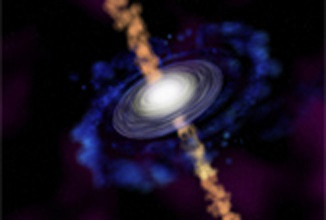
Artist's concept of protostar HH 211, believed to be accreting material from a surrounding disk. - Credit: Change Tsai (ASIAA)
For a dynamic view, see the video animation "Black Hole Blazar Jets" at
http://www.space.com/common/media/video/player.php?videoRef=080428_blazar-coil
I cannot help but thinking that what are called "jets" are in fact the black hole's incoming vortices. What appears as matter being expelled at near light velocity (those blobs of lighter color moving outward from the black hole) is really incoming matter lit up by powerful time-limited flashes of light escaping from the black hole's center. Matter is inward directed in the jet-cum-vortex and it encounters in its path flashes of light, giving the impression of matter exiting at near light velocity.
"Stars are thought to form at the center of rotating disks of hydrogen gas and dust", continues the article, describing the theory according to which gravitation is the principal star-forming mechanism. However, there is a problem: "The gas can't fall inward toward the star until it sheds excess spin power called angular momentum". As far as official theory goes, the vortices astronomers observed in HH 211, are thought to dissipate some of the energy of rotation which, it is argued, counter-acts accretion by giving rise to centrifugal forces.
That is the official theory, but this explanation of star formation has several problems.
One obvious question: where does the spin come from, that now needs to be dissipated and more importantly, what use does that spin have in star formation?Secondly, the "jets" observed to accompany the formation of both stars and galaxies and which are described in this instance as "reverse whirlpools" would seem be a very inefficient mechanism if not entirely counter-productive in the formation of a star. Instead of accreting material, they are said to be dissipating both matter and spin.
Thirdly, where there is no accumulation of matter, gravity cannot accumulate more matter. Also, when mathematically modeled, gravitation-induced accretion does not resolve into an accretion disk but works in a spherically symmetric way.
So what are we overlooking here?
In my view, this is one of the important areas where physics has gone down the wrong path in its insistence that gravity "obviously" must be the force that holds everything together, and that thus it is the sole force responsible for the accumulation of any kind of concentration of matter in the universe.
- - -
Vortex as an 'accretion' force
I am proposing a different, more or less diametrically opposed view of star and galaxy formation to the theory held today. Stars are formed by vortex action. It is the spin that initiates a vortex that is the seed for star formation, not gravity.
What is today called an "accretion disk" is actually a sign of dissipation. The work of accretion in star formation is done by the concentrating forces of a double vortex. That vortex accretes interstellar gases like a giant whirlpool and it is vortex action that is causing the accumulation of matter - not gravity as generally assumed.
Spin is the causative force in forming any agglomeration of matter. It is the seed for the formation of galaxies, stars and planets. Spin forms a double vortex, which is responsible for concentrating matter that is finely distributed in the universe. Spin is also a telltale signature of the energy of life.
Spin stresses and distorts the fabric of space forming a helixactually a pair of vortices. Those vortices, like two huge whirlpools, induce a flow of space and the matter contained in it, towards the center point of torsion, the star seed. At the point of impact of the two opposing in-flowing vortices, incoming matter collides and, in an explosive fireworks display that forms a plasma ball, is thrown outwards in roughly spherical symmetry.
At a certain distance out from this central point of impact - how far depends on the rotational strength of the star seed - the outward motion of the particles accreted by the vortices is now stopped by growing gravitational influence. The matter so collected starts to form a hollow shell of first gaseous and later solid matter. That shell is roughly spherical - with openings at the poles where the vortices are free to bring in further material.
What is generally called an "accretion disk" today is formed by matter that escapes along the shell's equator due to overwhelming centrifugal forces. In the case of a star, this becomes a protoplanetary disk, a flat equatorial disk of rotating matter that provides the material needed for the formation of planets. Planets coagulate around their own planetary seeds of spin, in a similar manner as the original star. A planetary vortex pair attracts matter from the protoplanetary disk to form a planetary shell. This hollow planetary structure coagulates around the point of equilibrium between centrifugal forces and gravity.
Instead of only gravitation, we have several forces at work in star and planet formation: the centripetal (concentrating and accelerating) action of vortex, the explosive, expanding action resulting from two opposing streams of matter violently impacting at the central point, gravitation which tends to stop and compact matter that tries to escape from the exploding center and finally centrifugal force which provides a counter to gravitation, and which is responsible for the formation of any "accretion disk" which is really a disk of matter that escaped gravity through overwhelming centrifugal force.
The firework at the point of impact of the two opposing vortices is a permanent feature, a source of light and other radiation located inside both planets and stars. In planets, it remains a hidden feature only occasionally giving rise to a halo of light we see as an aurora around the polar openings. In stars, that firework is what determines a star's luminosity.
The postulated fusion reaction of hydrogen into helium is not what drives heat and luminosity of stars. It may be a secondary reaction to the real source of the star's luminosity, which is the violent impact of two vortices at the center of the star.
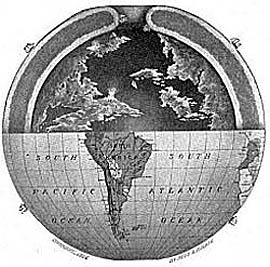
The concept of a "hollow earth" has been around for centuries. Today, it is debunked as a mere scientific curiosity, as in this article by John H. Lienhard, from which also comes the following illustration by William Reed published in 1906.
Is there any evidence for this and why haven't we seen it?
If this line of thought is to turn out correct, we should be finding evidence that planets and stars are hollow shells that possess polar openings and a luminous point at the center. There are some strong indications that this may indeed be so, but it seems that data is not freely released. Where some evidence does become available, it is explained away or simply not discussed - it does not fit the prevailing view.
We should see polar openings leading to the hollow interior of our own and other planets, only we don't - at least normally. Very few published images actually show the poles directly. Many of those present signs of having been manipulated. Try and find images that show the earth's north pole. You will see a blob of "white-out" or the electronic equivalent of it - a white spot that has been airbrushed into the picture.
Here is an example of an image of the north pole, where a large portion of the polar area is covered by ... ice you might say, but it really isn't ice as you can see by comparing the completely white area of the polar ice with the much more structured and darker color ice on adjacent Greenland.
I realize that there will be strong feelings both for and against, but I am bringing this forth as a matter for consideration, and in the firm expectation that time will prove that I am not out on a limb here.
Predictions
If my theory about the formation of stars and planets is correct, we should find evidence of polar "anomalies" on planets and moons, as our instruments get better and as more space probes scout our solar system.
Let me go on record here with some predictions:
We should find that
1) both planets and stars show variously sized openings at the poles
2) a central luminous feature will be visible when looking straight at the polar opening of a planet and reflections of this "internal light source" will cause luminous phenomena visible under certain conditions to observers who are not aligned with the planet's axis.
3) Planets are habitable (hospitable for life) not only on the outside but also on the inside of their "shell".
4) More heat is radiated by planets than is received from the outside.
5) As the planetary vortex continually collects and brings in more particles of matter, planetary shells will be found to be slowly expanding.

Dark Mission - The Secret History of NASA (Richard C. Hoagland and Mike Bara)
A confirmation (of sorts) for my model of primary influence of vortex action in star and planet formation comes from Richard Hoagland and Mike Bara, who in "Dark Mission" argue that the heat evolved by stellar and planetary objects is in direct proportion to their angular momentum.
"If the ultimate source of planetary (or stellar) energy is this vorticular (rotating) spatial stress between dimensions (a la Maxwell), then the constantly changing pattern (both gravitationally and dimensionally) of interacting satellites in orbit around a major planet/star coupled with its equally changing geometric configuration vis-à-vis the other major planets of the system must modulate that stress pattern as a constantly changing, geometrically twisted "aether". In Hoagland's hyperdimensional model, it is this constantly changing hyperspatial geometry that is capable of extracting energy from this underlying, rotating vorticular aether and then releasing it inside material. rotating objects."
Here is a collection of images from satellites and spaceships that tend to confirm the presence of openings and unexplained luminous phenomena at the poles of several planets and moons.
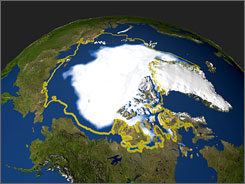
An image of the earth's north pole where a large area appears "airbrushed" in pristine white - to cover up ... what?
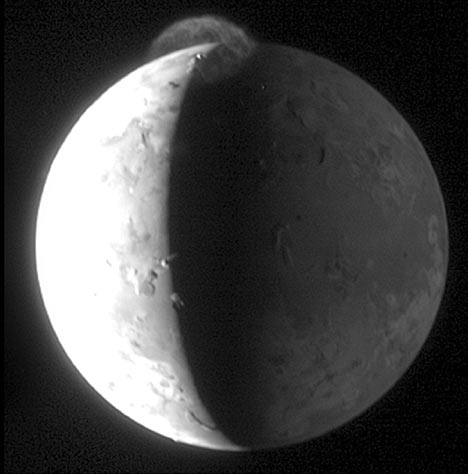
Unexplained halo on one of Jupiter's moons
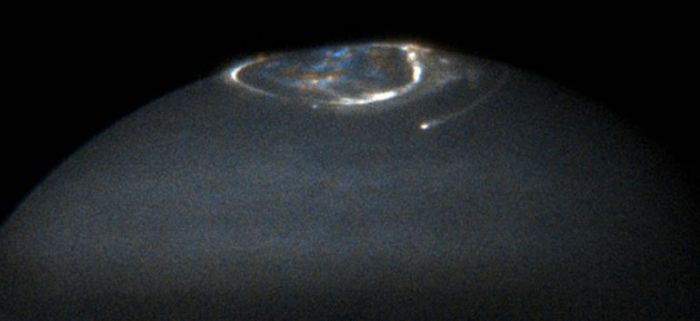
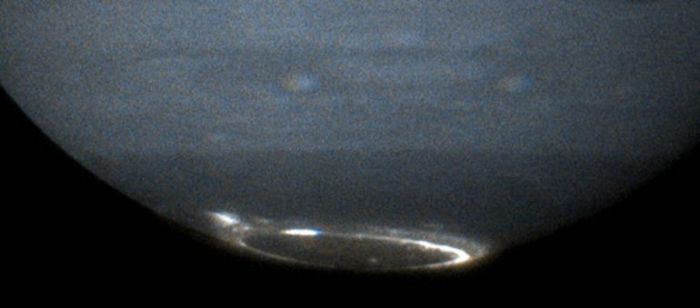
Jupiter's poles displaying a strange luminous phenomenon
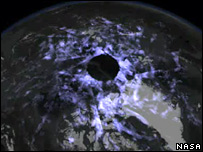
Cloud formations on earth's north pole analyzed by NASA, leaving an unexplained dark hole...
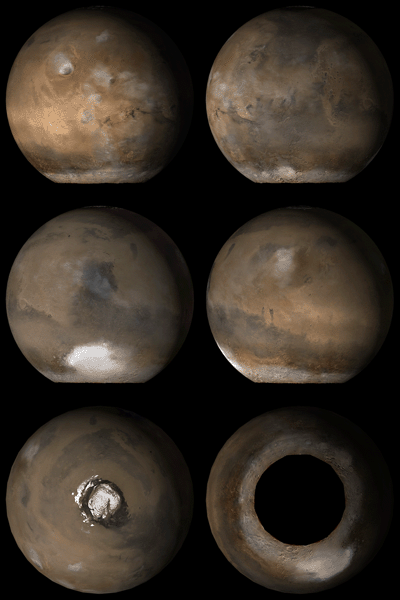
Mars pictured with South pole either cut off (first four images) or covered by a large circular black patch in the last image
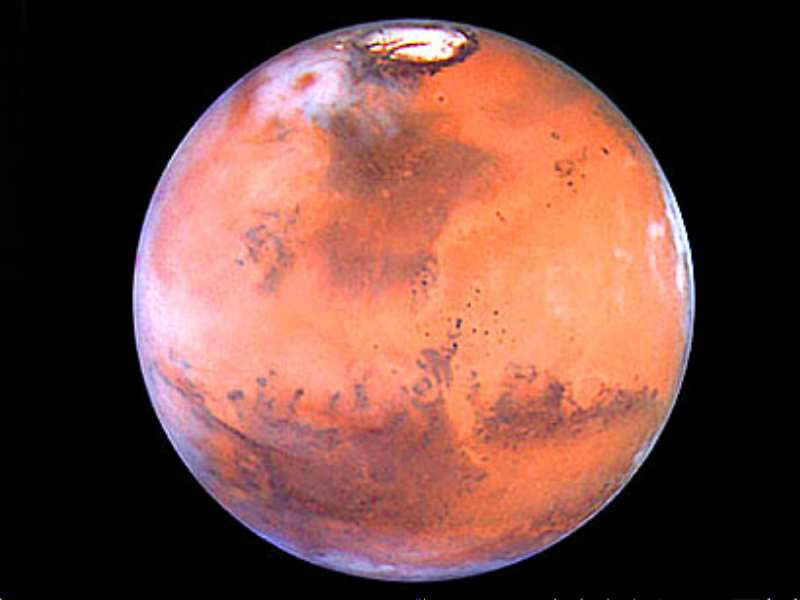
Another image of Mars showing a polar feature that is said to be ice, but may well be a polar opening...
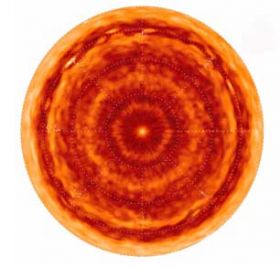
Despite more than a decade of winter darkness, Saturn's north pole is home to an unexpected hot spot remarkably similar to one at the planet's sunny south pole. The source of its heat is a mystery. Source: Phys.org
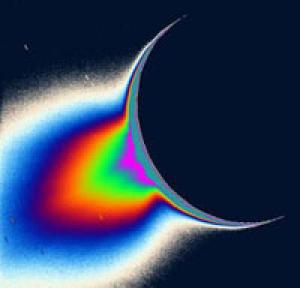
Instruments on the Cassini spacecraft revealed a gigantic plume of gas, water vapor and ice particles erupting from Enceladus' south pole. Here an enhanded colorized image from NASA, published on Science Daily.
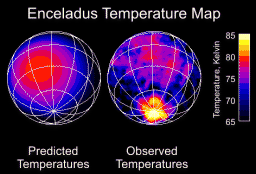
What CIRS (the Composite Infrared Spectrometer) saw at Enceladus was a stunner. The team expected to see a relatively homogeneous temperature map, warmest where the Sun's rays strike the moon most directly, and coolest in the night side and at the poles. But CIRS found a whopping hot spot at the south pole of Enceladus. (from planetary.org)
These are only a few images I came across without trying very hard. There certainly will be more evidence out there for the hollow configuration of stars and planets and the postulated heat and light source that should be at the center of each. If you have come across similar unexplained anomalies, please send any links or images you may find.
March 2008: A reader wrote about this article and in some way I felt I should explain more. Here is the exchange, which perhaps crystallizes more clearly what my thoughts are.
Tim writes
Re: Planet Vortex question
First of all I would just like to say how refreshing it is to find a site like yours that deals openly with subjects and ideas which are normally dismissed by others as being nothing more than "Hocus Pocus". After reading your article entitled "Star Formation: Vortex Builds Stars, Planets" I started thinking about our planet and the idea mentioned in the article concerning the Earth generating a Vortex. If possible I would be very grateful if you could perhaps shed some light on a query I have?
Let's just say for a minute that a Vortex is indeed being created by our Earth... It is my understanding that when a Vortex is created Centripetal and Centrifugal forces are created. If we consider the Centripetal or suctional forces to be gravity, then could you help me identify where the Centrifugal or pushing force may be? I guess what I am trying to ask is is there any point inside or outside of our atmosphere where we are exposed to a pushing force? If I am way off base here then please say, or indeed if my incredibly basic understanding of a Vortex is nonsense.
Once again I just wanted to say what a breath of fresh air it is to have discovered somebody like yourself that acknowledges some of the greatest (yet unknown) inventors/engineers of our time including Tesla and Viktor Schauberger.
In my answer, I try to make the picture of planet (and star) formation more clear...
Dear Tim,
here is how I imagine the formation of a planet or a star.
While it is true that rotation creates centrifugal forces, a vortex creates a strong centripetal force, which overcomes the centrifugal outward directed vector created by rotation. A vortex tends to concentrate whatever is in its reach, and the faster the rotation gets, the stronger the centripetal force and the narrower the spiral path that everything must follow.
In a planetary and stellar context, I see two vortices that enter at the poles, one from the north, the other from the south. Looking at these vortices from "outside" - like you would look into a funnel from the broad end - one of them is seen as left turning, the other as right turning.
Where the two vortices meet, figuratively speaking, "all heall breaks loose". There is a clash of huge forces, and the cosmic particles which the vortex pair brings together (mainly hydrogen) are undergoing very high acceleration/deceleration forces, some of them transforming through fusion events, and they eventually "explode" out resulting in a roughly spheric and rotating "cloud" of planetary or stellar matter. This is matter is largely gaseous in the beginning.
Now centrifugal force starts to play a role. The vortex force and centripetal action nullifies itself at the central point in a great display of "fireworks", but it leaves a rotational component of force intact. The resulting cloud of gaseous matter is spinning. There are centrifugal forces driving particles of matter outwards.
Gravity, which is different from the vortex itself, now starts to play a role. The cloud of matter generated by the twin vortex is a seed for gravitational action, i.e. the accumulated particles of matter start to generate gravitation and they start to attract other particles of matter in the vicinity.
The four forces - two of them inward directed and two outward directed - that now work together, start to form what eventually will become a planet or a star. The vortex pair continues to "bring in" ever more cosmic particles, accelerating them to the central point. The explosive force of the clash is outward directed and seeks to distribute those particles. The centrifugal force that results from the rotation of the cloud thus formed is also outward directed. The gravitational force that is a consequence of the presence of matter (the cloud) is inward directed.
What is formed is a relatively slowly rotating, roughly spherical "shell" of matter with two openings at the poles. This new planetary or stellar body will, with time, become more and more solidified, provided with new particles both from the inside by the vortex and from the outside by gravitational accumulation.
The central point of impact of the double vortex provides a source of radiation (light of all frequencies and heat) which, in the case of planets is not visible for anyone located outside the shell. The accumulated matter shields that source and keeps the light and heat inside.
In the case of larger bodies, the impact of the double vortex is so violent that the radiation cannot be shielded by accumulated matter. The light and heat radiates out into the universe. Se say we see a "star" or a "sun".
By the way, there is no need to postulate a nuclear furnace fusing hydrogen as the source of heat and radiation in stars, although some hydrogen fusion is certainly taking place at the place of impact of the stellar double vortex, accounting for the spectral signature of hydrogen in starlight.
Strange as it might seem, some say that planets are habitable not only on the outside of their solid shell, but also on the inside. This is a somewhat foreign concept for us, as we were raised with the idea that planets are solid and have a molten iron core. But indeed, the shell formed by the four forces I described could very well provide a gravitational force that acts from both sides, that is, things are attracted to the shell both from the inside and from the outside. Consequently, bodies of water exist both on the inside of the shell and on the outside, atmosphere exists both inside and out. And finally, there is a source of light and heat both on the inside of a planet and on the outside.
Strange world...
April 2008: Powerful Black Hole Jet Explained
A recent article on Space.com which references a video of what are called powerful jets, but which seem more like a giant vortex entering the black hole at the poles. The sequence shows huge blobs or clouds of luminosity moving outwards. These are apparently what gives the name "jets" to the phenomenon. But given the astronomical distances and the near light speed with which these phenomena propagate indicates that these outward-moving clouds are not particles but pulses of light moving outwards along the vortex that brings in matter. The pulses of light illuminate sequentially ever more distant parts of the particles contained in the vortex. The fast movement of luminosity outward is misinterpreted as matter moving outward at close to light speed.
Here is a series of snapshots from that video:
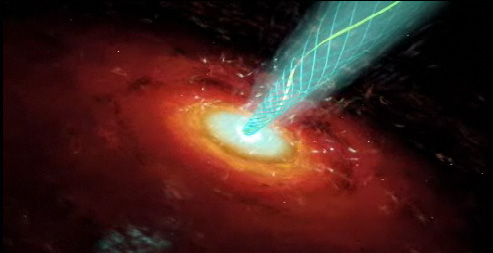
The "vortex" nature of the jet is clearly visible here
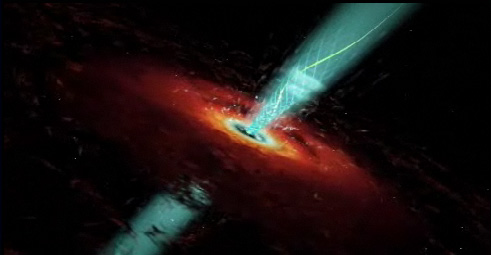
A double "pulse" of light moving outward along the path of the vortex
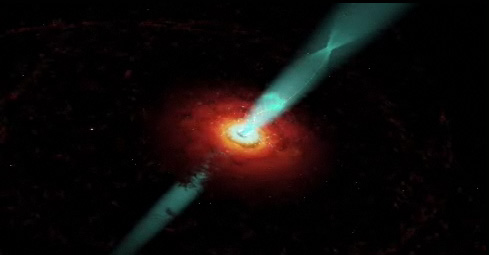
Another "pulse" moving outward. The vortex is showing a "node" as in a standing wave
- - -
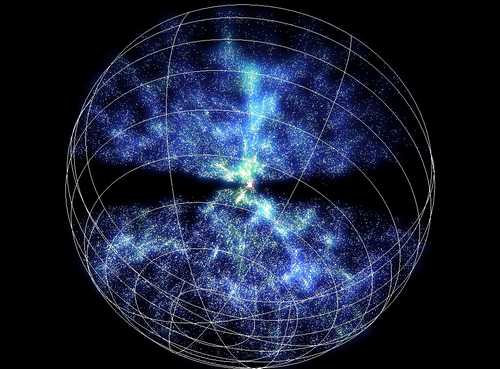
This is an image mapping 125,000 galaxies (from the recent 6DF Galaxy Survey). The distribution of galaxies in the universe mapped by this survey suggests a question:
Is the Universe itself a giant vortex?
- - -
September 2010:
Recent pictures of a polar vortex on Venus.
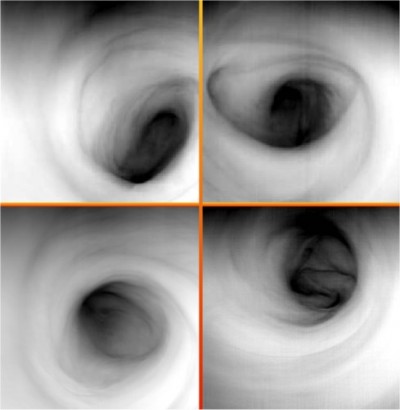
more on this in an article in Wired: Venus' Polar Vortex Is Surprisingly Wild
See also:
Space Vortex Theory: Einstein and Tewari's 'Cartesian Universe'
Physicists Mull Whether Inorganic Dust Formations Could Be Alive
Intriguing new evidence of life-like double-helix structures formed from inorganic substances in space has been reported in the New Journal of Physics. The physicists behind the discovery are now pondering whether extraterrestrial life could be composed of corkscrew shaped formations of interstellar dust.
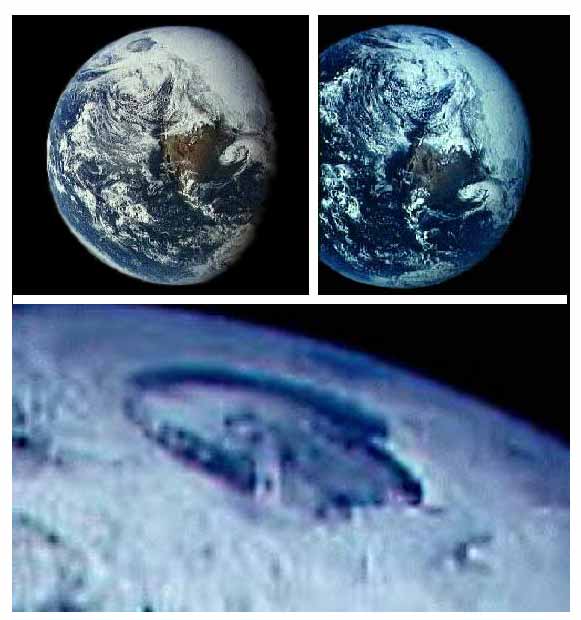
Apollo 8 and Apollo 16 Photos of Earth, validates Hollow Earth Theories
These Images Now Show a Circular Opening at the North Pole! ... Apollo 8 photos have been out since 1967 but up until now we haven't had any colored photos for the public to view.
Two unusual older stars giving birth to second wave of planets
These two stars have many characteristics of very young stars, Melis said, including rapid accretion of gas, extended orbiting disks of dust and gas, a large infrared excess emission and, in the case of BP Piscium, jets of gas that are being shot into space. Planetesimals, like comets and asteroids, along with planets, form from the gas and dust particles that orbit young stars; planetesimals are small masses of rock or ice that merge to form larger bodies.
Mercury polar anomaly
(from an article about a new NASA mission to explore our smallest planet)
On the closest planet to the sun, where temperatures can reach more than 800 degrees Fahrenheit (425 degrees Celsius), there might surprisingly be ice. Ice is highly reflective to radar, and Earth-based radar suggests deposits of frozen water might be hidden in deep, dark craters at Mercury's poles that have never seen sunlight. This water might have come gassing up from within the planet or from meteorite impacts. MESSENGER will search for hydrogen at the permanently shadowed floors of polar craters.
A Scaling Law for Organized Matter in The Universe (PDF)
Nassim Haramein et al show that a scaling law can be written for all organized matter utilizing the Schwarzschild condition of a black hole, describing structures from cosmological to sub-atomic scale. Black holes are postulated to exist at the center of all such structures, surrounded by a concentric "white hole" accumulation of matter. Spin and vorticity, not gravitation, are the principal drivers of organization. More research papers at http://www.theresonanceproject.org/
Black holes 'preceded galaxies'
Most if not all galaxies, including our own Milky Way, are believed to have massive black holes at their cores. It was unclear whether black holes came first, helping create galaxies by pulling matter towards them, or whether they arose in already formed galaxies. "It looks like the black holes came first," said Dr Chris Carilli, from the US National Radio Astronomy Observatory in Socorro, New Mexico, who took part in the study. "The evidence is piling up."
Initialphysics.org
"The galaxy is analogous to a hurricane in composition, shares the same principle of their movement as a vortex with velocity accelerates from its edge to its center."
Black Hole Creates Spectacular Light Show
Many supermassive black holes have jets of material that spray out perpendicularly from the donut-shaped ring of matter falling onto the black hole. These beams of hot gas are thought to result from magnetic field lines that are twisted by the black hole's mass, and propel charged particles outward.
But most rays do not appear to blaze up with such extreme intensity as HST-1. Scientists aren't sure if it is an exceptional case, or if it represents a normal event for black hole jets, which are still not very well understood.
I am linking this article just to show that officially, we're in the dark about what drives black hole "jets".
Giant space tornadoes create Earth's auroras
One vortex in the pair sends particles spiralling along Earth's magnetic field lines until they hit molecules of the ionosphere 400 km above the surface. The energy released by the collisions creates the auroral glow, like the gas in a neon light.
Charged particles return up through the other vortex, completing the electrical circuit. The vortices channel around 100,000 amps of electrical current to and from Earth's ionosphere every three hours or so.
Black Jets
An electromagnetic phenomenon on the fringes of galaxy NGC 7793 is confounding astronomers because they insist on seeing it as a gravitational superforce.
Explaining the jets of ionized particles often seen erupting from various objects in space ranks as one of the most difficult tasks facing modern astronomers. What force can create highly energetic particle emissions that span distances measured in light-years? What confines them into narrow beams?
Video: The Mystery Hexagon on SATURN
As mentioned in a comment, there is an unexplained but rather permanent hexagonal feature on Saturn's north pole. Here is a short video about it.
November 2010: Galaxy is found to have high energy 'bubbles' corresponding with rotational axis
New York Times: Bubbles of Energy Are Found in Galaxy
Something big is going on at the center of the galaxy, and astronomers are happy to say they don't know what it is.
A group of scientists working with data from NASA's Fermi Gamma-Ray Space Telescope said Tuesday that they had discovered two bubbles of energy erupting from the center of the Milky Way galaxy. The bubbles, they said at a news conference and in a paper to be published Wednesday in The Astrophysical Journal, extend 25,000 light years up and down from each side of the galaxy and contain the energy equivalent to 100,000 supernova explosions.
"And we think we know a lot about our own galaxy," Dr. Spergel added, noting that the bubbles were almost as big as the galaxy and yet unsuspected until now.
Jon Morse, head of astrophysics at NASA headquarters, said, "This shows again that the universe is full of surprises."
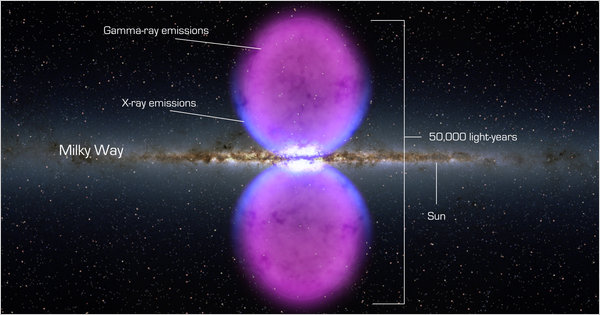
Here is the illustration that accompanies the NYT article.
My view is - you may have guessed - that we are getting a glimpse of the galactic vortex sustaining and continuously building our Milky Way.
Gravity differs strongly over earth's surface
ESA's Goce satellite has measured gravity over the earth's surface, and has constructed a map, linked in a short video clip in this BBC article.
The explanation given is that the Earth is formed like an irregular potato, rather than a sphere, but this does not really make any sense.
Viewing the earth's solid part like a shell, it would make sense that local variations in the thickness of the shell would determine similar variations in the gravity we experience at the surface.
Here are some screen grabs from the video. Gravity is strongest in yellow areas; it is weakest in blue ones.
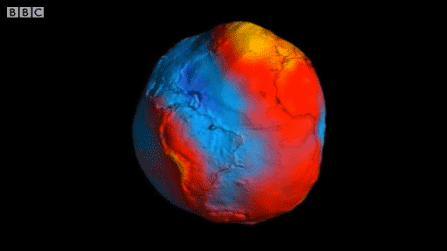
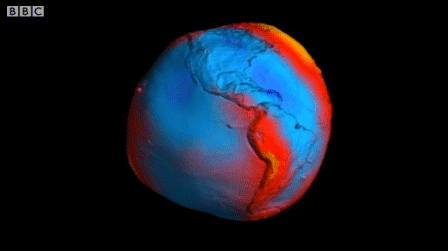
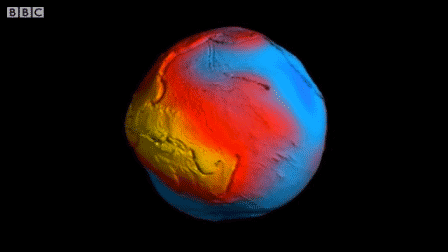
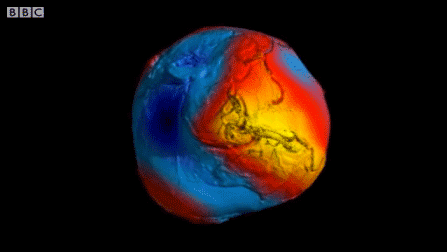
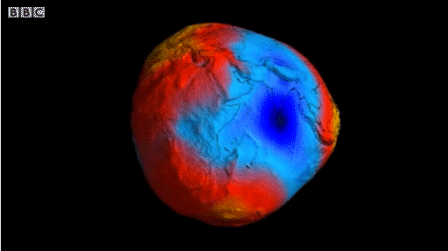
There is also a flat map view of the Goce gravity data, which was part of this article:
Goce satellite views Earth's gravity in high definition
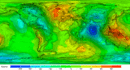
(Click on image to enlarge)
The shape-shifting southern vortex of Venus
New analysis of images taken by ESA's Venus Express orbiter has revealed surprising details about the remarkable, shape-shifting collar of clouds that swirls around the planet's South Pole.
Several planets in the Solar System, including Earth, have been found to possess hurricane-like polar vortices, where clouds and winds rotate rapidly around the poles. Some of these take on strange shapes, such as the hexagonal structure on Saturn, but none of them are as variable or unstable as the southern polar vortex on Venus.
Scientists have known about the presence of swirling clouds around the poles of Venus since they were first imaged by Mariner 10 in 1974. At the same time, it was discovered that Venus' upper winds sweep westwards around the planet in only four days, 60 times faster than the rotation of the solid surface of the planet - a phenomenon known as superrotation.
Thermal infrared imagery from the Pioneer Venus spacecraft subsequently revealed an enormous depression in the cloud blanket at the North Pole. This relatively warm polar 'hole' was thought to be caused by downward movement of gases, rather like water flowing down a drain. However, detailed examination of the thick clouds and dense atmosphere over the South Pole had to wait until the arrival of Venus Express in April 2006.
During its first orbit around the planet, multi-wavelength observations confirmed for the first time the presence of a huge 'double-eye' atmospheric vortex at the planet's South Pole. Some 2000 km across, it was comparable to the structure that had previously been detected at the North Pole.
Experiment Confirms Space-Time Vortex Around Earth
Gravity Probe B has returned from its seven year adventure in orbit, and it has brought some rather mind-blowing news: A space-time vortex exists around the Earth, just like Einstein theorized.
Video: Fibonacci's Fractals
(of fractals and spirals...)
The X-Ray Puzzle of Protostellar Jets
A new star develops by accreting material from a circumstellar disk; both in turn are embedded in a much larger, more nearly spherical envelope of in-falling dust and gas.
X-ray observations suggest that strong magnetic fields in the innermost region around the young star power intense shocks.
The young protostar rotates, and one consequence of its spin is that the star ejects bipolar jets of ionized and molecular gas. These outflows can be readily seen, and are important markers of stellar youth. However the mechanism(s) that drive these protostellar outflows - including the acceleration and the collimation processes - are poorly understood.
Could it be that our scientists are trying to fit the observed facts to a wrong model - gravitational accretion - when most of the evidence points to rotation and vortex action being the driving force of star formation?

Sure, gravity is a main power into formation of stars and universe itself.
Gravity is a force of space but generated by stellar objects.
We publish on Sepp home page about a-temporal gravity......
yours amrit
Hello Sepp!
Perhaps your readers here will be interested in the true structure of our observable universe (1). Refined observations, such as the one here, go only to increasingly buttress the model.
For the overall and ultimate concept propounded here on the nature of things, they may find the short (2½-page) preprint in (2) to be a worthwhile port of entry now. The response from Physics World to this submission has since been negative, leaving the monetary offer therein for its refutation still open! Would anyone take up the challenge?
The person has only to get a university physics department head to be the moderator and judge here (holding the minimum cash of US$25,000 in hand!). Moderator's fee, too, will be paid by me in advance. No joke; no scam; just an earnest appeal to all to resolve this matter for me early – not to my satisfaction but to that of the physics head alone. (The money offered is the least I could do in gratitude. It would be worth every penny for me considering the time I would otherwise be wasting in trying to flog a fundamentally flawed worldview.)
Thanks and all the very best for the New Year.
Eugene
(1) www.sittampalam.net/StarFormation.htm
(2) www.sittampalam.net/LateralThoughts.pdf
As per Space Vortex Theory by me, there is a through and through hole of 2.95 km diameter along the axis of the sun ---through which jets of matter must shoot out at speeds close to light speed. This is because at the Sun's center space vortex-cirulation of space reaches speed of light.Similarly, at the center of our galaxy, a spherical volume about 203000 times the Sun's radius, space vortex circulation reaches speed of light, thus creating matter and ejecting the same out as hydrogen jets at light speed. Matter is create from (mass less) space -circulation. Jeanna Bryner seems to be right in conclusions.
Paramahamsa
Sepp adds: See also an earlier article on Tewari's Space Vortex Theory
A comment (by email) from Paramahamsa Tewari:
Jeanna Bryner reports will be a historical fact for all the time to come . I had been looking for the polar view of the Sun and the planets for almost a decade by now. The attachment, taking the example of the Sun, reveals that space vortices enclosing the cosmic bodies with axial rotation in general, create gravitation (inward force) that compresses matter of stars and galaxies on their spinning space surfaces.
Best wishes,
paramahamsa
What possible interest could be served by keeping the hollowness of the earth a secret? How long do you think it would be before someone let the cat out of the bag? (For example, the graphic artist who was asked to airbrush out the Hole at the Pole.) It's all another unspecified conspiracy by a shady cabal bent on evil, I suppose? It usually is.
How thick are you claiming the Earth's crust is then?
Mass of the earth, when calculated taking note of the interaction between the space vortices enclosing the sun and the earth (leading to electrical repulsive forces between the sun and the planets), comes to 2.66 time less than the presently accepte value. The density of the earth comes to 1.85 gram per cm cube.[This is close to the average density of the earth's crust]. This precludes any possibility of an iron core at the earth's center because the magnetic effets are explained by the ionospheric current driven by the space vortex around the earth.Calculations show that vortex circulation at the earth's center reaches speed of light-- showing the possibility of continuation of matter creation there. But how large is the hollowness at the center seems to be difficult to predict even under these new principles of space vortex theory.
To Colin:
let's not talk about conspiracy. There may be good reasons, as far as those keeping this secret are concerned, for doing so. We simply don't know.
I'm really just pointing to an alternative way of seeing the genesis and configuration of planets and stars. The details are not fully accessible to us yet, but there are lots of indications here and there...
Sepp,
I am not suggesting a conspiracy. It is the only inference to be drawn from what the author states in the article when he talks about airbrushing the evidence out. If such statements are made, they have to be substantiated with some theory (e.g.Military, security or commercial interests being served by the concealment). No such evidence is brought forth. Furthermore, the existence of polar holes has not been reported by mainstream researchers despite numerous expeditions/ overflights to the poles by many nations, some of whom are ideologically opposed to each other and thus unlikely to participate in any conspiracy to conceal such holes.
Finally, my understanding of the Earth's density is that it is close to 5.25 grams per c.c. The genesis of stars and planets may well be different from the accepted model, but the fanciful and incomprehensible theories being advanced here have yet to undergo a stringent examination and remain in the realm of speculation for the time being.
I came across a strange item of news today:
Boomerang returns, even in space
In an unprecedented experiment, a Japanese astronaut has thrown a boomerang in space and confirmed it flies back, much like on Earth.
Astronaut Takao Doi "threw a boomerang and saw it come back" during his free time on March 18 at the International Space Station (ISS), a spokeswoman at the Japan Aerospace Exploration Agency said.
Mr Doi threw the boomerang after a request from compatriot Yasuhiro Togai, a world boomerang champion.
"I was very surprised and moved to see that it flew the same way it does on Earth," the Mainichi Shimbun daily quoted the 53-year-old astronaut as telling his wife in a chat from space.
The space agency said a videotape of the experiment would likely be released later.
Doi travelled on US shuttle Endeavour on the March 11 blast-off and successfully delivered the first piece of a Japanese laboratory to the ISS.
- - -
Could vorticity be a cause of this certainly strange effect?
This is a comment from a new energy list I am copying here as very relevant to the subject:
The statement is I suppose referenced to the Sun. The basic assumption for the past about 80 years has been that the sun was doing thermonuclear fusion. Unfortunately there is absolutely no data to back this up. Here goes for the proofs.
(1) If the sun is a thermonuclear fusion furnace as postulated it will produce the neutrino output associated with the reactions. (The have not been found. I know the excuses but fudging doesn't fix a theory!)
(2) If the sun core is the source of solar heat, it will be hotter near the core and cooler as one extends outward. (In fact the sun gets hotter going out towards and past the photosphere. The temperature of the surface that is seen is about 5,000 C to 10,000 C. The corona temperature reaches 2,000,000 C. The heat is going the wrong way folks! )
(3) If the sun core is the source of solar heat, the "solar wind" will be fastest as it leaves the sun and slow down as the ionized material exits the sun and goes far into space. This is defined by the laws of motion and by the laws vapor pressures, ionization etc. (In fact the solar wind accelerates going outward to a great extent. The solar wind varies but has been observed to leave at about 10,000 km/hr and to pass earth going about 83,000 km/sec. The same event saw the material pass Saturn going nearly 150,000 km/sec. And yes I do know that the speed of light is 300,000 km/sec.) -- That ain't possible by the fusion theory of the sun!
So we have 3 big undeniable violations of the process. But it gets deeper. The concept of the construction of a star by nebular condensation which follows the rules in (3) says that as soon as a star went critical on its fusion reactions, the result would blow the star to bits. We would never see anything but a trivial emission from a star because it would stop collecting matter if it cranked up.
Now the spectrograph has actually told us quite well what the sun was for 250 years. It is in fact a body largely of Iron and Nickel with a thin Xenon atmosphere with hydrogen and helium in it. Thin here is relative to size.
The issues then come up. How do we power the sun and what evidence do we have of this power and then what are the results of it.
If you divert to the FARADAY basic design for a generator you find that you have the basic prototype for any body in space that is spinning. It generates current centered on a mid latitude band near the equator and at both poles. These currents will enter the disc as vortex structures of plasma. This is exactly what we have seen with the Stereo B mission to the Sun. It is exactly what we see with the aurora on earth and it has been observed on the sun as the concentration of the opposite charge appears on the polar zone also somewhat separate of the pole. This is typical plasma physics. The only problem with the Faraday design is that it provides a massive torque load on the spinning body. However; De Palma solved this in the 1950's. If the magnetic field bias is allowed to float with the spinning disk, you get all the current and none of the torque loading. So now you can get the energy of a spinning earth, sun or whatever without a torque stopping the spin. This is the observed Storms and Aurora on the earth and is the observed sun spots and polar aurora on the sun. It has been observed on Saturn, Jupiter and Uranus.
This predicts the flow patterns observed and temperatures observed. The surface of the sun would be much cooler as it would actually have little current passing it. The exterior would be hotter and the solar wind would sustain increasing velocity so long as it is connected to the disc. Similarly the earth would have such high altitude heating and ionization. It does!
The sun and all bodies in the universe operate the same way and this is standard electrical physics and plasma physics industrial rules. This explains a lot and doesn't need the funky physics and dark matter etc that says we cannot see what is going on.
Now there is only one problem with this prediction set. According to the Gravity theories of the Universe, the high mass of the sun predicted by the intensity of the discharges on it and the mass predicted by the spectrograph demands a mass of the sun be about 100,000 times that observed. This would seem to be a theory killer until you run into the work which has been experimentally demonstrated and is published on CERN. This is the work of Fran De Aquino of Brazil. It turns out that these massive plasma flows in space gravity shield the mass of the sun from us. As a result the sun can and probably does have 100,000 times the observed mass by Gravity effects.
Thought you might like to know. There is absolutely no evidence to support the nuclear theory of stars. I know that this blows up nearly all the pet theories of cosmology and such. But it opens the door to understanding the structure and operations of the universe. This is what Tesla called the Wheel Work of Nature.
One of the curious facts of Gravity shielding is that the inertial mass of an object is proportional to the G. That is if you shield to 1/100th G you have 1/100th inertial mass. The oddity here is well described on Fran De Aquino's website. If you read it, it tells how to build an interstellar space ship motor and power it. This is pretty simple stuff so don't get lost in his heavy math.
The rendering bares a striking resemblance to that of a "black hole" surrounded by a collapsing gas cloud. I agree with you observation on gravity as the binding force of the universe as observed in the physics of black holes which have to jet.
The Russian astrophysicist N. A. Kozyrev who observed an active volcano on Earth's moon ("The Secret of the Aristarchus Crater") and offered an explanation for the aurora borealis of Venus, published a paper in the Bulletin of the Crimean Astrophysical Observatory (ca. May 1949, as I recall; print references here are as recalled) on a Theory of Stellar Energy and the Internal Structure of Stars [in Russian] which was abstracted in the Harvard Observatory Bulletin. In that paper (one of two cited later by A.P. Levich at http://www.chronos.msu.ru/ ),
as abstracted and as far as I can make out from the original, he proposes that the main source of solar energy is the the passage of time. See also the experimental findings, discussion and bibliography in Kozyrev, N. A. :Possibility of Experimental Study of the Properties of Time, in: Zeman, Jiri: Time in Science and Philosophy An International Review of Some Current Problems. Academia, publisher of the Czech Academy of Sciences. Prague, 1970; and 1975, 1982 Kozyrev papers cited by Levich (op. cit.).
Rudolf Steiner referred to the etheric or life organisation body (a distinct structural field surrounding and interpenetrating the physical body; cf. Chinese: j'ing and ch'i; European: facultas formatrix and elan vitale, and, e.g., the Kirlian electrophotograph of the "lost leaf" effect showing the complete "energy" field image of a leaf a part of which had been cut away, on the cover of the Jan/Feb 1974 issue of The Sciences Journal of the New York Academy of Sciences) the "time" body.
In your view can these stellar double vortices and related astronomical phenomena also be interpreted as, equivalently, on the one hand, etheric (W. Reich: "orgone") or on the other hand, time-energy, manifestations of universal energy flows (compare for example A. P. Levich)?
Kozyrev does talk about a state of "non equilibrium" in the context of physical universe.
In my view, the double vortices are etheric in origin, in that a vanishingly small influence on a non equilibrium aether can start the dance of stars and planets which in physical terms would first manifest as a vortex and later as an actual celestial body formed at the "seed point".
One could also follow Kozyrev's reasoning that it is time-energy, because time, in a physical context, is motion of matter in space. So anything that would start a rotary motion would also be starting "time", which in turn quantifies the resulting "energy".
regarding
Star Formation: Vortex Builds Stars, Planets
this vortex transforms energy of the space that is gravitational energy into energy of matter
The treatise is based on one fundamental assumption. Namely, if aether exists its differential elements must recede from each other in accord with Hubble’s law of the recessional motions of the galaxies of the universe. Light propagation in a Hubble expanding aether has never been analyzed because the problems involved seam insuperable. An exact solution [1] of Euler’s nonlinear equations for the monatomic adiabatic ideal fluid bypasses all insuperable problems. The solution is an intrinsic part of the Hubble expansion. It determines in general the nonlinear interactions between the Hubble expansion of this fluid and any fluid motions superimposed on it. The nonlinear interactions are identical for all superimposed motions. Moreover, they are stated precisely without any knowledge of the mathematical description of the superimposed motions. One finds that Hubble’s law, as it now exists, is only a small part of an extended Hubble law, called the pervasive Hubble law, which resolves outstanding questions and paradoxes that have puzzled and irritated scientists for many years.
The extended Hubble law does not change solutions of any law of physics at the present time, t = 0. Moreover, over historic times it changes solutions of order one parts in 10.5 billion parts per year. The changes are unobservable when calculations and observations extend over time spans of a few decades or less. They begin to reveal themselves when such time spans exceed several centuries or more. They increase without limits when t approaches minus the present Hubble age of the universe. One retains Einstein’s law, E = mc2, except that the light velocity, c diminishes with time by about three cm/sec per year. There are no relativity principle, twin paradox, curved and four dimensional spaces. A PDF format of the treatise is available on the web site, www.drleifrongved.com.
[1] Rongved, L. "Fluid Dynamics of an Expanding Ideal Fluid", Quarterly of Applied Mathematics, Vol. XLVII, Num. 4, p 735-745. 1980.
Johan Masreliez (jmasreliez@estfound.org) says in relation to vortex action:
Let me offer a possible explanation to vortex action. Recently I published a paper in Physica Scripta (an official organ for the Nordic countries Academies of Sciences), proposing that Inertia is a curved spacetime phenomenon. Inertia might be caused by contraction of the metrics of both space and time during acceleration. This contraction occurs via a scale-factor that multiplies all four metrics of the Minkowskian line-element. This inertial scale-factor is 1-(v/c)2, which we recognize from Special Relativity (SR).
With this dynamic scale-factor, which is a function of velocity, all accelerating motion becomes motion on geodesics of GR. This means that the inertial force is of the same kind as the gravitational force; they are both caused by spacetime curvature.
This also means that there is connection to SR, but since all inertial frames by SR have the same Minkowskian line-elements, SR cannot explain inertia. SR is based on the Lorentz transformation, but there is another transformation that actually preceded the Lorentz transformation (LT), which was published in 1887 by Woldemar Voigt.
Here comes the interesting part! Voigt’s transformation works as well as the LT but unlike the LT it is consistent with the dynamic scale that explains Inertia!
Lorentz did not know about Voigt’s transformation (VT) and admitted that he would have used this instead of his own had he known about it. Check this letter!
H. A. Lorentz to W. Voigt Leiden, July 30, 1908
Dear friend,
I would like to thank you very much for sending me your paper on Doppler’s principle
together with your enclosed remarks. I really regret that your paper has escaped my notice.
I can only explain it by the fact that many lectures kept me back from reading everything, while I was already glad to be able to work a little bit.
Of course I will not miss the first opportunity to mention that the concerned transformation and the introduction of a local time has been your idea.
Sincerely,
Your H. A. Lorentz
The VT differs from the LT by a constant scale-factor γ, which in the LT has the effect of restoring the Minkowskian line-element, thereby hiding the scale adjustment that models Inertia. The two transformations are physically equivalent and work equally well in Maxwell’s equations as well as in physics in general, since they are scale-equivalent. It is ironic to note that if Lorentz had adopted the VT, Einstein might perhaps have chosen the VT instead of the LT in his SR-paper, and the origin of Inertia might have been found a long time ago.
Based on this we may conclude that the LT actually represents the VT combined with a scale adjustment that changes the pace of time, with the implication that two coordinate frames related by the LT have different metrics! This would resolve a few problems with SR, for example the Twin Paradox; the twins see different time intervals simply because they use different temporal metrics.
Inertial field energy generated by acceleration
Now to vortex action. Since the metrics contract during acceleration there is a corresponding energy-momentum tensor of general relativity (GR), by which under certain conditions the energy density of spacetime becomes negative! This inertial field energy density is proportional to the mathematical divergence of acceleration, which can become negative during inwardly directed acceleration. This explains vortex action as being associated with the generation of negative energy, which has to be balanced by positive energy somewhere else. The vortex becomes an engine!
Inward acceleration might also explain the operation of several over-unity machines. This is new insight is valuable since it provides a theoretical justification for over-unity operation. I will send you a supporting paper if you promise to publish it prominently on the Internet and communicate it to people in the free energy field. It cannot be published in peer reviewed journals because they have not yet caught on to this new development.
Thought this may be of interest here.
Spin ScienceListen to or download the mp3 or Ogg files. (what's ogg?)
Two examples of vortices found in nature, courtesy Concordia University Back in the 19th century, many of the world's leading physicists became extremely interested in vortices. Everyone's seen a vortex. It's the centre of a hurricane, or the whirlpool that forms in the centre of your coffee cup when you stir. But to the physicists of the 19th century, the vortex held the key to the mysteries of the atom. Complex equations were developed to describe the vortex and what happens when the speed of rotation was increased. However, for all the equations, no one actually looked at a vortex to see if the theory matched reality. That is, until Dr. Georgios Vatistas came along. He's a professor of mechanical engineering at Concordia University, and in his lab, he's been able to prove that the equations of the 19th century perfectly describe what happens in a vortex. This knowledge will help explain everything from the structure of the universe to how to quiet the rotors of a helicopter.
Related Links
Concordia news releaseProfile of Dr. VatistasPhysical Review Letters
This is indeed interesting, Chris.
The observation by Vatistas of stable geometrical patterns at the bottom of a vortex gives new meaning to the persistent hexagonal cloud formation on Saturn's north pole found first by Voyager in the 1980's and then confirmed by the Saturn-orbiting Cassini probe.
Nasa's description of this image makes reference to a strong vortex on the planet's south pole and says the hexagon visible on the north pole has been stable for at least 20 years.
The hexagon rotates, indicating that it is indeed caused by an exceptionally strong vortex. There are short video sequences available here:
Bizarre hexagon spotted in Saturn’s clouds
Astronomers can’t explain six-sided pattern at planet’s north pole
and here:
NASA - Spinning Saturn
... all in confirmation of the general hypothesis of vortex involvement in forming planetary bodies in the way described in this article.
Leif Rongved wishes to make the comment that nucleons and electrons, which are the makeup of stars and planets, are various kinds of looped vortex singularities.
Astronomers forget that, since light bends near mass, our perception of what goes on will be distorted. I suggest that a quasar's light is actually derived from the opposite jet for the most part, greatly magnified by a huge mass at the center. You may see this discussed in the URL in the box above.
Hi Sepp, You have some great pictures of vortical structures that show hyperdimensional effects taking place between large scale interactions. First of all, mass does not create itself and requires an outside energy source. Galaxies to form require quasar antimatter ejections from cores of parent galaxies. What is really going on here is that gravitons are moving around the ecliptic at HFTL [higher frequency than light] speeds towards the massive central black hole. Flipping takes place at the event horizon, whereas there is an antimatter core that is moving in the opposing direction. This core dynamic is what drives the entire dynamo creating an hour glass antigraviton radiation and antimatter magnetic field above and below the ecliptic that is repulsive and that is why clouds of antimatter are found pushed against the outer galactic gravitomagnetic shell.
The core vortex is moving at faster than light speeds, yet observable motion has been measured at 4.4 million miles per hour while the galaxy itself is moving through space at 1.4 million miles per hour. Mass forms in arms of galaxies from spin off from central black hole of gravitomagnetic fields of captured gravitons that are cycling around mass forming magnetic fields and virtual electrons. Protostars memic black holes with antimatter induction taking place causing antimatter jets. Matter dominates in forward time, whereas Antimatter dominates in reverse time.
Gravitons originate from Reverse Time. John Rickey
Hi Sepp,
Perhaps you have forgotten, it's been a few years, but I first proposed the very same theory to you in a comment I left with this very same website. You need to go back and check your records. My comment was in response to an article you published by Tewari which discussed electron structure.
It remained under your website comments for quite a while and then it must have been removed. I developed that theory in 2003. I still have my original notes. It has also been published and presented at other websites. Here is a copy of what was published in January 2009, more than a year ago;
1 | Wyzical
January 2, 2009 at 12:44 am
The depressions at the poles of any planet are evidence in support of Dugan King’s theory that planets are aether vortices. Note the funnel shape of the depression. As the Aether flows into the north and south poles of the vortex, the outer invisible streams create the magnetic effect. As the flow begins to enter into the poles it condenses to form auroras. As the Aether continues to flow and spin into the core of the planet, the two streams collide around the vacuo or black hole at the core where they condense into a winding helix of plasma. The turbulent helix of plasma breaks down further into tinier vortices which form into the basic atoms or elements of the periodic chart. This is the fusion process which creates the illusion of matter, but each particle is nothing more than spinning Aether. All natural phenomena in the universe are sensory illusions created by the electro-magnetic flowing of the metamorphic Aether. When the Aether flows into a vortex, with a low pressure zone or vacuo at it’s core, it creates the particle effect, whether atom, planet, star or galaxy. When the vacuo is extinguished, the vortex achieves equilibrium and ceases to spin. The illusion ends and the particle vanishes. The Aether also flows in waves and currents to give us the electro-magnetic spectrum. When the Aether returns to rest, it defies detection by our sense organs and mimics emptiness. But the Aether fills the entire universe with its primal substance and can morph into universal forms and incredible creations. The Aether is the Infinite Spirit which flows to create all things.
Sepp, I'm happy that you agree with my theory. Perhaps it remained subliminally in your memory. But I would appreciate it if from now on you would mention my name as the originator of the theory. I also have a new theory of gravity which falls right in line with this theory.
Hi Sepp,
I just went through my notes and found the copies of our exchange regarding my vortex theory which you published as your own theory. You responded to the comment I left under your site in response to "Vortex Theory: Einstein and Tewari's 'Cartesian Universe'". Your e-mail to me was dated Fri,17 Dec 2004. Do you still have that on record.
Regards,
Dugan King
Dugan,
I am happy to know that you thought about vortices as far back as 2003 and that you were commenting on one of my articles in 2004.
That doesn't necessarily mean that you are the originator of thought on vortices, or even on the thought that vortices form not only particles of matter but heavenly bodies such as planets, stars and galaxies. A little research will convince you that there have been - through time - numerous scientists who were convinced that matter was arranged in vortical patterns.
Even Rene Descartes, as far back as the 1600's was describing the world of physical manifestation in terms of aether vortices.
My own thoughts on the matter go back to the 90's and have been available on my www.hasslberger.com site for more than a decade.
So I agree with you that vortices play a large role in physical manifestation, but I don't agree that you are the originator of that concept. For that reason, you will no doubt appreciate, it would be difficult for me to ascribe such a role to you.
Sepp,
You are right that people like Pythagoras, Aristotle, Descartes, Huuygens, Faraday, Maxwell, Tesla and Schauberger originated many of our fundamental ideas about aether vortices. I'm not making any such claim. I'm referring to the additional theory of a flowing aether, or what Einsteinians call the fabric of space, streaming down into the opposite magnetic poles of a star or planet where it condenses to form aurora rings, polar jets, polar indentions and where the two streams eventually collide at the core to form a helix of plasma a.k.a fusion chamber which slowly accretes a surrounding sphere of atomic elements. That is a new development in vortex metaphysics which originated in my mind as a result of much study and analysis and was shared with your website as a comment to Tewari's article in December 2004. I have a print out of our exchange. The theory is a fundamental key which logically evolves to clearly define the force of gravity. That is a part of the theory that I purposely held back and which you or Newton or Descartes or Einstein have yet to fully comprehend. The part of your theory that I did not propose is the part about life existing on both the exterior and the interior of the earth's hollow shell. That is an old literary myth which has no part in the logical progression of the aether vortex theory. But I do agree with you about the apparent attempts to suppress public knowledge concerning the polar indentions of the Earth and the planets. I've noticed it myself. Maybe it's something that our government wants to keep top secret. I can see where such knowledge would be dangerous if it was placed in the wrong hands. Tesla's advanced knowledge of aethereal resonance and magnification laid the foundation for top secret, Area 51 experiments involving free energy, invisibility and antigravity. It also appears to this investigator that Tesla accidently destroyed the Siberian wilderness of Tunguska when he fired up his Wardenclyff Tower in an experimental attempt to excite the aurora borealis during Admiral Perry's polar expedition of 1908. And then there was Tesla's involvement in the Philadelphia Experiment. Dangerous stuff. That is a plausible reason for suppressing any visible evidence of an aethereal vortex. It also has a lot to do with nuclear weapon development. Keeping Aethereal attributes under a wrap is probably a good thing. My aethereal explanation of gravitation completes the theory and will be presented at an appropriate time under copyright.
Hi there!
We don´t know what is inside planets, moons and stars. I have considered there might be gas and dust deep down, like interstellar clouds but denser and pressurized. Or perhaps "sand" or porous rocks. Some theories propose an inner sun. Anyway,whether the Earth is hollow or semihollow I don´t see the need of polar openings towards the "inner world". Are a sort of service for us so we can go inside? The poles might be special in some way but I don´t think are entrances to the unknown.