|
|
Main
Science can only function if it is open to challenge - including even of the most fundamental theories and laws. The penalty for closing science to challenge from 'outsiders' is a deterioration into dogma halting all progress. In this beginning of the third millennium there are plenty of spider webs impeding scientific inquiry ...
May 26 2011 - This is an appeal for cooperation from G. Edward Griffin (see his Reality Zone Site) which I would like to make available here ... perhaps one or the other of my readers is interested in the chemtrail phenomenon and would like to contribute to ending any uncertainty that still surrounds this "painted skies" mess.
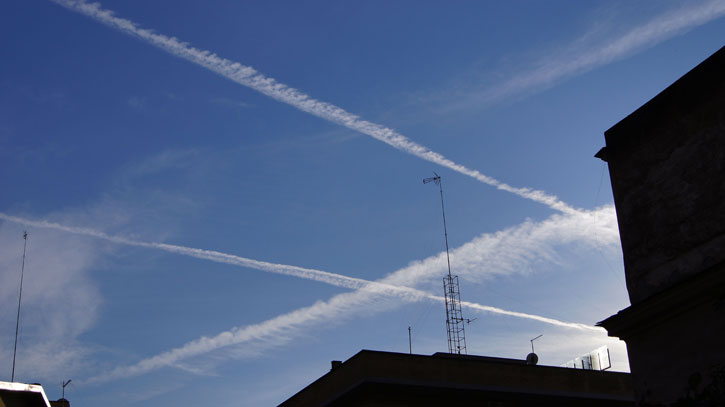
Image: Chemtrails over Rome - December 29, 2010
INVESTIGATORS WANTED
Can Chemtrails be proved?
It seems that the die-hard skeptics refuse to believe what they see with their own eyes. No matter how many laboratory tests we collect, they always seem to come up with a theory that, no matter how far fetched it is, would explain the high levels of aluminum, barium, and strontium as merely due to some climate condition or error in preparing the chemical sample or some unintended human interaction.
SKI SLOPE THEORY
When we released our documentary, What in the World Are They Spraying, we included snow samples taken from Mt. Shasta in Northern California, which contained toxic levels of these metals. Since snow is merely frozen rain water, it was clear that this came from the sky and not from the soil or water run-off from some toxic waste dump. Nevertheless, an Internet debunker challenged our conclusion by claiming that people ski on Mt. Shasta, and skis are made of aluminum. Therefore, the tested aluminum probably came from the skis! Nothing to worry about after all.
Of course, this was all made-up nonsense. People do ski on Mt. Shasta, but it is a big mountain, and there has never been any skiing in the area where the samples were taken. Even if there had been, that would not explain the high levels of barium and strontium. These metals are not used in the construction of skis. Our debunker never bothered to check on any of that. He was merely looking for some plausible explanation in order to plant doubts into the minds of casual readers. If people are confused by seemingly plausible explanations that even remotely could explain away the high levels of aluminum, barium, and strontium in snow and rain water, they will back away from coming to a conclusion and align themselves with the prevailing view.
DUST-BOWL THEORY
Another debunker contacted me a few days ago and claimed that a plausible explanation for the chemicals in snow on Mt. Shasta is that the samples were taken in a year with early snow melt which, according to him, means there was a lot of bare earth exposed at the time, and the wind must have blown dust from the earth onto the snow. Furthermore, he claims that the soil on Mt. Shasta contains the same metals as found in the samples; so, you see? Here is another perfectly plausible explanation. Once again, nothing to worry about.
We are planning to respond to this gentleman as soon as we can find the time to carefully examine his claims about the early snow melt, the amount of bare earth exposed, the composition of the surface soil, and especially the rainfall and moisture levels of the soil during this period. I expect to find that, even if there had been an early snow melt, the soil on Mt. Shasta would have been far too moist and covered with moss, ferns, or other ground cover to make the "dust-bowl" theory even remotely plausible. But it will take a little time to pull the facts together.
Meanwhile, we must not just play defensive and spend our lives answering the debunkers. We must take the initiative and obtain new data and information that will be impossible to dispute. The on-going collection of new snow and rain samples is part of that strategy. After we have literally hundreds of such chemical tests, I think our critics will run out of plausible-denial theories.
PLANE FINDER
One of the most promising technologies to generate hard evidence of chemtrails is the Internet tracking of planes in flight. There are several computer programs and devices that track commercial flights in real time and show, not only their location, but also their flight number, type of aircraft, origin, destination, speed, and altitude. The cost for this App on an iPhone is about $4, and on a computer, it is free. This is amazing technology, and the programs actually are fun to use. They work by receiving what is called ADS-B plane feeds, which are radio signals transmitted by commercial and private aircraft. Military aircraft and those on classified missions do not transmit this signal.
I'm sure you already see where this is going. It is theoretically possible to identify every commercial plane you see overhead either by pointing your iPhone camera at it or locating it on the screen of your computer. If the debunkers are correct, we will find that planes spewing a trail from horizon-to-horizon will all be identified as merely commercial craft and what we see are merely normal contrails after all. On the other hand, if we find that commercial craft do not leave streaks from horizon to horizon but the ones that do are missing from the system ... well, even the most die-hard skeptic would have to take a serious look at that.
Continue reading "Can Chemtrails be proved?" »
Global Warming or Climate Change is a reality, we are being told, it is something we must deal with if in the near future we don't want to see the earth become inhospitable to life. And Global Warming is being brought on by humans burning oil and coal. It is the increase of carbon dioxide in the atmosphere, a gas that transforms our planet into a greenhouse, destined to warm up until we stop burning those fuels.
"Cap and trade", is the way to reduce emissions to levels that will stop the inevitable warming up of the planet. No more increase in fossil fuel burning except ... if a country can pay for the right to continue emitting carbon dioxide.
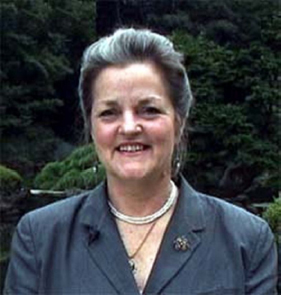
Leuren Moret, examining global warming in the context of geological history, comes to a different conclusion. In her interesting and immensely readable examination of Global Climate Change, the whistleblower at the Livermore Nuclear Weapons lab, and former
Environmental Commissioner in the City of Berkeley, lays out for us the reasons for global changes in temperature in the context of "deep time", the long term geological history of the earth, and some of the behind-the-scenes manipulations that have led to a rather hysterical campaign that sees us concentrate our attention on one of the minor causes for the changes that doubtless are afoot.
Continue reading "Global Climate Change: The Arctic Deep Time" »
Could oil and other hydrocarbons be a continuously produced natural geological resource that is - contrary to what we are being told - not running out any time soon?
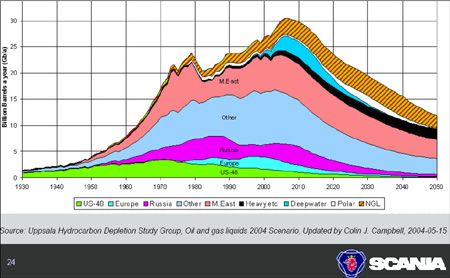
Screen capture of a Powerpoint slide of projected oil production. Note that everything to the right of 2005, that's the peak you see in this graph, is purely hypothetical. The graph wants to make us believe that its makers have a crystal ball that allows them to look into the future. If you care to dig up older graphs of this kind, you will notice that the "peak" is always at the point in time the graph was made, with the future looking bleak. Only, the real world is not like that. Every time so far, the real production has kept ging up, despite the predictions of the doomsayers. - Image credit: EV World
The question - whether hydrocarbons are geological reality instead of the remains of huge quantities of once living matter compressed to become goo - is not as far fetched as it might seem. One of the world's leading advocates for the theory that hydrocarbons are renewable is Dr. Thomas Gold. He contends that oil is not a limited resource, and that oil, natural gas and coal, are not so-called "fossil fuels."
In his book, The Deep Hot Biosphere: The Myth of Fossil Fuels, he explains that dinosaurs and plants and the fossils from those living beings are not the origin of oil and natural gas, but rather generated from a chemical substance in the crust of the Earth. Gold says:
"Astronomers have been able to find that hydrocarbons, as oil, gas and coal are called, occur on many other planetary bodies. They are a common substance in the universe. You find it in the kind of gas clouds that made systems like our solar system. You find large quantities of hydrocarbons in them. Is it reasonable to think that our little Earth, one of the planets, contains oil and gas for reasons that are all its own and that these other bodies have it because it was built into them when they were born?" That question makes a lot of sense. After all, they didn't have dinosaurs and ferns on Jupiter to produce oil and gas?
The quote is from an article by Joel Bainerman who asks: If hydrocarbons are renewable- then is "Peak Oil" a fraud?
Alexander Alan Scarborough has formulated an Energy Fuels Theory, which makes a very similar argument. Scarborough explains:
The theory that fuels (gas, oil and coal) were made from fossils has gone unchallenged for almost 150 years. This fossil fuels theory (FFT) was formulated in the 1830's on the basis of three observations common to 100 coal mines. During the 1920's, the theory was enhanced by the concept of petroleum being created from marine organisms. Over the years, a significant amount of subtle, yet substantial evidence that argues against the validity of the FFT has accumulated in the literature.
These arguments have been condensed into six critical points that simultaneously render strong support to the new theory of fuels formation by natural laws of physics and chemistry. The new energy fuels theory (EFT) explains the formation of fuels (and all known matter) by the logical progression of the transformation of energy particles into atoms, into gaseous molecules, then into liquid and solids via molecular chain-building processes. The intimate relationships of gas, oil and coal, are illustrated by five facts that render additional strong support to the EFT. The immense ramifications of the new concept that appears destined to replace the FFT are briefly discussed.
Considering that the "peak oil" alarm was first sounded by a petroleum geologist working for one of the major oil producers, there is a good probability that indeed, as Bainerman suggests, the "peak oil" scare could be a scam designed to justify stratospheric profits of the major petrochemical companies, which we have indeed seen in these last few years.
Peak oil, also sometimes called Hubbert's peak, goes back to a prediction, first made in 1949 by M. King Hubbert, a geophysicist and Chief Consultant for the Exploration and Production Research Division of Shell, that oil production would continue to increase but would "peak" in about 1970 and decline thereafter.
US oil production has indeed peaked at the predicted time. But some say that this was due to a systematic program of shutting down and sealing many oil and gas producing wells. Not surprisingly however, world production seems reluctant to follow suit. You can shut oil wells in one country, but it is difficult to do so all over the world. Some say the wars in the Middle East were about protecting oil supplies. Wake up, people - those wars did the exact same thing that was done previously on the US mainland. They effectively shut down production. Remember the burning oil fields in Irak after the first oil war there, or the fall in Irak's oil output since the more recent US "shock and awe" campaign?
Since there is demand for hydrocarbons and since indeed oil seems to be a renewable and constantly growing resource, as suggested by Gold, Scarborough and others, it is hardly surprising that international oil production has not been hitting its peak just yet.
Continue reading "Renewable Coal, Oil and Gas - Hydrocarbons of Geological Origin" »
Space is built out of its contents
- Roger Y. Gouin -

The 'Ghost Head Nebula' is one of a chain of star-forming regions in the Large Magellanic Cloud.
Image: European Space Agency.
According to Roger Gouin, life manifests in the physical through quantum processes, but current theory and classical quantum formalism cannot account for the complex processes that determine the growth and operation of organisms. The Quantum Dynamics of Life is a collection of essays written by Gouin and Amrit Sorli. A few of Amrit's articles on this site are linked below.
The aim of 'Quantum Dynamics' is to bridge the large gap between today's physics and a real understanding of the universe, which includes of course that-which-cannot-be-seen and that which we can't measure - life. The essays discuss time, the mind and conscious as well as rational experience, the assumptions of general relativity and Active Galactic Nuclei as Spacial Sink-Source Systems that continuously re-cycle both space and matter.
In the second essay, "Space and the Basis of Life" Gouin, starting from his specialty which is biology, shows how the cell as a common manifestation of life is organized in a complex way that defies purely physical analysis. And the basis for cellular organization and duplication is not DNA, as we might assume. Before developing DNA as a central molecule, cells duplicated with the help of a biological supramolecule called the centriole. He also introduces the concept of manipulation of the geometry of space by matter, particularly living matter. These concepts are further explained and expanded upon in an Annex to Quantum Dynamics, which makes for lighter reading as the concepts are introduced in dialogue form and garnished with illustrations to help those of us who are conceptually impaired.
Ben Connell, who after Roger Gouin's death in 2004 has put all that research on a website, says that Roger has "expanded his ideas into developmental biology and cell science since this book and appendix was written" and that these more up-to-date papers are available on Ben's website. So anyone interested in Gouin's work should definitely check out this web site (www.rogerygouin.org) which links many articles as well as Gouin's book-length thesis 'On the Origin of Space'. The work of Gouin goes far beyond the approach from the side of biology:
"There is a basic whole to my work, and this is summarized in the statement:
*******Space is built out of its contents*******
I attempt to prove that fact in particle physics, in quantum mechanics, in astrophysics, in Life and in Computer Science. This is the thrust of my thesis.
So anybody looking at only one part may misunderstand, or not understand at all. I cannot help that fact. The rewrite into articles helps, but the difficulty is still there.
The statement above is so UNINTUITIVE that even mathematicians do not understand it, and this because math cannot exist in a world where space is built by its contents. Math can only be a rough tool since it deals with separated things, as classical mechanics did. Only our quantum mind can process that information. This is why I wrote the equivalent of 20+ articles on the matter. ."
Continue reading "The Quantum Dynamics of Life" »
Volcanic activity - that's the sparks that fly and the heat that develops at the interface between the hydrogen-saturated mantle of the earth and the carapace or outer crust, where oxygen dominates. When hydrogen and oxygen meet and mix, heat is released that melts stone and results in lava. At times, a more explosive reaction involving certain gases generates great fireworks and leaves a fine ash - sometimes in thick strata - that covers the surroundings of the site of the explosion.
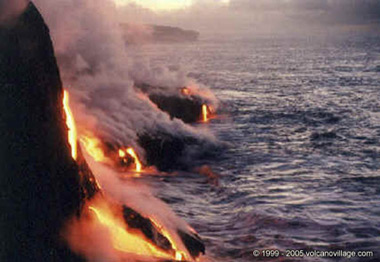
Mount Kilauea erupting into the sea - Image credit: Volcanovillage
Of course that is a very simplified statement of the findings of Charles Warren Hunt, author of two books: Environment of Violence and Expanding Geospheres. In a recent article titled Triple Geospheres: Oxidic Carapace: Hydridic Mantle: Ultimetal Core which was published in Frontier Perspectives, the magazine of Temple University's Center for Frontier Sciences, Hunt explains why he postulates a neat separation of two very different geospheres, and how the interaction between the dominating gases of the two spheres generates the enormous amounts of heat we observe in volcanic activity and what chemical reactions are most likely involved.
The article is an interesting read, and the theory makes sense, whereas the official view of how volcanoes are fed by a huge reservoir of liquid magma inside the earth is rather less convincing.
Continue reading "Volcanism: Activity at the Hydrogen/Oxygen Interface" »
|
Email updates for new articles
|