Main

Vortex


Viktor Schauberger said "you are using the wrong kind of motion", when referring to today's heat and explosion based technologies. He was the great genius who imagined a kind of technology based not on heat but cold, not on explosion but implosion, a technology that links into nature's mechanisms instead of fighting against them. The vortex is the archetypal form of this new technology but we must learn to use its power.


December 13, 2009

Great Oceanic garbage patches - what to do?

Meg White of BuzzFlash published an article titled Giant 'Islands' of Garbage Floating in the Ocean, With No Fix in Sight. Yet...

You may have heard of a great accumulation of plastic garbage in certain areas of the oceans. It's all stuff we throw away and it keeps accumulating because plastic does not easily degrade. Birds and fish eat it, mistaking the pieces of plastic for food.


ocean conservancy.jpg

Image credit: Ocean Conservancy


"The dangers of these garbage patches are great in both quantity and quality. Marine animals of all sizes, from zooplankton to whales, mistake the plastic for food. Some organisms become entangled in the mass and die", says Meg White.

We can of course combat the continued accumulation of that garbage by controlling what we throw away, but that is a slow process, and it does nothing about what's already there and which will continue to float where it is for decades if not centuries to come.

As for the trash that's already there, many throw their hands in the air nihilistically. "There's just too much, and the ocean is just too big," said one expert about the possibility of cleaning up the garbage patches.

No one seems to have a solution for what's already there, other than waiting for it to magically disappear or kind of nebulously suggesting that the stuff should really be collected and brought to land, a truly Herculean task to say the least.

But there is a solution, and it isn't too difficult either:

Continue reading "Great Oceanic garbage patches - what to do?" »

January 26, 2009

Vortex Induced Vibrations to generate energy from river flow

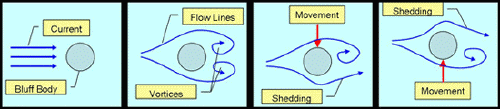
The Detroit River is the site of an unusual experiment. Whirlies in the water that the river carries form around cylindric 'wings' that are forced to move up and down in alternation. It is the imbalance of the attractive forces of vortices that form when water flows by the round obstacle that do the moving. Mike Bernitsas, director of the Marine Renewable Energy Laboratory at the University of Michigan and inventor of the device is ready to deploy a three kilowatt pilot plant that will prove his concept in a real-life setting.

PESWiki has a page that explains the Vivace concept, including some drawings and videos of a test set-up:

Fish-Inspired, Low-Speed Water Current Harvesting

Vivace-demo_500.gif

Vivace or Vortex-Induced Vibrations for Aquatic Clean Energy is a rather unique system that puts the power of vortices forming in flowing water to positive use. The formation of a vortex alternately above and below the cylindric 'obstacle' forces an alternating vertical motion of the cylinder, the energy of which can be harnessed.

Another one of those systems that use the normal flow of river water is the invention of Austrian engineer Zotloterer, where the water forms a snail's vortex, which is then directly converted into electricity by shedding its power to turn a slow-running turbine. See Water Vortex Drives Power Plant.

Other systems that utilize slow water flow are described in PESWiki's Low Impact Hydro page.

While such use of slow flowing water seems much less efficient than using the water pressure built up by a dam, the number of sites that can potentially be used is almost unlimited. This more than compensates for the relatively low efficiency. An advantage that should not be underestimated is the fish-friendly nature of these technologies, as well as their adaptability to an infinite variety of local conditions. They make it possible to produce our electric energy right where we need it - close to cities and villages - rather than in some remote region from whence it then has to be transmitted to reach the point of consumption.

Here is an article about the VIVACE project in Michigan from Phys.org, as first published by the Detroit Free Press - http://www.freep.com

Continue reading "Vortex Induced Vibrations to generate energy from river flow" »

December 30, 2007

Star Formation: Vortex Builds Stars, Planets

Star formation is thought to be driven by gravity-induced accretion of material distributed in space. A recent article on space.com titled Jets Spiral in 'Reverse Whirlpool' from Star illustrates this widely accepted but mistaken concept of the formation of heavenly bodies. Space.com's Jeanna Bryner reports that

"Astronomers have observed for the first time a jet of matter spiraling outward from an infant star, as if a lengthy strand of curly pasta. The enormous jet, which shoots out in two directions, is rocketing material away from the so-called protostar and into interstellar space at more than 'supersonic speeds'."


Jets_Spiral.jpg

Artist's concept of protostar HH 211, believed to be accreting material from a surrounding disk. - Credit: Change Tsai (ASIAA)


For a dynamic view, see the video animation "Black Hole Blazar Jets" at

http://www.space.com/common/media/video/player.php?videoRef=080428_blazar-coil

I cannot help but thinking that what are called "jets" are in fact the black hole's incoming vortices. What appears as matter being expelled at near light velocity (those blobs of lighter color moving outward from the black hole) is really incoming matter lit up by powerful time-limited flashes of light escaping from the black hole's center. Matter is inward directed in the jet-cum-vortex and it encounters in its path flashes of light, giving the impression of matter exiting at near light velocity.


"Stars are thought to form at the center of rotating disks of hydrogen gas and dust", continues the article, describing the theory according to which gravitation is the principal star-forming mechanism. However, there is a problem: "The gas can't fall inward toward the star until it sheds excess spin power called angular momentum". As far as official theory goes, the vortices astronomers observed in HH 211, are thought to dissipate some of the energy of rotation which, it is argued, counter-acts accretion by giving rise to centrifugal forces.

That is the official theory, but this explanation of star formation has several problems.

One obvious question: where does the spin come from, that now needs to be dissipated and more importantly, what use does that spin have in star formation?

Secondly, the "jets" observed to accompany the formation of both stars and galaxies and which are described in this instance as "reverse whirlpools" would seem be a very inefficient mechanism if not entirely counter-productive in the formation of a star. Instead of accreting material, they are said to be dissipating both matter and spin.

Thirdly, where there is no accumulation of matter, gravity cannot accumulate more matter. Also, when mathematically modeled, gravitation-induced accretion does not resolve into an accretion disk but works in a spherically symmetric way.

So what are we overlooking here?

In my view, this is one of the important areas where physics has gone down the wrong path in its insistence that gravity "obviously" must be the force that holds everything together, and that thus it is the sole force responsible for the accumulation of any kind of concentration of matter in the universe.

Continue reading "Star Formation: Vortex Builds Stars, Planets" »

June 30, 2007

Water Vortex Drives Power Plant

In a fairly radical departure from the principles that normally govern hydroelectric power generation, Austrian engineer Franz Zotlöterer has constructed a low-head power plant that makes use of the kinetic energy inherent in an artificially induced vortex. The water's vortex energy is collected by a slow moving, large-surface water wheel, making the power station transparent to fish - there are no large pressure differences built up, as happens in normal turbines.


Vortex_Turbine.jpg

Special turbine collecting vortex energy - Image: zotloeterer.com.


The aspect of the power plant reminds a bit of an upside-down snail - through a large, straight inlet the water enters tangentially into a round basin, forming a powerful vortex, which finds its outlet at the center bottom of the shallow basin. The turbine does not work on pressure differential but on the dynamic force of the vortex. Not only does this power plant produce a useful output of electricity, it also aerates the water in a gentle way. Indeed, the inventor was looking for an efficient way to aerate the water of a small stream as he hit upon this smart idea of a plant that not only gives air to the medium but also takes from it some of the kinetic energy that is always inherent in a stream.

Of course the use of water vortices has been pioneered by another Austrian - Viktor Schauberger, who was also known as the "water wizard". He floated hard-to transport heavy logs from remote regions of the Austrian forests, not accessible at the time by streets, to where they would be milled and processed. The feat was accomplished by carefully regulating the water's temperature and by inducing a rolling, longitudinal vortex motion in the water.

At one point, Schauberger took out a patent on a turbine he invented, that made use of vortex dynamics. An article about that turbine of Schauberger's which I wrote way back in the 90s can be found here. The turbine wheel was designed in the form of a cone with a cork screw pattern, and it was fast running. Quite different from the turbine of Zotlöterer which is optimized for aerating the water, rather than for production of power.

Still, Zotlöterer's results are quite respectable. The cost of construction for his plant was half that of a conventional hydroelectric installation of similar yield and the environmental impact is positive, instead of negative.

Continue reading "Water Vortex Drives Power Plant" »

May 6, 2007

Kozyrev: Aether, Time and Torsion

The Russian scientist Dr Nikolai Kozyrev is in many ways a forerunner - the father of today's efforts to re-interpret physics in a way that does not contradict intuitive understanding. Our efforts to reconcile the inherent contradictions of the standard model of physics, firmly based as it is on Einstein's relativity and Quantum Mechanics, have brought less than satisfying results.


kozyrev-yang.jpg

N.A. Kozyrev - Image credit: schools.keldysh.ru


Kozyrev has measured spin or torsion field effects at a time when Western science was busy smashing atoms into ever smaller fractions. He investigated time and the aether before most of us in the West ever thought of questioning the workability of our modern interpretations of the universe.

A most welcome effort to increase our awareness of Kozyrev's outstanding work is a book chapter on David Wilcock's site, which introduces him with the following words:


Dramatic scientific evidence that all of physical matter is formed by an “aether” of invisible, conscious energy has existed since at least the 1950s. Renowned Russian astrophysicist Dr. Nikolai A. Kozyrev (1908-1983, pronounced Ko-zir-ev,) proved beyond any doubt that such an energy source had to exist, and as a result he became one of the most controversial figures in the history of the Russian scientific community. The awesome implications of his work, and of all those who followed him, were almost entirely concealed by the former Soviet Union, but with the fall of the Iron Curtain and the advent of the Internet we are finally gaining access to “Russia’s Best-Kept Secret.” Two generations of remarkable research by thousands of Ph.D. level specialists have emerged from Kozyrev’s seed findings, which completely change our understanding of the Universe. With our prominent mention of him in this book, we hope to permanently establish his historical importance and impact to our colleagues and readers.


After having heard of Kozyrev in the 90s, I came upon his name again in a recent issue of NEXUS magazine, where a summarized version of David Wilcock's book chapter is published under the title: The Aether Science of Dr N. A. Kozyrev. That short version, published in NEXUS, is copied here:

Continue reading "Kozyrev: Aether, Time and Torsion" »

More articles:


The Double Helix Theory of the Magnetic Field
Real Physics - The Universe is Mechanical
Schauberger Q and A - Making the Data Available
Man Made Vortex To Tame Hurricanes
Technology Turned Inside-out: Implosion Instead of Explosion