
|
|
Main
While the individual is indeed supreme, we have been effectively cut off from the decision making process in our society by inefficient and easily corrupted 'rules of democracy'. Direct involvement of all in the process of political decision making is now possible through the net. We need to cobble together new rules that will govern direct democracy...
The World Economic Forum is being held in Davos, Switzerland. Until Sunday, 31 January, the economic powers-that-be are meeting in the secluded ski resort town.
The Growing Influence of Social Networks is one of the themes to be discussed in Davos this year. Public input was invited, but the request was somewhat hidden in a brand new Ning group with little more than a hundred members, and it reads as follows:
Given the topic of the workshop it was natural to open it to input from the different social networks. We want to hear from you:
1. "How are social networks changing society?"
2. "What are the most important implications and risks for society?"
3. "What should individuals and institutions do to leverage the power of social networks and improve society?"
Are social media going to change the world?
A big question to be hidden away in a group with very few members. Still, some great comments and suggestions were made. To get the whole conversation, see the posting
The Growing Influence of Social Networks
And indeed, how do social media influence and change society? I tried to answer those questions, and was surprised at my answers. Social media are more important than we might believe. We are having conversations, mostly for fun, and sometimes with the intention of changing things we perceive to be going in the wrong direction. Yet, the implications of what we are doing are profound, indeed world changing....
Continue reading "Davos and the Importance of Social Media" »
According to facebook, the site has more than 350 million active users, half of which log on in any given day. On a recent facebook press release, these and a number of other statistical details show how traffic on the site is increasing. This means many users spend more and more of their online time on facebook.
I am not sure whether this is a positive development or something negative that should be balanced out, in some way.
Privacy has become a major issue on facebook, but it seems that the important privacy issue that facebook use brings with it, is glossed over in those discussions. By interacting with our peers, we permit the servers of facebook to construct online social profiles for each of us users that go WAY beyond anything we would normally dream to put in public view. Who then has access to that kind of data? It's anybody's guess.
Again, is that a bad thing, or is it part of a new openness that we consciously choose to engage in?
On the other hand, facebook is the first online service that, along with a few others, allows us to open up and explore a new dimension of networking. I almost feel as if we're constructing a global mind, each one of us being similar to a neuron and learning to interact with other neurons. Where that could lead, is not quite clear as yet.
Some friends of mine have a rather strongly negative reaction when I invite them to join me on facebook and recently, I received an email from a friend and fellow blogger who says he started to use the service but was banned.
He brings up some interesting perspectives from which to see the expanding phenomenon of on-line social interaction. Here is what he said:
Continue reading "Spending too much time on Facebook" »
Meg White of BuzzFlash published an article titled Giant 'Islands' of Garbage Floating in the Ocean, With No Fix in Sight. Yet...
You may have heard of a great accumulation of plastic garbage in certain areas of the oceans. It's all stuff we throw away and it keeps accumulating because plastic does not easily degrade. Birds and fish eat it, mistaking the pieces of plastic for food.

Image credit: Ocean Conservancy
"The dangers of these garbage patches are great in both quantity and quality. Marine animals of all sizes, from zooplankton to whales, mistake the plastic for food. Some organisms become entangled in the mass and die", says Meg White.
We can of course combat the continued accumulation of that garbage by controlling what we throw away, but that is a slow process, and it does nothing about what's already there and which will continue to float where it is for decades if not centuries to come.
As for the trash that's already there, many throw their hands in the air nihilistically. "There's just too much, and the ocean is just too big," said one expert about the possibility of cleaning up the garbage patches.
No one seems to have a solution for what's already there, other than waiting for it to magically disappear or kind of nebulously suggesting that the stuff should really be collected and brought to land, a truly Herculean task to say the least.
But there is a solution, and it isn't too difficult either:
Continue reading "Great Oceanic garbage patches - what to do?" »
There is serious doubt whether carbon dioxide emissions are a major driver for global warming or, as it has recently come to be called, 'climate change'. Water vapor is a more potent greenhouse gas and the sun's influence on our climate is orders of magnitude stronger than any amount of carbon dioxide we could ever produce. But carbon dioxide may have a secondary effect that has been hardly mentioned in the past. Every time a carbon dioxide molecule is produced by burning carbon-based fuels including oil and gas, two oxygen atoms get locked up together with one of carbon. The oxygen that drives the burning process comes from the atmosphere.
Until recently, I had been under the impression that oxygen levels in the atmosphere are quite stable around 21 per cent, and have been so for a long time. However in a recent discussion about burning coal as fuel, some interesting information emerged that tends to disprove the concept of a stable oxygen level.
Historical trends, as explained in Atmospheric Oxygen, Giant Paleozoic Insects and the Evolution of Aerial Locomotor Performance by R. Dudley, JExB, show a high of about 35% just before the beginning of the Permian, with a rapid decline to a low of about 13-14% near the beginning of the Triassic, then a small spike at about 17% in mid Triassic, another drop to about 14-15% early in the Jurassic, a sudden climb to about 21% by mid-Jurassic, then a gentle climb to about 26% early in the Tertiary, and a rather constant, steady decline to the present "20.9%."
But even now, we are not necessarily assured of a more-than-20-per cent oxygen level in the air at all times.

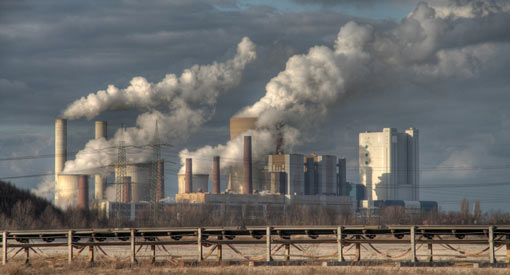
Coal fired power plant - Image credit: Sun-volt.com
In that discussion, Adrian said: "There is really no such thing as "clean" coal. Even if you take all of the non-carbon contents out, the resultant burning still produces enormous amounts of carbon dioxide. We may be getting to the stage where we will have to be concerned about the amount of oxygen we have left in the atmosphere to breathe... I read that a research paper comparing the health of people living at low compared to high altitudes showed that it was the lack of oxygen that was harmful for certain ailments.
Oxygen used to be about 20% of the atmosphere but today in some places, it is as low as 16%. Carbon dioxide is actually a fairly heavy gas (molecular weight 44 as compared to oxygen 32 and nitrogen 28) so that during times of little wind, it would have a tendency to settle in pockets. That is one reason cave exploration can be so hazardous.
People living in large cities in India have such a high incidence of lung disease that older diesel motors have been banned. I have not read any carbon dioxide studies but reducing the amount of oxygen available, certainly places a strain on the heart, especially for old people with weak hearts and those with any type of lung problems.
Carbon dioxide sequestering seems to be a stupid idea because the process also sequesters oxygen in the process. Someone needs to present calculations showing how the burning of coal, oil and natural gas is affecting our oxygen supply. The question really boils down to "how much oxygen would be left in the atmosphere if all fossil fuels were consumed?" Yes, people will say that trees and algae will take care of the oxygen production but the real concern is what level of oxygen is required to maintain a good healthy atmosphere for humans as well as for other living organisms."
So it appears the oxygen content of air is not uniform all over the planet, some places seem to be much worse than others. The cause: use of carbon-based fuels, together with our disregard for the contribution of forests to keeping the air breathable.
Continue reading "Is Oxygen depletion more worrying than global warming?" »
The story of how humans came to live in peace and plenty is a developing conversation. The initiator is David Braden, who proposes that we network, but with an additional dimension. Instead of only interacting on a flat, person-to-person basis, Braden says that we must also consider the larger system and our environment in what we do, and he calls it 3D Networking. You can get a good idea from his website 3DN Introduction, which explains three dimensional networking in its bite sized, linked pages.

David Braden, initiator of 3D Networking
One particularly interesting proposal is what Braden calls the Self-help Corporation. Today's economy does not have any place for people that aren't directly involved in making more and more profit for the corporate players. At first, these were only the people who did not have the right skills, but more and more people are being laid off because the corporation that employed them is cutting costs. It is nothing for a huge corporation to buy its competition and then start "slimming down", laying off thousands of people who thought they had secured stable employment. Thus, the ranks of those who don't fit keep swelling.
Braden's self-help corporation (this link is to an abbreviated description) is a way of balancing the needs of these individuals against the focus on profit which is a characteristic of the corporations and which does not allow giving someone a job simply because they need to make money to live.
"The self-help corporation is a simple, practical and economical way to alleviate the resulting poverty. It does not require public consensus, expensive government programs or massive charitable fundraising. One can be started now, by anyone, anywhere in the world.
Poor people are poor because they do not have skills that can be marketed in the "market economy" or their labor is valued by the market economy at a level that does not provide them adequate resources for a decent standard of living. They are not, however, without skills and resources. In particular, they possess the skills and available labor to produce basic necessities."
The question is whether such an idea has real transformative potential. Will people actually come together in solidarity and contribute their money or their skills to make it possible for a whole group to take care of basic necessities in a way that's much more economical than today's 'everyone for themselves' way of doing it.
The vision is growing and it's becoming more focused. A part of this process is documented in a discussion around The Story of How Humans Came to Live in Peace and Plenty on the "open money" Ning group.
Continue reading "The Story of How Humans Came to Live in Peace and Plenty" »
|
|