

Quantum Aether Dynamics: A New Foundation for Physics
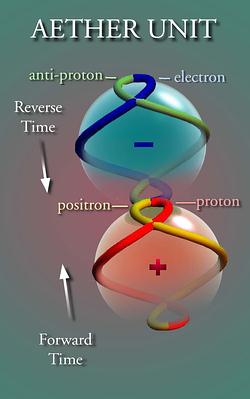
This is a paper that was first published in PESWiki but it certainly deserves to be widely known. It is based on a deep re-thinking of current physics and models the aether as a substrate for all things physical.
While the new model is fully developed in a book: Secrets of the Aether that was published in 2004, authored by David W. Thomson III and Jim D. Bourassa, the paper gives a good description of the basic features and lots of detail about how the new model compares with contemporary physics.
Sterling Allan of PESWiki says about it:
"The Aether Physics Model quantifies quantum structure within an Aether/angular momentum paradigm (as opposed to the mass/energy paradigm of Einstein). It is destined to merge with Quantum Mechanics and provides the means for tapping Zero Point Energy."
Abstract
"Modern physics describes the mechanics of the Universe. We have discovered a new foundation for physics, which explains the components of the Universe with precision and depth. We quantify the existence of Aether, subatomic particles, and the force laws. Some aspects of the theory derive from the Standard Model, but much is unique.
A key discovery from this new foundation is a mathematically correct Unified Force Theory. Other fundamental discoveries follow, including the origin of the fine structure constant and subatomic particle g-factors, a slight correction of neutron magnetic moment, a geometrical structure for charge, the quantification of electromagnetic charge as separate from electrostatic charge, a more precise meaning of spin, the quantification of space-resonance in five dimensions, and a new system of quantum units.
The Aether quantifies as a fabric of quantum rotating magnetic fields with electromagnetic, electrostatic, and gravitational dipole structures. Subatomic particles quantify as angular momentum encapsulated in a quantum, rotating magnetic field. All quantum, atomic, and molecular processes can be precisely modeled, leading to discrete physics with new understandings and insights."
Continue reading "Quantum Aether Dynamics: A New Foundation for Physics" »